The birds’ life cycle is one of the most fascinating natural processes on Earth. From a tiny egg in a nest to a fully grown adult bird capable of flying, feeding, migrating, and reproducing, every stage shows how closely birds are connected to nature. Birds are warm-blooded vertebrates with feathers, beaks, wings, and a high-energy body system that helps many species fly, hunt, migrate, and survive in different habitats.
Today, scientists recognize more than 11,000 bird species worldwide, although the exact number changes slightly depending on the checklist used. For example, the IOC World Bird List v15.2 lists 11,227 species, while the Cornell/eBird 2025 taxonomy lists 11,167 species after recent species splits and lumps.
Birds live almost everywhere: forests, wetlands, grasslands, deserts, mountains, cities, farms, oceans, and polar regions. Their life cycle is not only about birth and growth; it also includes feeding, learning, migration, avoiding predators, finding mates, raising chicks, and maintaining ecological balance.
Quick Answers: Most Common Questions
Q: What are the main stages of the birds’ life cycle?
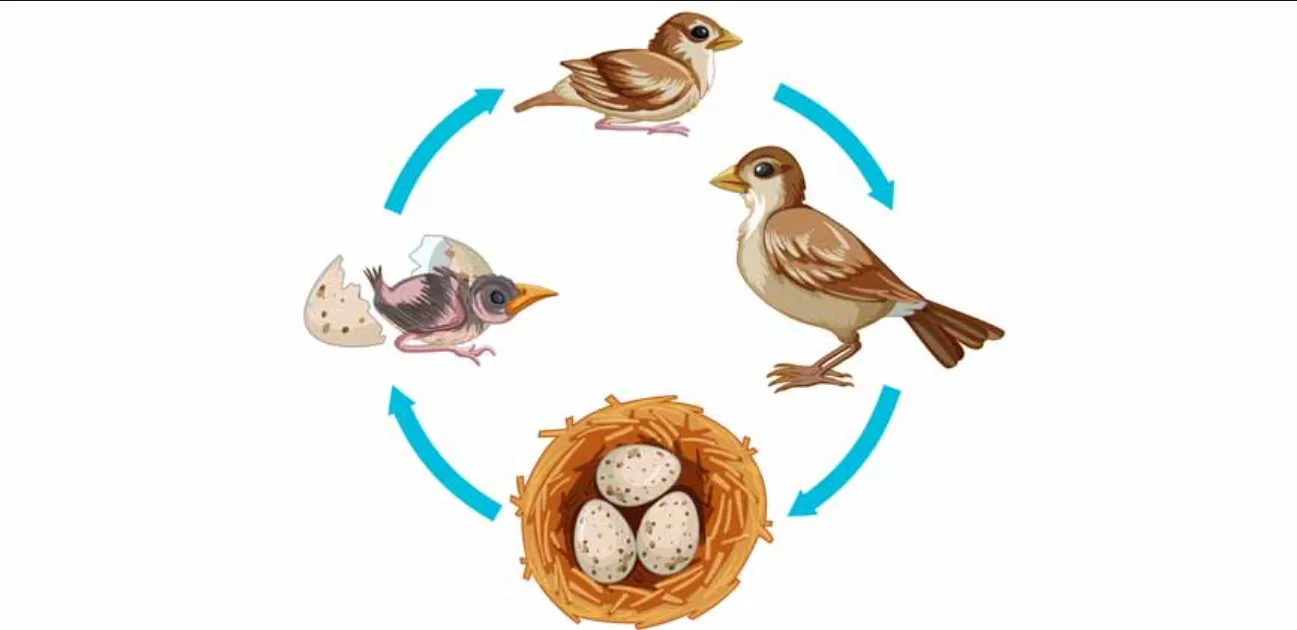
A: The main stages are egg, hatchling, nestling, fledgling, juvenile, and adult bird.
Q: How long does it take for a bird egg to hatch?
A: It depends on the species. Small songbirds often hatch in about 10 days to 2 weeks, while larger birds may need several weeks.
Q: Why are birds important in nature?
A: Birds help with seed dispersal, pollination, pest control, scavenging, and maintaining healthy food chains.
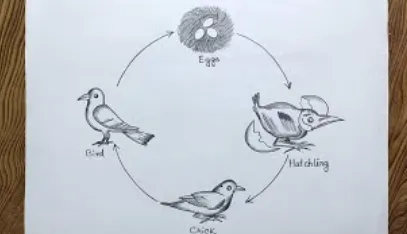
Quick Life Cycle Table
| Life Cycle Stage | What Happens | Simple Example |
| Egg | Female birds lay eggs; parents incubate them | Eggs stay warm in the nest |
| Embryo | A baby bird develops inside the egg | Heart, beak, wings, and legs form |
| Hatchling | Chick breaks the shell and comes out | Weak, hungry, often featherless |
| Nestling | Chick grows feathers and needs food | Parents feed insects, seeds, or fish |
| Fledgling | The young bird leaves the nest and practices flying | Short flights and landing practice |
| Juvenile | Bird learns survival skills | Finds food and avoids predators |
| Adult Bird | A mature bird can reproduce | Builds nest, mates, lays eggs |
The History of Their Scientific Naming
The scientific naming of birds is closely connected with the history of biological classification. Birds are traditionally placed in the class Aves, a Latin word meaning birds. This name is widely used in zoology to describe feathered, warm-blooded, egg-laying vertebrates.
Early classification work was shaped by naturalists such as Francis Willughby and John Ray, who organized birds in their 1676 work Ornithologiae. Later, Carl Linnaeus refined biological classification in the 18th century through his famous system of naming organisms. His work laid the foundation for modern taxonomy.
Important points about bird scientific naming:
- Aves is the traditional scientific class name for birds.
- Birds are part of the larger vertebrate group.
- Modern science places birds within Theropoda, the dinosaur lineage.
- Scientific names help avoid confusion between local names.
- Each bird species has a two-part Latin name, such as Passer domesticus for the house sparrow.
Today, bird classification continues to evolve as scientists use DNA research, fossils, anatomy, and behavior to understand relationships among birds better.
Their Evolution And Their Origin
The origin of birds is one of the clearest examples of evolution recorded in the fossil record. Modern birds did not appear suddenly. They evolved gradually from small, feathered theropod dinosaurs, the same broad dinosaur group that included many two-legged carnivorous species.
One of the most famous fossil links is Archaeopteryx, which lived around the Late Jurassic period. It had feathers and wings like a bird, but it also had dinosaur-like features such as teeth, claws, and a long bony tail. This mixture of features makes it important in understanding the transition from dinosaurs to birds.
Feathers likely evolved before true powered flight. At first, feathers may have helped with warmth, display, balance, or protection. Over time, some feathered dinosaurs developed stronger wings, lighter bones, better balance, and more advanced muscles. These changes helped early bird-like animals glide and later fly.
After the extinction event that wiped out non-avian dinosaurs about 66 million years ago, surviving bird lineages diversified widely, and they spread into forests, oceans, wetlands, grasslands, and open skies.
This evolutionary history explains why birds are sometimes called living dinosaurs. Every pigeon, eagle, duck, crow, owl, and sparrow carries a deep evolutionary connection to ancient theropod dinosaurs.
Important Things That You Need To Know
To understand the birds’ life cycle, you must first understand what makes birds different from other animals. Birds are not only animals that fly. Some birds, such as ostriches, penguins, and kiwis, cannot fly, but they are still birds because they share key biological features.
The most important feature of birds is feathers. Feathers help with flight, body temperature control, waterproofing, courtship display, camouflage, and protection. Birds also have beaks instead of teeth, and the shape of the beak often shows what they eat.
Another important feature is their egg-laying reproductive system. Birds lay hard-shelled eggs, usually in nests or protected places. Parents often incubate eggs until the chicks hatch.
Here are the key LSI-related terms you should know:
- Birds
- Bird eggs
- Bird nest
- Baby birds
- Adult birds
Birds are also highly adaptable. Some migrate thousands of kilometers each year, while others stay in one local area for life. Some eat insects, some eat seeds, some eat fish, some drink nectar, and some hunt other animals.
This diversity is why birds are found on every continent. Their life cycle may seem simple, but it involves complex behaviors, strong parental care, environmental adaptation, and survival skills.
Their main food and its collection process
Birds’ diets depend on species, habitat, season, and body structure. Birds have different beak shapes, feet, wings, and digestive systems that help them collect food in unique ways.
Main types of bird food include:
- Seeds and grains: Sparrows, finches, pigeons, and many farm birds eat seeds, rice, wheat, grass seeds, and grains.
- Fruits and berries: Parrots, hornbills, bulbuls, and many tropical birds eat fruits and help spread seeds.
- Insects: Swallows, warblers, flycatchers, and woodpeckers eat insects, larvae, beetles, ants, and caterpillars.
- Fish and aquatic animals: Kingfishers, herons, pelicans, and eagles catch fish, frogs, and small water animals.
- Nectar: Hummingbirds and sunbirds collect nectar from flowers and often help with pollination.
- Meat and carrion: Eagles, hawks, owls, vultures, and crows eat animals, dead bodies, or small prey.
Birds collect food in different ways. Some peck from the ground, some dive into water, some hover near flowers, and some hunt from the sky.
Parent birds also collect food for chicks. During the nestling stage, many chicks need protein-rich food, so parents often bring insects, worms, or small animals. This feeding process is essential for fast growth and feather development.
Their life cycle and ability to survive in nature
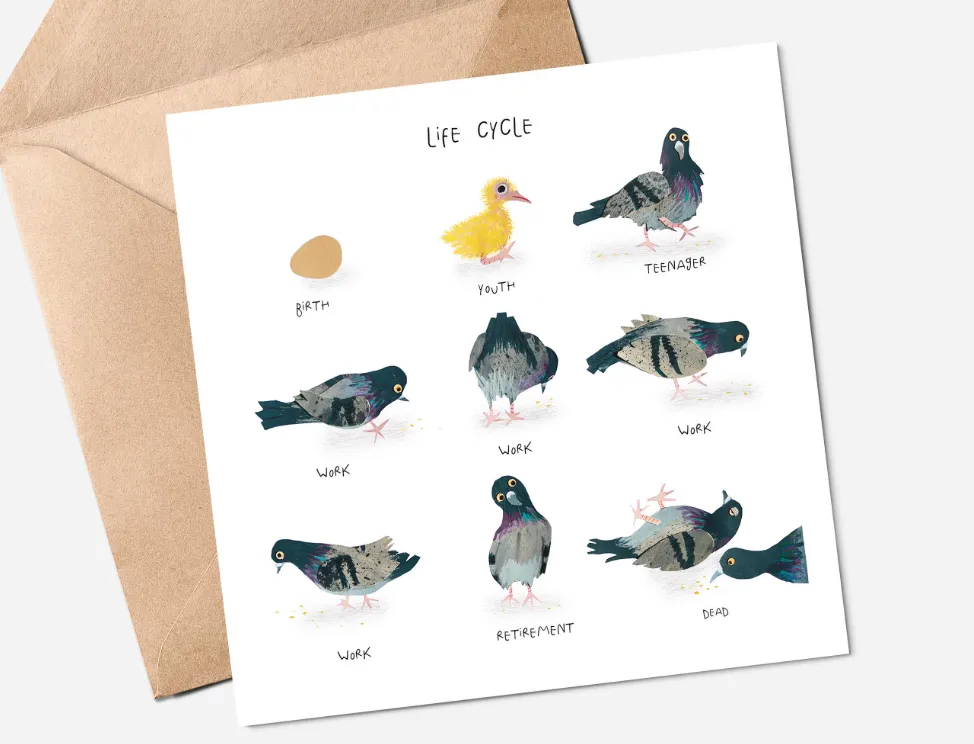
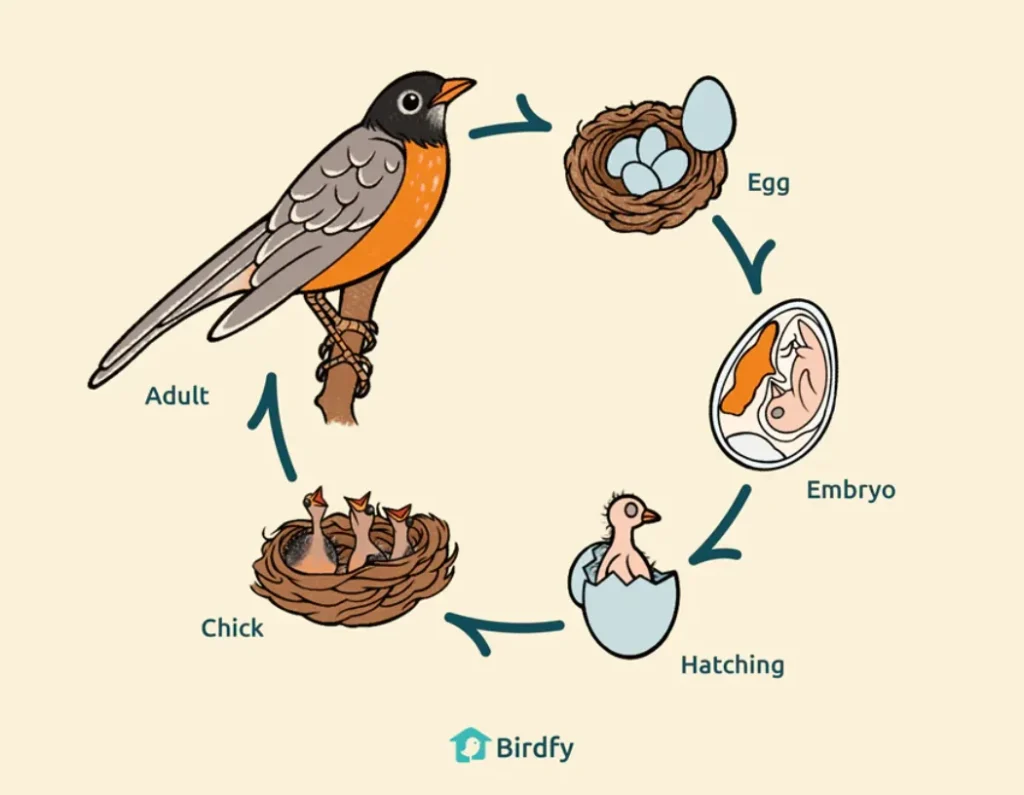
Egg Stage
The bird’s life cycle begins when the female lays eggs. Eggs are protected by a hard shell, usually made mostly of calcium carbonate. Inside the egg, the embryo develops with nutrients from the yolk.
Hatching Stage
When development is complete, the chick uses a small egg tooth on its beak to break the shell. This process is called hatching. Hatchlings are often weak and need warmth, food, and protection.
Nestling Stage
A nestling remains in the nest and depends on its parents. During this stage, feathers grow, muscles strengthen, and the chick gains weight quickly.
Fledgling Stage
A fledgling leaves the nest but is not fully independent. It practices flying, landing, balancing, and finding food. Parents may continue feeding it for days or weeks.
Adult Survival
Adult birds survive through flight, camouflage, sharp eyesight, migration, flocking behavior, strong memory, and quick response to danger. Some species survive cold climates by migration, while others grow thick feathers or store fat.
Birds also adjust their nesting time in response to food availability and weather. These survival abilities make them one of the most successful animal groups on Earth.
Their Reproductive Process and raising their children
Bird reproduction is a carefully organized process. It includes courtship, mating, nest building, egg laying, incubation, hatching, feeding, and teaching young birds how to survive.
Important steps include:
- Courtship display: Male birds may sing, dance, show colorful feathers, or bring food to attract females.
- Pair formation: Some species stay together for one season, while others form long-term pairs.
- Nest building: Birds build nests using grass, twigs, leaves, mud, feathers, hair, or tree holes.
- Egg laying: The number of eggs is called a clutch. Clutch size differs widely among species.
- Incubation: One or both parents keep eggs warm until hatching.
- Feeding chicks: Parents collect food repeatedly to support rapid growth.
- Protection: Parents defend the nest from snakes, cats, larger birds, and other predators.
- Teaching survival: Young birds learn to fly, feed, make warning calls, and avoid predators.
Bird chicks can be altricial or precocial. Altricial chicks hatch weak, blind, and helpless, like many songbirds. Precocial chicks hatch more developed and can walk or feed shortly after hatching, like ducks and chickens.
The importance of them in this Ecosystem
Birds Control Pests
Many birds eat insects, rodents, and crop pests. Swallows catch flying insects, owls hunt rats, and woodpeckers remove insects from trees. This natural pest control supports farming and forest health.
Birds Spread Seeds
Fruit-eating birds swallow fruits and later drop seeds in new places. This helps forests regenerate naturally. Hornbills, pigeons, parrots, and bulbuls are important seed dispersers.
Birds Help Pollination
Some birds transfer pollen while drinking nectar. Hummingbirds, sunbirds, and honeyeaters help many flowering plants reproduce.
Birds Clean the Environment
Vultures, crows, and other scavenging birds eat dead animals. This reduces disease risk and keeps the environment cleaner.
Birds Support Food Chains
Birds are both predators and prey. They connect insects, plants, mammals, reptiles, and humans within food webs.
Birds Indicate Environmental Health
When bird populations decline, it often warns us about habitat damage, pollution, climate stress, or food-chain problems. Conservation groups use bird data to understand ecosystem conditions. BirdLife’s conservation work and Red List assessments show that monitoring birds is important for identifying species at risk.
What to do to protect them in nature and save the system for the future
Protecting birds means protecting forests, wetlands, grasslands, rivers, farms, and urban green spaces. Birds face threats such as habitat loss, pollution, hunting, climate change, invasive predators, pesticides, and collisions with buildings.
To protect birds and save natural systems:
- Protect natural habitats, including forests, wetlands, mangroves, grasslands, and coastal areas.
- Plant native trees that provide fruits, flowers, insects, nesting places, and shelter.
- Avoid cutting trees during nesting season because eggs and chicks may be inside.
- Reduce pesticide use to protect insects that many birds need for food.
- Keep water sources clean because many birds depend on ponds, rivers, lakes, and wetlands.
- Prevent plastic pollution, as birds may eat it or become trapped in it.
- Control free-roaming cats near nesting areas, as they kill many small birds.
- Install bird-safe glass or window stickers to reduce building collisions.
- Do not steal eggs or chicks from nests.
- Support protected areas and conservation programs.
- Create bird-friendly gardens with native plants, clean water, and safe shelter.
- Teach children about birds so future generations value wildlife.
- Report illegal hunting or trading of wild birds.
- Support citizen science by recording bird sightings responsibly.
Saving birds is not only about one species. It protects the entire EcosystemEcosystem that supports plants, animals, agriculture, and human life.
Frequently Asked Questions (FAQs)
Q1: What is the bird’s life cycle?
A: The bird’s life cycle is the natural growth process from egg to hatchling, nestling, fledgling, juvenile, and adult bird.
Q2: Do all birds follow the same life cycle?
A: Yes, all birds begin from eggs and grow into adults, but timing, nesting style, food, and parental care differ by species.
Q3: How long do baby birds stay in the nest?
A: Small songbirds may stay for about 10 days to 2 weeks, while larger birds may stay much longer before fledging.
Q4: What do baby birds eat?
A: Many baby birds eat insects, worms, soft seeds, fish pieces, or food brought by parents. Diet depends on the species.
Q5: Why do birds build nests?
A: Birds build nests to protect eggs and chicks from weather, predators, and environmental danger.
Q6: Are birds really related to dinosaurs?
A: Yes. Modern birds evolved from feathered theropod dinosaurs, making them the living descendants of that ancient lineage.
Q7: What is the difference between a nestling and a fledgling?
A: A nestling stays in the nest and depends fully on its parents. A fledgling has left the nest but is still learning to fly and survive.
Q8: How can we protect birds at home?
A: Plant native trees, avoid pesticides, keep water clean, protect nests, reduce plastic use, and make windows bird-safe.
Conclusion
The bird’s life cycle is a beautiful example of growth, adaptation, and survival in nature. A bird begins life as an egg, develops into a hatchling, grows as a nestling, learns to fly as a fledgling, and finally becomes an adult capable of reproduction. This journey may look simple, but every stage requires warmth, food, protection, learning, and strong instincts.
Birds are also essential for healthy ecosystems. They control pests, spread seeds, pollinate plants, clean the environment, and support food chains. Their presence tells us a lot about the condition of forests, wetlands, farms, and cities.
Protecting birds means protecting the future of biodiversity. By saving habitats, reducing pollution, planting native trees, and stopping illegal hunting, we can help birds survive and continue their important role in nature for generations.
Also Read: american roach life cycle
About the Author