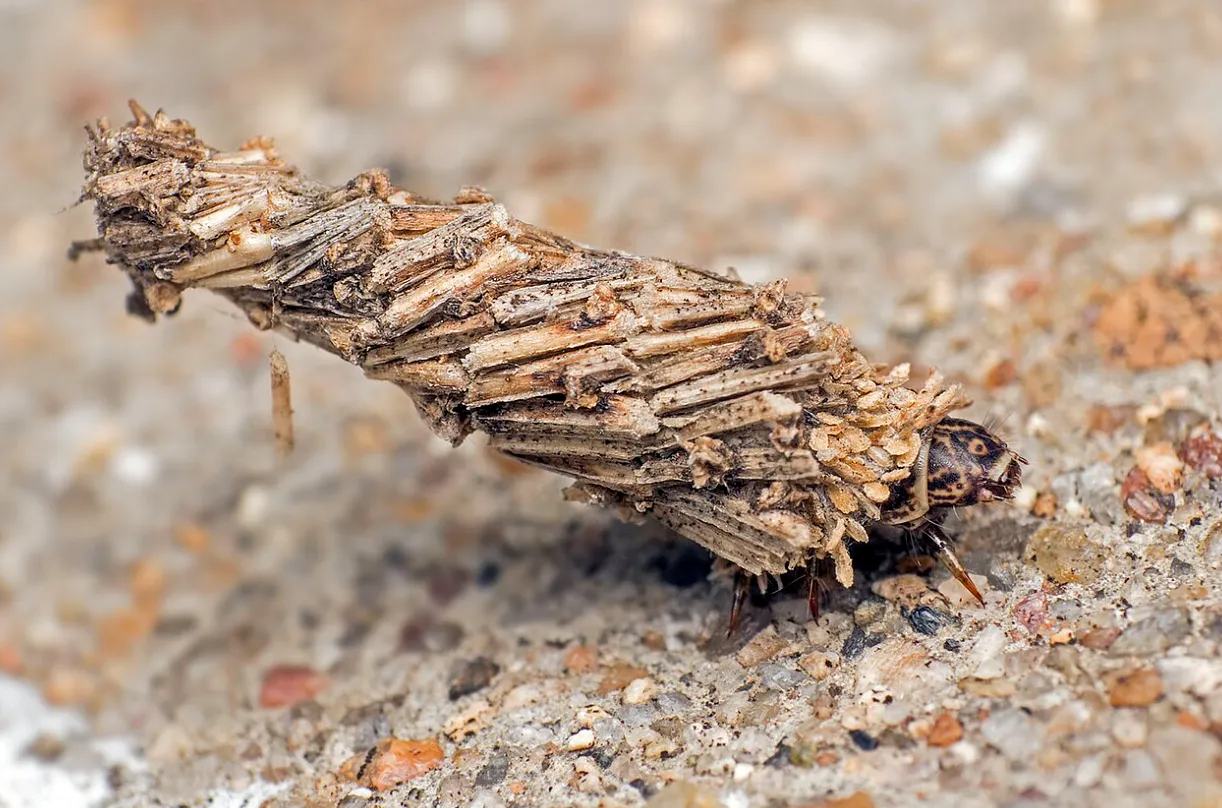
The bagworm moth life cycle is one of the most unusual stories in the insect world because the animal spends much of its life hidden inside a portable protective “bag.” A bagworm moth caterpillar builds this bag from silk, leaves, twigs, bark, dust, sand, or other nearby materials. This natural case serves as armor, camouflage, a nursery, a shelter, and later a pupal chamber.
Most true bagworm moths belong to the family Psychidae, a family within the order Lepidoptera. The well-known evergreen bagworm moth is Thyridopteryx ephemeraeformis, a species often found on arborvitae, juniper, cedar, pine, spruce, cypress, and other landscape plants. Its life cycle usually moves from overwintering eggs to spring larvae, summer feeding, late-summer pupation, adult mating, and egg laying inside the old female bag. Extension sources describe females as flightless and males as short-lived, flying moths that exist mainly to find females and reproduce.
The term plaster bagworm moth is also popular, especially in warm, humid places like Florida. Still, it usually refers to the household casebearer, Phereoeca uterella, which belongs to Tineidae, not Psychidae. It is called a bagworm because its larva carries a small, spindle-shaped case indoors, on walls, in closets, under curtains, and on shaded surfaces.
Q: What is the bagworm moth life cycle?
A: The basic life cycle is egg → larva/caterpillar → pupa → adult moth. In many evergreen bagworms, eggs overwinter inside the female’s old bag, larvae hatch in late spring, feed through summer, pupate in late summer, and adults mate in early fall.
Q: Why do bagworm moth caterpillars live inside bags?
A: The bag protects them from predators, drying weather, and visual detection. It also helps them blend with the host plant or surface because the caterpillar decorates the silk case with local materials.
Q: Are bagworm moths harmful?
A: They are not dangerous to people, but larvae can damage trees and shrubs when populations are high. Indoor “plaster bagworms” may become a nuisance and can feed on old spider webs, lint, hair, and sometimes woolen goods.
Quick Life Cycle Table
| Stage | What Happens | Usual Time or Duration | Easy ID Tip |
| Egg | A female lays hundreds of eggs inside her old bag | Fall to next spring in many evergreen bagworms | The bag remains attached to the twig |
| New larva | Tiny caterpillar hatches and may disperse by silk ballooning | Late spring to early summer | A very small moving case begins |
| Feeding larva | Caterpillars eat leaves, needles, lichens, webs, or debris, depending on the species. | Summer, often June to August, for the evergreen bagworm | The bag grows longer as the larva grows |
| Pupa | Larva seals the bag and transforms inside it | Late summer; about 3–4 weeks in some reports | The bag hangs firmly from a twig or surface |
| Adult male | Winged male emerges and searches for female | Late summer to early fall | Dark moth with clear or reduced-scale wings |
| Adult female | Usually wingless, it stays inside the bag, mates, and lays eggs | A few days after maturity | Often never leaves the bag |
| Next generation | Eggs remain protected until the favorable season | Winter to spring | The old bag may contain eggs |
The quick life-cycle table shows why the bag is at the center of the whole story. For the evergreen bagworm moth, young larvae hatch around late May or early June in many eastern U.S. areas, feed during summer, pupate in late summer, and leave eggs protected through winter. Timing changes with local climate, species, and host plant condition.
Important Things That You Need To Know
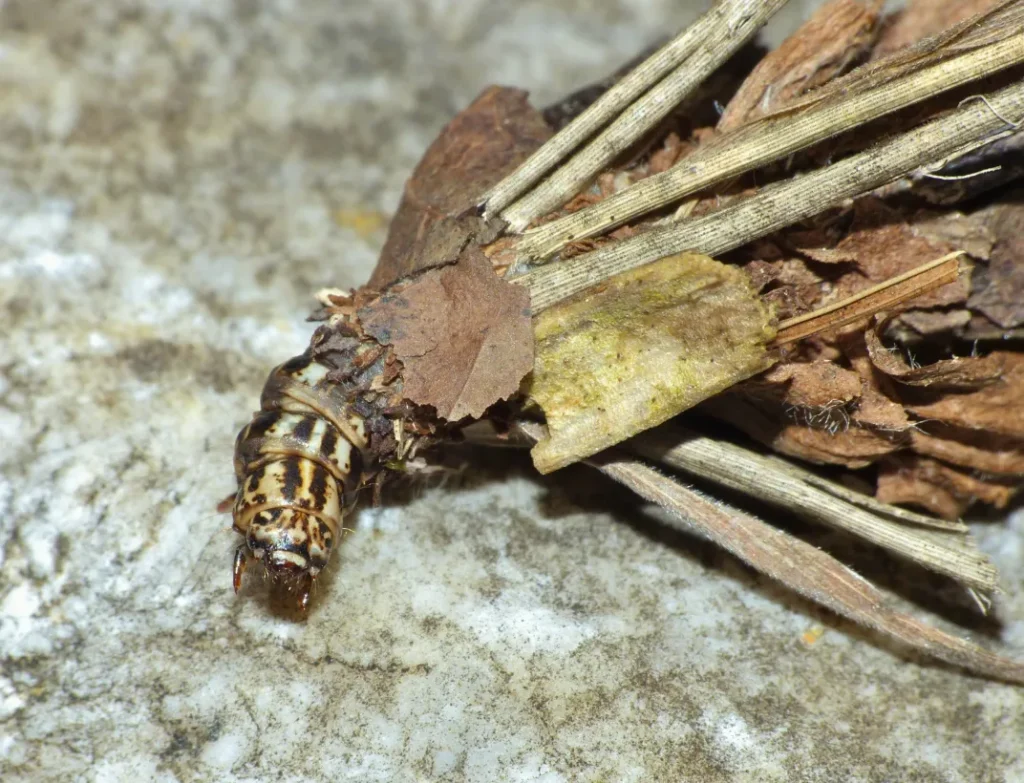
Before studying the full bagworm moth life cycle, it is important to separate common names from scientific identity. Many people use the words “bagworm,” “case moth,” and “plaster bagworm” for insects that carry protective cases, but not all of them belong to the same family.
The term “bagworm moth” usually refers to moths in the family Psychidae. These insects are famous for their larvae, which build silk bags from plant debris. The evergreen bagworm moth, Thyridopteryx ephemeraeformis, is one of the best-known North American examples and is common on evergreen ornamental trees.
The bagworm moth caterpillar is the damaging and feeding stage. It comes out of the bag only partly, eats leaves or needles, then retreats into the case when disturbed. As it grows, it enlarges the case with fresh plant pieces, bark, or needles.
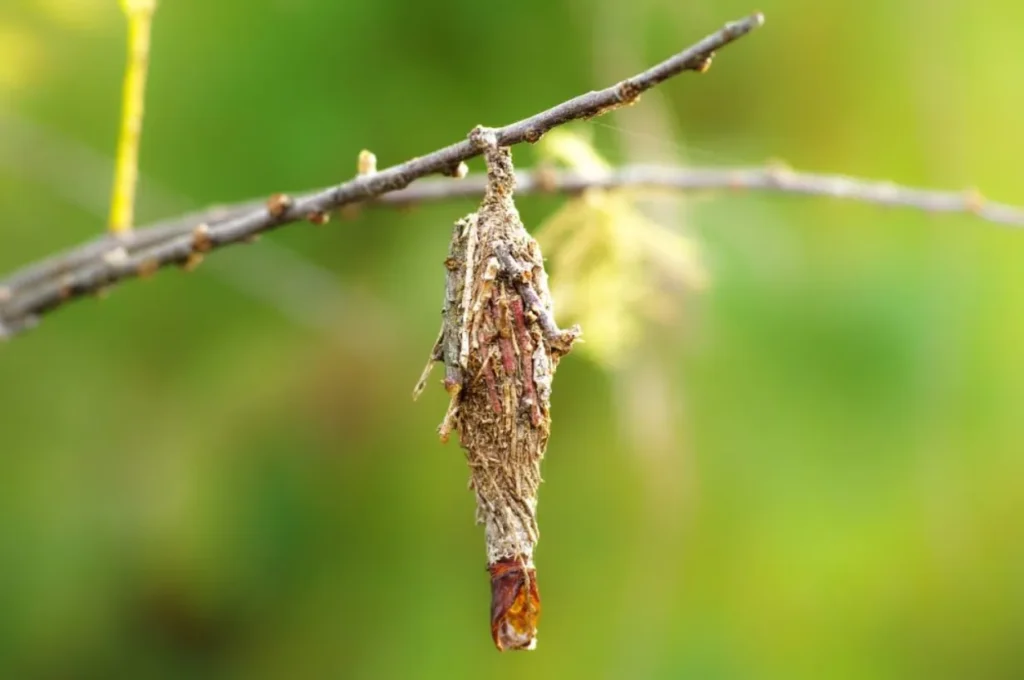
The phrase bagworm moth caterpillar house is a simple way to describe the bag itself. It is not a true house, but it functions like a mobile home, a shield, a camouflage coat, and a cocoon.
The plaster bagworm moth is different. In many homes, especially in warm, humid regions such as Florida, this name refers to Phereoeca uterella, also called the household casebearer. Its larvae make small, flat, spindle-shaped cases from silk, sand, lint, hair, and other debris, which are often found on walls and ceilings.
So, when identifying a case, check the location. A hanging leafy bag on arborvitae or juniper is likely an evergreen bagworm moth. A small, gray, dusty case on an indoor wall is more likely a plaster bagworm moth or a household casebearer.
The History of Their Scientific Naming
The scientific naming of bagworm moths helps separate true biological groups from casual common names.
- Psychidae is the family name for true bagworm moths. The word is New Latin, formed from Psyche, the type genus, plus the family suffix -idae.
- In classification, bagworm moths are placed in Animalia, Arthropoda, Insecta, Lepidoptera, Tineoidea, and Psychidae. BugGuide lists Psychidae under the superfamily Tineoidea, which also includes tubeworm, bagworm, and clothes moth relatives.
- The well-known evergreen bagworm moth is scientifically named Thyridopteryx ephemeraeformis. Taxonomic references list its authority as Haworth, 1803, meaning the species was originally described by Haworth in 1803.
- The common indoor plaster bagworm moth is usually Phereoeca uterella. Its species name uterella is linked to the Latin uter, meaning ‘hide bag’ or ‘waterskin,’ referring to the larval case.
This naming history shows that “bagworm” is both a scientific and descriptive idea: the insect’s identity is tied directly to its bag-building behavior.
Their Evolution And Their Origin
The evolutionary success of bagworm moths stems from a simple yet powerful adaptation: the larva builds a protective case and carries it throughout life. In evolutionary terms, this bag reduces exposure. A soft caterpillar is normally vulnerable to birds, wasps, spiders, weather, and drying sunlight. But a silk-lined case covered with local material makes it harder to see, harder to grab, and harder to dry out.
True bagworm moths are part of Psychidae, a family with worldwide distribution. Some references list about 1,000 species globally, while broader summaries often cite more than 1,300 described species. North America north of Mexico has about 30 species, according to the Missouri Department of Conservation.
Their origin is linked to the larger evolution of moths in Lepidoptera. Like butterflies and other moths, they undergo complete metamorphosis. But bagworms became highly specialized, retaining the larval shelter throughout feeding, molting, pupation, and even reproduction in many species.
One major evolutionary feature is female flightlessness. In many bagworm moths, adult males are winged and mobile, while females remain wingless or nearly wingless inside the case. Studies on the reduction of bagworm moth wings note that female winglessness likely evolved alongside the case-dwelling lifestyle. This means females saved energy by staying protected and investing more in egg production, while males evolved to search for hidden females using scent.
This lifestyle has a cost. Because females often cannot fly, natural spread is limited. But tiny larvae solve part of this problem through ballooning, releasing silk threads that are carried by the wind to nearby plants. That makes the life cycle both protected and mobile at the earliest stage.
Their main food and its collection process
The food of a bagworm moth caterpillar depends strongly on the species and habitat. The best-known evergreen bagworm moth feeds mainly on leaves and soft stems of trees and shrubs, especially evergreen plants.
- Evergreen hosts: Arborvitae, juniper, cedar, pine, cypress, spruce, and eastern red cedar are common hosts. Missouri and Delaware sources note that evergreen bagworms are often noticed on junipers, arborvitaes, and related landscape plants.
- Deciduous hosts: Some populations also feed on oak, willow, cherry, sycamore, locust, and other deciduous trees. Damage may be less permanent on deciduous plants because they can regrow leaves, but repeated heavy feeding still weakens plants.
- Indoor food sources: The plaster bagworm moth or household casebearer feeds differently. Its larvae feed on old spider webs and may eat woolen goods when available. They are often associated with lint, hair, dead insects, dust, and humid indoor corners.
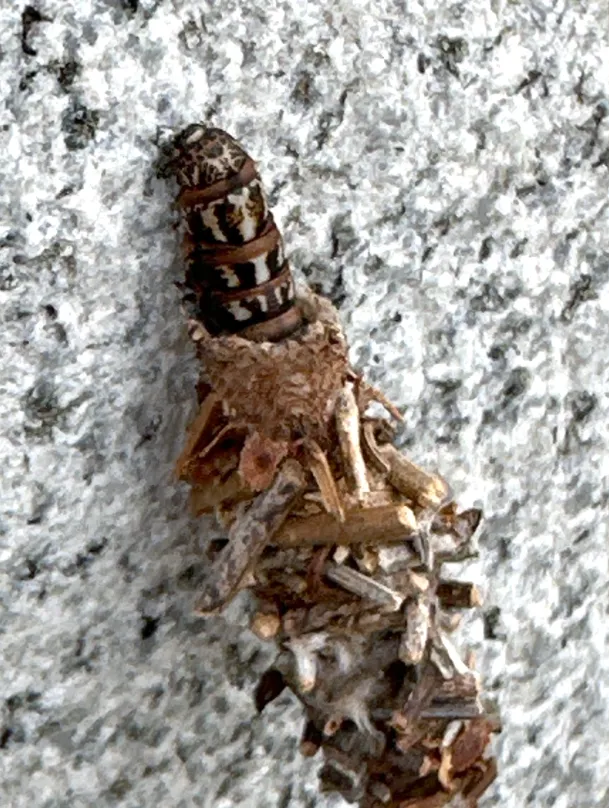
The collection process is fascinating. The larva extends its head and thorax from the front opening of the bag, grips the plant or surface, and chews food using larval mouthparts. It does not abandon the bag. Instead, it drags the bag along as it feeds.
At the same time, the caterpillar collects building material. On trees, it cuts small pieces of leaves, needles, twigs, bark, or plant fiber and attaches them to the silk case. Indoors, a plaster bagworm may use sand grains, dust, lint, and fibers. The result is a case that matches the surrounding environment.
This is why bags on cedar often look woody or needle-covered, while indoor cases look gray, dusty, and flat.
Their life cycle and ability to survive in nature
Egg stage: protected winter survival
In many evergreen bagworm moths, the female lays hundreds of eggs inside her old bag. The eggs remain inside through winter and hatch the following spring. UConn reports that females may lay 500–1000 eggs, which explains why a single missed bag can produce a large local population the next year.
Larval stage: feeding and bag building
After hatching, larvae crawl away or disperse by silk threads. Young larvae immediately start building small bags. As they feed, they enlarge the bag and decorate it with host material. Extension sources report that larvae feed from early summer through late August in many regions.
Pupal stage: transformation inside the bag
When mature, the caterpillar firmly attaches the bag to a twig, stem, wall, or other surface. It closes the opening and pupates inside. Texas A&M notes that some bagworms pupate in August or September, and adults emerge after about a three-week pupal period.
Adult stage: short life and reproduction
Adult males emerge as moths, fly, and search for females. In many Psychidae species, adult females remain inside the bag. Adults generally do not feed or feed very little because their main purpose is reproduction.
Survival ability in nature
Their main survival tools are camouflage, silk engineering, female protection, egg sheltering, and early larval dispersal. The bag protects the larva from predators, buffers it against the weather, and allows the insect to complete several life stages within a single safe structure.
Their Reproductive Process and raising their children
The reproductive process of bagworm moths is unusual because the adult female often remains inside the same bag she used as a larva and pupa.
- Male emergence: The male leaves his pupal case as a winged moth. In the evergreen bagworm moth, males are dark and fuzzy, often with clear wings, because scales may be shed as they emerge from the bag.
- Female calling: The female releases pheromones, chemical signals that attract males. Since many females cannot fly, scent communication is essential.
- Mating through the bag: The male locates the female’s bag and mates by extending his abdomen into the bag opening. This behavior lets the female remain protected while reproducing.
- Egg laying: After mating, the female lays eggs inside the bag. In many species, she dies soon afterward. The eggs stay in the protective case until the next season.
- No parental care after eggs: Bagworm moths do not raise young the way birds or mammals do. Their “parental investment” is structural, not behavioral. The mother leaves the eggs inside a tough, camouflaged shelter.
- New generation dispersal: When larvae hatch, they leave the old bag, crawl to nearby foliage, or disperse on silk threads. Each larva then builds its own separate case.
This system is efficient. The mother does not feed, guard, or guide the babies. Instead, she provides a safe egg chamber, and the larvae are born ready to build, feed, and survive independently.
The importance of them in this Ecosystem
Natural food web value
Bagworm moths are part of the food web. Their larvae, pupae, eggs, and adults can feed birds, parasitoid wasps, predatory insects, and spiders. Delaware Extension notes that bagworms have natural enemies, including paper wasps, parasitoids, and birds such as finches.
Plant population pressure
Bagworms can act as natural plant consumers. Light feeding is part of the normal ecological balance. In forests and mixed habitats, some larval feeding can help transfer plant energy into insect biomass, which then supports predators.
Habitat-building behavior
Their bags are miniature examples of animal engineering. The caterpillar uses silk and environmental materials to create a structure that changes as it grows. This behavior helps scientists and naturalists study camouflage, predator avoidance, and insect adaptation.
Decomposition and indoor cleanup role
The plaster bagworm moth or household casebearer may feed on old spider webs and organic debris. While it can become a household nuisance, its natural feeding habit involves recycling dead organic material in sheltered places.
Economic and landscape impact
The ecological importance of bagworms has a negative side in gardens and nurseries. Heavy infestations can defoliate ornamental trees and shrubs. Missouri notes that large infestations may weaken plants, render nursery stock unsalable, or kill young, stressed plants.
What to do to protect them in nature and save the system for the future
Protecting bagworm moths does not mean allowing damaging outbreaks everywhere. The best approach is balance: conserve natural biodiversity while managing heavy infestations only when needed.
- Keep mixed plant habitats: Diverse gardens support birds, parasitoid wasps, and predators that naturally reduce bagworm populations.
- Avoid unnecessary broad-spectrum insecticides: These can kill beneficial insects along with bagworms. Use targeted control only when damage is serious.
- Hand-pick bags when populations are high: On small trees and shrubs, removing bags during winter can reduce next season’s eggs without harming the wider Ecosystem.
- Protect native plants: Healthy native trees and shrubs support natural predator communities and reduce pest imbalance.
- Monitor before spraying: Look for young larvae in late spring or early summer. Control is most effective when larvae are small.
- Preserve birds and wasps: Finches, paper wasps, and parasitoids can help suppress bagworms naturally. Avoid destroying all wasp habitats unless it creates a safety risk.
- Reduce indoor humidity for plaster bagworms: For household casebearers, improve ventilation, remove old webs, vacuum lint, and clean corners instead of overusing chemicals.
- Leave harmless cases in natural areas: If bagworms are not damaging valuable plants, they can remain part of the local food web.
- Educate gardeners: Many people panic when they see bags. Proper identification prevents the unnecessary killing of insects that may be harmless in low numbers.
- Use integrated pest management: Combine observation, hand removal, natural enemies, and selective treatment only when needed.
This future-focused method protects both plant health and insect biodiversity.
Frequently Asked Questions (FAQs)
Q1: What is a bagworm moth?
A: A bagworm moth is usually a moth in the family Psychidae. Its caterpillar builds a portable silk case covered with plant debris, soil, sand, or other materials.
Q2: What is the full bagworm moth life cycle?
A: The life cycle is egg, larva, pupa, and adult. In evergreen bagworms, eggs overwinter in the female’s bag, larvae hatch in spring, feed through summer, pupate in late summer, and adults mate before females lay the next egg mass.
Q3: What does a bagworm moth caterpillar eat?
A: True bagworm larvae often eat leaves and needles of trees and shrubs. The evergreen bagworm commonly feeds on arborvitae, juniper, cedar, pine, cypress, spruce, and sometimes deciduous plants.
Q4: What is a bagworm moth caterpillar house?
A: It is the caterpillar’s protective bag. The larva makes its from silk and local materials. It works as a mobile shelter, camouflage, and later a pupal chamber.
Q5: Is a plaster bagworm moth a true bagworm moth?
A: Usually no. The common plaster bagworm moth is Phereoeca uterella, also called the household casebearer. It belongs to Tineidae, not Psychidae, but it is called a bagworm because the larva carries a case.
Q6: Why are bagworm moths common in Florida homes?
A: Warm, humid conditions favor household casebearers. In Florida, the term plaster bagworm is commonly used for indoor case-bearing larvae found on walls, closets, and shaded surfaces.
Q7: Do adult bagworm moths eat?
A: Many adult bagworm moths do not feed or have reduced mouthparts. Their adult life is short and mainly focused on reproduction.
Q8: How many eggs can a bagworm moth lay?
A: The evergreen bagworm female may lay hundreds of eggs. UConn reports egg masses of 500–1000 eggs in the female’s old bag.
Conclusion
The bagworm moth life cycle is a remarkable example of survival through shelter, camouflage, and specialization. From the egg hidden inside an old bag to the tiny bagworm moth caterpillar building its first case, every stage depends on protection. The evergreen bagworm moth shows how a small insect can become both an ecological food source and a serious plant pest when its population rises. The indoor plaster bagworm moth shows a similar case-bearing strategy in homes, although it belongs to a different moth family.
Understanding these insects helps us respond wisely. Not every bagworm needs to be destroyed, and not every case means danger. In natural habitats, they support birds, wasps, and other predators. In gardens, careful monitoring and balanced control protect plants without damaging the Ecosystem. The best approach to the future is simple: identify correctly, manage only when needed, and respect the hidden engineering of these small but extraordinary moths.
Also Read: amorphophallus titanum life cycle
About the Author