Understanding the pantry moth life cycle is important because pantry moths do not usually appear in a kitchen by accident. Most infestations begin quietly inside dry foods such as flour, cereal, rice, nuts, dried fruit, birdseed, pet food, or spices. By the time adult moths are flying around the kitchen, pantry moth larvae may already be feeding, spinning silk, and contaminating food in hidden packages.
The most common pantry moth is the Indian meal moth, scientifically known as Plodia interpunctella. It goes through four main stages: egg, larva, pupa, and adult moth. The larval stage causes the most damage because the larvae feed directly on stored food and leave behind silk webbing, frass, shed skins, and eggshells. Extension sources describe it as one of the most common pantry pests in homes and food storage areas.
Understanding this life cycle helps you know what you are seeing. Tiny pantry moth eggs are hard to notice. Cream-colored larvae are easier to spot. Adult moths are often the warning sign, but they are not the stage of eating your food. This guide explains each stage clearly and also covers pantry moth traps, food sources, reproduction, ecosystem role, and prevention.
Q: What is a pantry moth?
A: A pantry moth is a stored-food moth, most often the Indian meal moth, that lays eggs on dry foods. Its larvae feed inside pantry products and contaminate them.
Q: How long is the pantry moth life cycle?
A: The full cycle can be as short as about 27 days in warm conditions or much longer in cooler conditions. Some sources report a range of 27 to 305 days, depending on food and temperature.
Q: Do pantry moth traps remove the whole infestation?
A: Pantry moth traps help catch male moths and monitor activity, but they usually cannot remove an infestation alone because eggs, larvae, pupae, and female moths may remain hidden in food or cracks.
Quick Life Cycle Table
| Life Cycle Stage | What It Looks Like | Where You Find It | Main Activity | Why It Matters |
| Egg | Tiny, pale, hard to see | On or near dry food | Hatches into a larva | This is where hidden infestation begins |
| Larva | Cream, pinkish, yellowish, or greenish caterpillar with a brown head | Inside cereal, flour, nuts, seeds, pet food, spices | Feeds and spins silk | This is the most damaging stage |
| Pupa | Cocoon-like resting stage | Cracks, shelf corners, ceilings, package edges | Changes into an adult moth | Often hidden away from food |
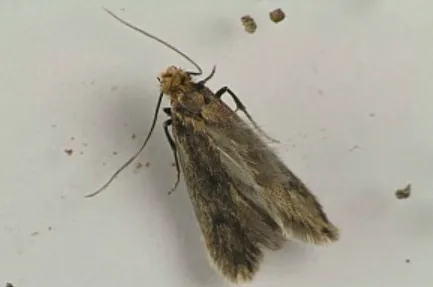
| Adult moth | Small gray and copper-brown moth | Kitchen, pantry, walls, lights | Mates and lay eggs | Signals that breeding is active |
| Full cycle | Egg to adult | Pantry or food storage area | Repeats if food remains | Several generations can overlap indoors |
The History of Their Scientific Naming
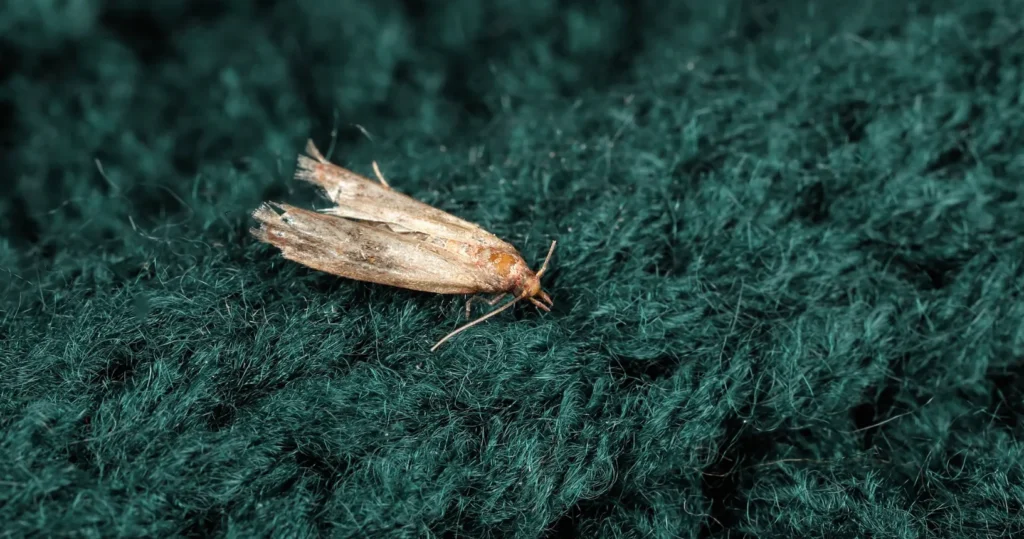
The pantry moth most people see in kitchens is the Indian meal moth, Plodia interpunctella. It belongs to the order Lepidoptera, the same insect order that includes moths and butterflies, and to the family Pyralidae. The species name is usually credited to Hübner, with 1813 as the year of publication in many taxonomic listings.
Key naming points:
- Plodia interpunctella is the accepted scientific name for the common Indian meal moth.
- The common name “Indian meal moth” does not imply that the insect originated in India.
- “Indian meal” was an older name for cornmeal or maize meal.
- The name became linked with the moth because larvae were found feeding on stored cornmeal.
- Other common names include pantry moth, flour moth, grain moth, and sometimes weevil moth.
The name matters because many people confuse pantry moths with clothes moths. A pantry moth is linked to stored food. Clothes moths feed on animal-based fabrics such as wool, fur, or feathers. Correct naming helps with correct control.
Their Evolution And Their Origin
The pantry moth life cycle is the result of a long evolutionary history tied to dry plant material, stored seeds, and human food storage. Like other moths, Plodia interpunctella developed through complete metamorphosis. This means it has four separate stages: egg, larva, pupa, and adult. Each stage does a different job.
The larva is the feeding stage. The adult is mainly the reproductive stage. This separation helps the insect survive because larvae can focus on building body mass while adults focus on mating and egg laying.
The exact natural origin of the Indian meal moth is not consistently presented across references. Some sources describe it as originally from Europe, while others say it originated in Asia or South America. Because this insect has traveled widely with stored grains, dried fruits, nuts, and packaged foods, its early natural range is harder to state with certainty. What is clear is that it is now cosmopolitan, meaning it is found in many parts of the world, wherever suitable stored food is available.
Its success comes from several survival traits. Pantry moth larvae can feed on many dry foods. Mature larvae can leave the food source and hide in cracks before pupating. Adults can fly through rooms, which helps them spread from one food source to another. Indoors, generations may overlap, so eggs, larvae, pupae, and adults can be present at the same time.
This insect did not become common in homes because it is strong or aggressive. It became common because human food storage created the perfect habitat: dry food, dark shelves, steady warmth, and many hidden cracks.
Their main food and its collection process
The main food of the pantry moth is not fresh fruit, fresh vegetables, or cooked meals. Its larvae prefer dry stored food. Adult moths do not cause the main feeding damage. The real feeding happens during the larval stage.
Common food sources include:
- Flour
- Rice
- Cereal
- Oatmeal
- Cornmeal
- Pasta
- Nuts
- Dried fruit
- Seeds
- Bird seed
- Dry pet food
- Powdered milk
- Chocolate
- Spices
- Dried herbs
- Crackers and biscuits
Colorado State University Extension notes that larvae develop in many stored foods, including grains, cereals, dried herbs, dried fruits, nuts, bird seed, and dry pet food.
Their food collection process is simple but effective:
- A female moth lays pantry moth eggs on or near a suitable food source.
- Eggs hatch into tiny larvae.
- Larvae crawl into loose food, cracks in packaging, or broken grains.
- They feed near the surface on dry food.
- While feeding, they spin silk that loosely binds food particles.
- The food becomes contaminated with silk, frass, shed skins, and eggshells.
This contamination is often worse than the amount of food actually eaten. The larvae do not “collect” food like ants or bees. Instead, they live inside or near the food and feed continuously as they grow.
Loose packaging helps them spread. Thin cardboard, paper, and poorly sealed plastic bags are weak barriers. That is why tight glass, metal, or strong plastic containers are better for pantry storage.
Their life cycle and ability to survive in nature
Egg Stage
The pantry moth life cycle begins when a female lays eggs on or near dry food. These eggs are tiny and pale, so most people never notice them. In warm conditions, eggs can hatch quickly. UF/IFAS reports that eggs may hatch in 3 to 4 days at 30°C and 7 to 8 days at 20°C.
Larval Stage
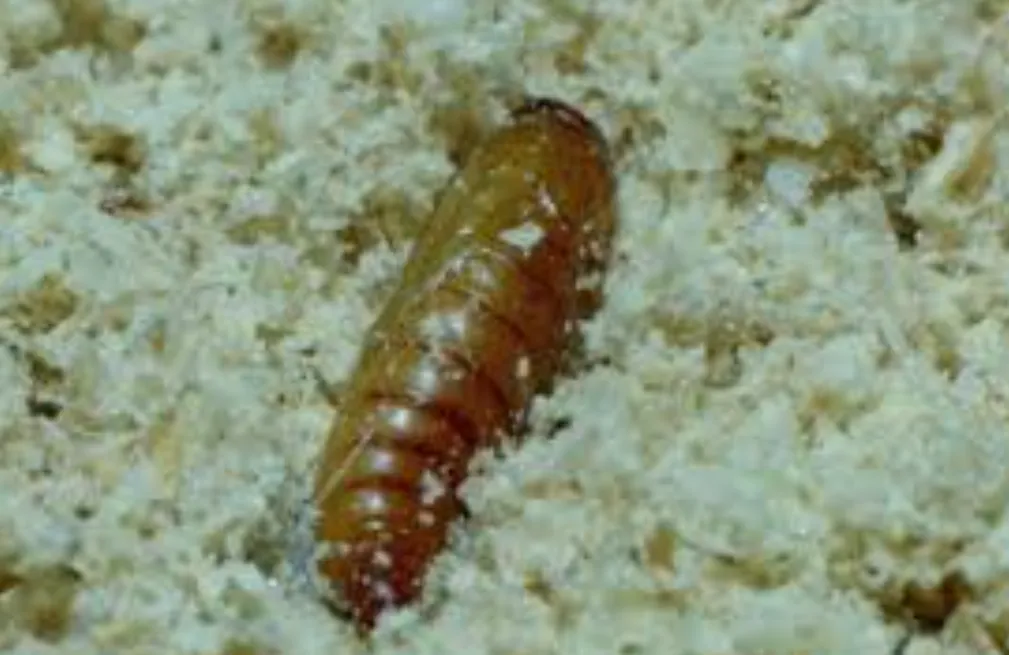
The larva is the stage people often call a “small pantry worm.” Pantry moth larvae are usually cream-colored, but they may look pinkish, yellowish, or greenish depending on the food. They have a darker brown head.
This is the survival stage. Larvae feed, grow, shed their skin, and produce silk. They may complete development faster in warm places with good food, but poor food or cooler temperatures slow them down.
Pupal Stage
When larvae are mature, they often leave the food and crawl to cracks, shelf corners, wall edges, or container rims. There, they form a cocoon and pupate. This hidden stage is one reason pantry moths can return even after obvious food is thrown away.
Adult Stage
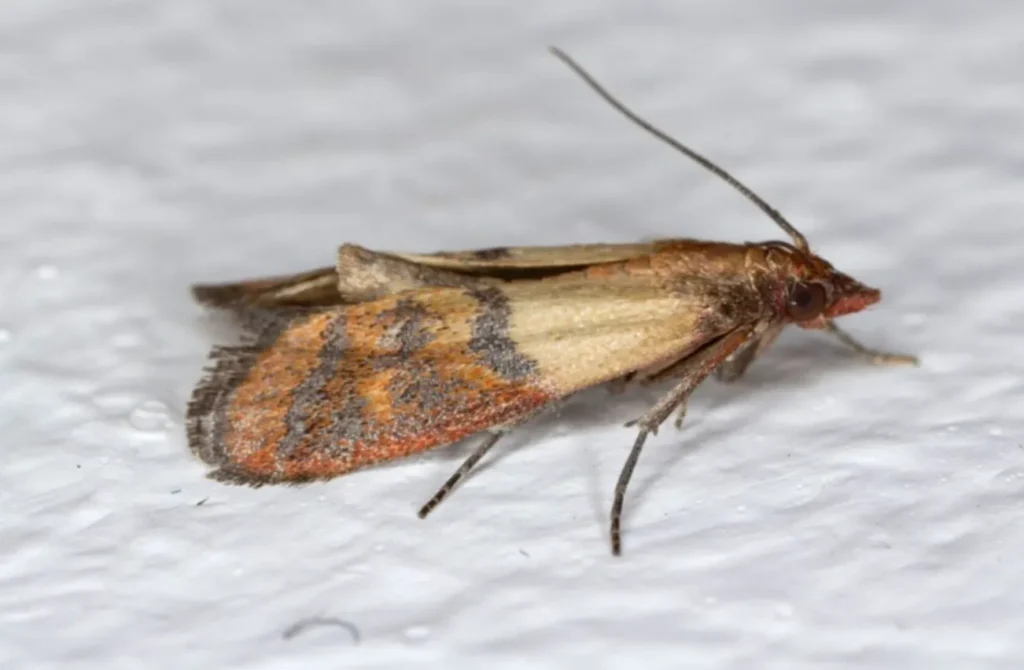
Adult pantry moths are small and often gray with coppery or bronze wing tips. Adults fly weakly, often at night or near lights. Their main job is reproduction, not feeding. Once adults mate, females lay eggs, and the cycle starts again.
Survival Ability
Pantry moths survive well because they hide in food, use warm indoor spaces, and live in small cracks. Their ability to feed on a wide range of foods makes them among the most persistent stored-product pests.
Their Reproductive Process and raising their children
Pantry moths do not raise their young in the way birds or mammals do. There is no parental care after egg laying. Still, their reproductive process is highly successful because females choose food-rich places for their eggs.
Key points about reproduction:
- Adult moths emerge from pupae and soon look for mates.
- Mating and egg laying can begin within a few days after adult emergence.
- Females lay eggs directly on or near food.
- A single female may lay many eggs. UF/IFAS reports that one female can lay up to 400 eggs after mating.
- Eggs are placed where larvae can begin feeding soon after hatching.
- Newly hatched larvae disperse and quickly enter food sources.
- Several generations may occur indoors when warmth and food remain available.
The “raising” of the young is mostly done through smart placement. The female does not feed the larvae. She gives them the best chance by laying eggs near dry food.
Once the eggs hatch, the larvae take over. They crawl, feed, spin silk, and grow through several larval stages. Their silk helps protect them and binds food particles together. As they mature, they leave the food source to pupate in safer, hidden spots.
This reproductive system explains why pantry moths spread so fast. One undisturbed box of cereal, nuts, or bird seed can support more than one generation.
Important Things That You Need To Know
Many people first ask, what is a pantry moth, only after they see small moths flying around the kitchen. The important thing to know is that the flying moth is only one part of the problem. The hidden stages are often more serious.
A pantry moth usually means the Indian meal moth, Plodia interpunctella. It is not the same as a clothes moth. It does not want your shirts, cotton clothes, or furniture. It wants dry food products. The most damaging stage is the pantry moth larva, because it feeds on food and leaves behind silk webbing.
You may search for pictures of pantry moth eggs, but in real life, the eggs are so small that they are hard to identify without magnification. Instead of looking only for eggs, check for webbing, clumps in food, small crawling larvae, adult moths, and dust-like frass.
A pantry moth trap is useful, but it is not a full cure. Most traps use pheromones to attract male moths. This helps you monitor activity and locate problem areas. However, traps do not remove eggs, larvae, pupae, or all females.
Use pantry moth traps as one part of control, not the only step. The real solution is finding the infested food, throwing it away or treating it, cleaning shelves deeply, and storing all dry foods in tight containers.
The importance of them in this Ecosystem
Natural Decomposers of Dry Plant Material
In nature, moth larvae like these can help break down dry plant-based materials such as seeds, grains, and dried fruits. Their feeding turns larger food particles into smaller waste and makes organic matter easier for microbes and other decomposers to process.
Food for Other Animals
Pantry moths and similar small moths can become food for spiders, predatory insects, small birds, reptiles, and other animals. Even insects that annoy humans may still be part of a larger food chain.
Part of Stored-Food Ecology
In human environments, pantry moths are considered pests. Still, from an ecological perspective, they show how quickly insects can exploit a food-rich niche. Stored grain, dried fruit, and packaged food create an artificial ecosystem with warmth, shelter, and steady nutrition.
Indicator of Storage Problems
Their presence can also act as a warning. When pantry moths appear, it often means food has been stored too long, packaging is weak, shelves need cleaning, or dry goods are not sealed well. In that way, they reveal problems in food storage systems.
Balance Between Nature and Human Spaces
The goal is not to protect pantry moths inside kitchens. In homes, food safety matters first. But in outdoor systems, moths and their larvae play small roles in nutrient cycling and food webs. The key is to control human food systems without harming the wider environment.
What to do to protect them in nature and save the system for the future
Pantry moths should not be protected inside homes, food shops, warehouses, or kitchens. But nature still needs healthy insect diversity. The better approach is to manage pests safely indoors while protecting the wider Ecosystem outdoors.
- Avoid unnecessary pesticide use in kitchens and food storage areas. Extension guidance often favors inspection, sanitation, disposal of infested food, and sealed storage over spraying food areas.
- Use pantry moth traps responsibly. A pantry moth trap can monitor male moth activity, but it should not replace cleaning and food inspection.
- Protect natural insect habitats outdoors. Small moths, beetles, bees, flies, and other insects support birds, reptiles, amphibians, and soil life.
- Store food properly instead of relying on chemicals. Use glass jars, metal tins, or strong plastic containers with tight lids.
- Reduce food waste. Buy dry food in amounts you can use within a reasonable time.
- Freeze risky dry foods. Flour, nuts, birdseed, and grains can be frozen for a few days before storage to reduce the risk of hidden pests.
- Keep storage areas dry. Many stored-product pests do better in higher humidity, so ventilation and dry shelves help.
- Clean cracks and corners. Larvae may pupate away from food, so vacuuming shelf corners and wall edges is important.
- Do not release pantry moths from infested food near homes. Seal infested items before disposal so the infestation does not simply move elsewhere.
Frequently Asked Questions (FAQs)
Q1: What is a pantry moth?
A: A pantry moth is a small stored-food moth. The most common type is the Indian meal moth, or Plodia interpunctella. It infests dry foods such as flour, cereal, rice, nuts, spices, bird seed, and pet food.
Q2: What do pantry moth eggs look like?
A: Pantry moth eggs are very small, pale, and difficult to see with the naked eye. Instead of relying only on egg identification, look for webbing, larvae, clumped food, frass, and adult moths.
Q3: Where can I find pictures of pantry moth eggs?
A: You can find pantry moth egg pictures in entomology guides and extension pest resources, but in a real pantry, eggs are usually too tiny to confirm easily. Signs of larvae and webbing are more practical for detection.
Q4: What do pantry moth larvae look like?
A: Pantry moth larvae look like small cream-colored caterpillars with brown heads. Depending on what they eat, they may appear yellowish, pinkish, or slightly greenish.
Q5: Are pantry moth larvae harmful to humans?
A: They are not known for biting or poisoning people, but infested food should not be eaten because it can contain larvae, silk, droppings, shed skins, and eggshells.
Q6: Do pantry moth traps really work?
A: Pantry moth traps work well for monitoring and catching male moths. But traps alone usually do not end the infestation, because larvae, eggs, pupae, and females may be present.
Q7: How long does the pantry moth life cycle take?
A: It depends on temperature and food. In warm conditions, the life cycle may finish in about a month. In cooler or poor conditions, it can take much longer.
Q8: How do I stop pantry moths from coming back?
A: Remove infested food, vacuum shelves, wash storage areas, check unopened packages, use tight containers, freeze risky foods, and keep pantry moth traps for monitoring.
Conclusion
The pantry moth life cycle is simple, but it can create a frustrating infestation when ignored. The insect passes through egg, larva, pupa, and finally the adult moth. The adult moth is what most people notice first, but the pantry moth larvae are the stage that damages food.
The best way to control pantry moths is to break the cycle. That means finding the hidden food source, removing contaminated items, cleaning shelves, sealing dry foods, and using pantry moth traps as a monitoring tool. Looking for pantry moth egg pictures may help with learning, but real pantry control depends more on spotting webbing, larvae, and damaged food.
Pantry moths have a role in nature, but they do not belong in stored food. With clean storage habits and tight containers, you can protect your kitchen, reduce waste, and stop the infestation before the next generation begins.
Also Read: lightning bug life cycle
About the Author