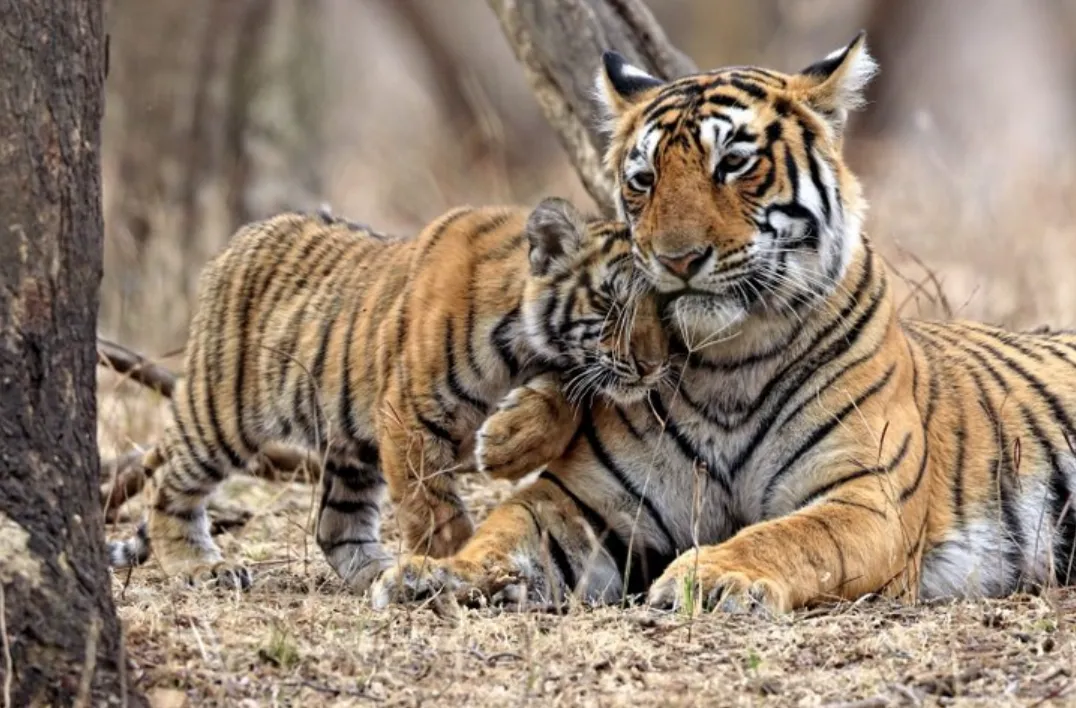
The tiger life cycle is one of the most powerful stories in the wild. A tiger begins life as a tiny, blind cub hidden in grass, caves, tree roots, or thick forest cover. From there, it slowly grows into one of nature’s strongest hunters. Every stage matters: birth, nursing, learning, hunting practice, independence, breeding, and old age.
A tiger is not just a beautiful striped animal. It is a top predator that helps control deer, wild pigs, and other prey animals. This balance keeps forests, grasslands, and wetlands healthier. Tigers live across parts of Asia, including India, Nepal, Bhutan, Bangladesh, Russia, China, Southeast Asia, and Sumatra.
They survive in forests, grasslands, mangrove swamps, and cold taiga regions, but their range is now much smaller than it once was. Smithsonian notes that tigers may now occupy only a small part of their historic range, while WWF-UK reports that wild tiger numbers are rising but still far below early 20th-century levels.
Q: How long is the tiger’s life cycle?
A: A tiger can live around 10 to 15 years in the wild, though some may live longer in protected conditions.
Q: When do tiger cubs leave their mother?
A: Tiger cubs usually stay with their mother for about 18 months to 3 years, depending on food, safety, and hunting ability.
Q: What is the most important stage in a tiger’s life cycle?
A: The cub stage is the most fragile because young tigers are blind, helpless, and fully dependent on their mother.
Quick Life Cycle Table
| Life Cycle Stage | Approximate Age | What Happens |
| Newborn Cub | Birth to 2 weeks | Cubs are blind, weak, and hidden by the mother. |
| Early Cub Stage | 2 weeks to 2 months | Eyes open, hearing improves, and cubs begin moving more. |
| Learning Stage | 2 to 6 months | Cubs follow their mother and start eating meat. |
| Hunting Practice | 5 to 12 months | Cubs watch hunts, play-fight, stalk, and learn survival skills. |
| Juvenile Stage | 1 to 2 years | Young tigers grow stronger and begin making small kills. |
| Independence | 18 months to 3 years | Tigers leave their mother and search for their own territory. |
| Adult Stage | 3 to 5 years onward | Tigers become mature, breed, hunt alone, and defend territory. |
| Old Age | 10+ years | Hunting becomes harder, and survival depends on health and territory. |
Important Things That You Need To Know
The word tiger usually refers to the large cat Panthera tigris. But online searches often mix animal facts with other meanings, so it is useful to clearly separate them.
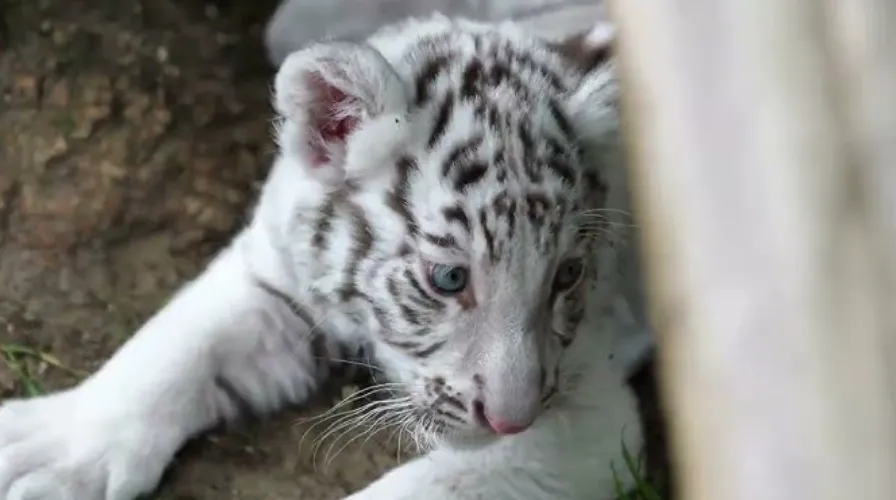
A Bengal tiger is one of the best-known tiger populations and is found mainly in the Indian subcontinent. It is often linked with forests, grasslands, and mangrove areas such as the Sundarbans. The white tiger is not a separate species. It is usually a color variation caused by a rare genetic condition, most often linked with Bengal tigers.
The saber-toothed tiger is also commonly searched for, but it was not a true tiger. People often use that name for extinct saber-toothed cats such as Smilodon, which belonged to a different branch of the cat family.
Onitsuka Tiger is not related to wildlife in any way. It is a fashion and footwear brand, so it should not be confused with the animal’s biology or conservation.
A tiger drawing can still be useful for learning. Students often use drawings to understand the tiger’s body shape, stripes, claws, cub growth, and hunting posture. For education, a drawing should show the tiger’s strong shoulders, long tail, sharp teeth, and stripe pattern.
Knowing these differences helps readers understand the real tiger life cycle without mixing it with brands, extinct animals, or art-related searches.
The History of Their Scientific Naming
The scientific naming of the tiger has a long history, dating back to early natural history studies.
- The modern tiger’s scientific name is Panthera tigris.
- The word Panthera refers to the genus of big cats that includes tigers, lions, leopards, jaguars, and snow leopards.
- The word tigris comes from older Greek and Latin naming traditions linked with the tiger.
- Early scientists first placed many cats in broader groups before modern taxonomy became more detailed.
- Britannica identifies the tiger as Panthera tigris, the largest member of the cat family, Felidae.
- Over time, scientists studied tiger skulls, coats, body size, geography, and, later, DNA to understand tiger populations better.
- Today, tiger classification can still be discussed in different ways. Some sources describe several living subspecies, while others group them more broadly into mainland and island forms.
Scientific naming is important because common names can be confusing. A Bengal tiger, an Amur tiger, and a Sumatran tiger are all tigers. Still, they live in different regions and face different body sizes, coat colors, and survival challenges.
Their Evolution And Their Origin
The tiger belongs to the cat family, but it has its own deep evolutionary story. Tigers are part of the Panthera group, which also includes lions, leopards, jaguars, and snow leopards. These big cats share strong jaws, sharp claws, powerful bodies, and hunting instincts, but each species has adapted in different ways to survive.
Tigers are believed to have evolved in Asia. Their ancestors spread through forests, river valleys, grasslands, cold regions, and islands. This explains why modern tigers can live in very different habitats. An Amur tiger can survive freezing conditions in eastern Russia, while a Sumatran tiger lives in a tropical forest. The Bengal tiger can live in forests, grasslands, and mangrove areas.
Their striped coat is one of their most useful adaptations. In tall grass, forest shade, and broken sunlight, tiger stripes help hide their body shape. This gives them a better chance to stalk prey before attacking. Smithsonian also notes that no two tigers have the same stripe pattern, which helps researchers identify individual tigers in the wild.
Tigers did not evolve to chase prey over long distances like some open-land predators. Instead, they became ambush hunters. They move quietly, wait, stalk, and attack from close range. Their strong front legs, heavy body, and sharp teeth help them pull down large animals.
This evolutionary path shaped the whole tiger life cycle. Cubs must learn patience, stalking, timing, and strength from their mother. Without those lessons, survival in the wild becomes very difficult.
Their main food and its collection process
Tigers are carnivores, which means they eat meat. Their main food sources include deer, wild pigs, antelope, buffalo, and other medium- to large-sized animals. In some places, they may also hunt smaller animals when large prey is hard to find.
The food collection process is not simple. A tiger does not usually run after prey for a long distance. Instead, it follows a quiet hunting method.
- Searching for prey: Tigers often move through forest trails, grass edges, riverbanks, or waterholes where animals come to drink.
- Using smell and hearing: A tiger listens carefully and uses scent to understand where prey has passed.
- Stalking silently: It lowers its body, moves slowly, and uses bushes, grass, and shadows as cover.
- Short attack: When close enough, the tiger rushes suddenly and uses its body weight to knock the prey down.
- Killing bite: Large prey is usually killed with a bite to the throat or neck. National Geographic describes tigers as solitary hunters that often wait until dark and attack with teeth and claws.
- Eating and hiding the kill: After feeding, a tiger may drag or hide the carcass so it can return later.
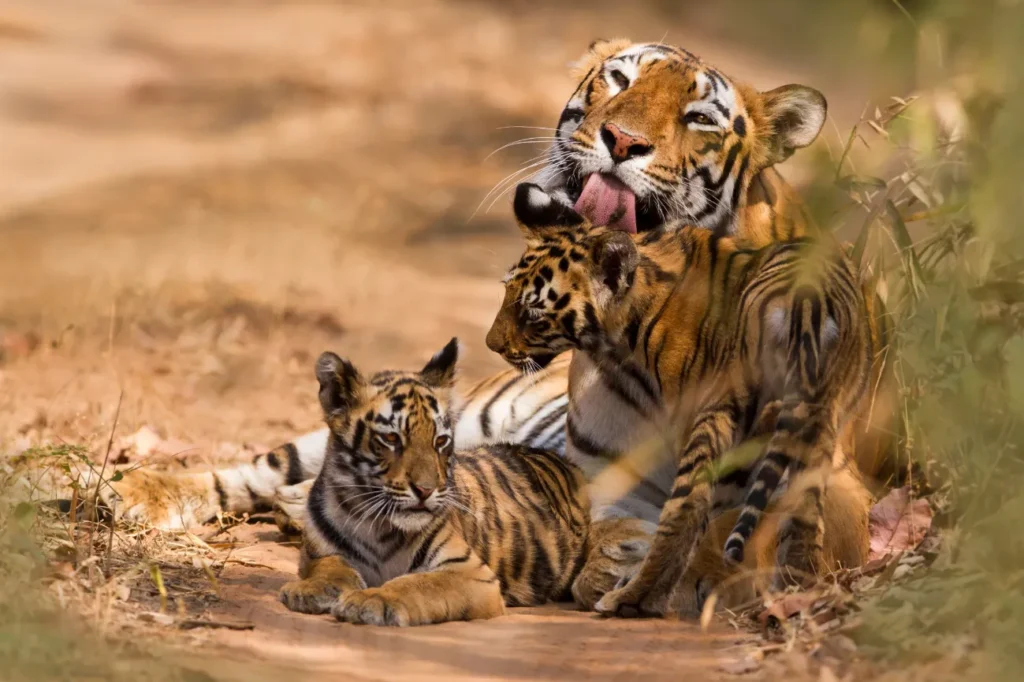
A mother tiger with cubs must hunt more often because she needs food for herself and her growing young. Animal Diversity Web notes that a mother caring for cubs may need to increase her killing rate to support both herself and her offspring.
Food availability directly affects the tiger’s life cycle. If prey is low, cub survival drops, adults roam farther, and conflict with humans becomes more likely.
Their life cycle and ability to survive in nature
Birth and the first hidden days
The tiger’s life cycle begins when a female gives birth after a gestation period of about 96 to 111 days, with an average of around 103 days. Cubs are born blind, weak, and fully dependent on their mother. A litter may have one to seven cubs, but two to three is common.
During the first days, the mother hides them in a safe den. She may use tall grass, rocky shelter, thick bushes, or tree roots for cover.
Growing, playing, and learning
Tiger cubs open their eyes after several days and slowly begin to move. By around two months, they start following their mother. They also begin eating meat while still depending on milk.
Play is not just fun. It teaches cubs how to bite, pounce, wrestle, stalk, and judge distance. These early lessons prepare them for hunting.
Hunting and independence
From around five to six months, cubs may join hunting trips. They watch their mother closely and copy her movements. Over time, they practice on small animals and learn how to avoid danger.
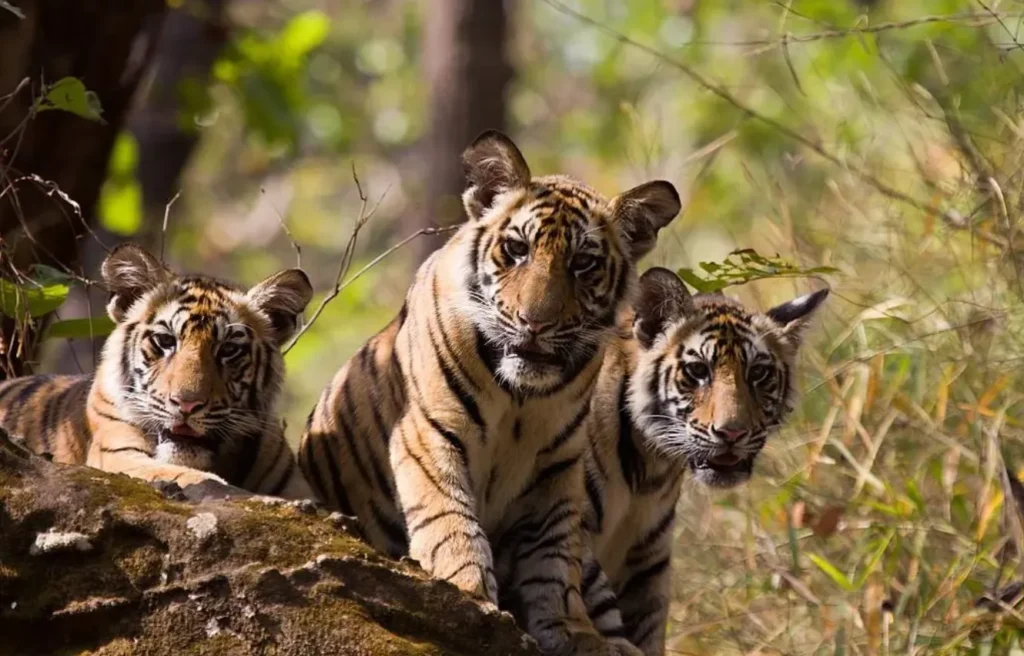
Young tigers usually become independent between 18 months and 3 years. This is one of the hardest stages. They must find territory, avoid stronger adults, locate prey, and survive without their mother.
Adult survival
Adult tigers live mostly alone. They mark territory with scent, scratches, and calls. A strong territory gives them access to prey, water, shelter, and opportunities to mate.
Their Reproductive Process and raising their children
The reproductive process of a tiger is closely connected to territory, food, and safety.
- Solitary life before mating: Tigers usually live alone. Males and females come together mainly for mating.
- Female readiness: Female tigers come into estrus every few weeks and are receptive for only a few days.
- Mating period: During this time, a male and female may stay close and mate several times.
- Gestation: Pregnancy lasts about 103 days on average.
- Birth: Cubs are born hidden, blind, and helpless. Their mother chooses a safe place away from danger.
- Mother’s care: The mother nurses, cleans, protects, and moves her cubs if the den becomes unsafe.
- No male parenting: Male tigers rarely raise cubs. The mother does nearly all the work.
- Learning to eat meat: Cubs begin eating meat at around two months while still depending on their mother.
- Hunting education: The mother teaches them how to stalk, wait, attack, and avoid injury.
- Independence: Cubs leave after they become strong enough to hunt and survive alone.
Raising tiger cubs is risky. Cubs may die from starvation, flooding, predators, disease, or the death of their mother. The Smithsonian reports that many wild tiger cubs do not survive their early years, making each successful litter important for the future of wild tiger populations.
The importance of them in this Ecosystem
Tigers control prey populations.
Tigers are apex predators, meaning they sit near the top of the food chain. They help control animals such as deer and wild pigs. Without enough predators, prey animals can grow too quickly and overgraze forests, grasslands, and young plants.
WWF-UK explains that tigers help keep their environment healthy by controlling herbivore numbers, which protects the balance of local ecosystems.
Tigers protect whole habitats.
The tiger is often called an umbrella species. When large tiger habitats are protected, many other species benefit too. These can include elephants, leopards, deer, birds, reptiles, insects, trees, and river systems.
Protecting a tiger means protecting its forest, prey base, water sources, and movement corridors.
Tigers support forest health.
Healthy forests store carbon, protect soil, clean water, and reduce flooding. In places like the Sundarbans, tiger habitats also help protect coastal communities from storms and erosion.
Tigers support local economies.
Responsible wildlife tourism can create jobs for guides, rangers, drivers, researchers, and local communities. When tourism is managed properly, living tigers become more valuable than illegal hunting.
Tigers show ecosystem strength.
A forest with breeding tigers usually has prey, water, cover, and enough space. That makes the tiger a living sign of a functioning wild system.
What to do to protect them in nature and save the system for the future
Saving tigers means saving land, prey, water, and people’s safety at the same time. A tiger cannot survive only inside a small forest patch forever.
- Protect tiger habitats: Forests, grasslands, wetlands, and mangrove areas must be protected from illegal logging and careless land clearing.
- Connect forest corridors: Tigers need safe pathways between habitats so that young adults can find territory and mates. WWF warns that small, scattered habitat islands raise risks such as inbreeding and poaching.
- Stop poaching: Strong patrols, better law enforcement, and wildlife crime monitoring are needed to stop illegal trade.
- Protect prey animals: Tigers need deer, wild pigs, and other prey. If prey disappears, tigers may move toward villages.
- Support local communities: People living near tiger habitats need safe livestock systems, fair compensation, clean energy options, and real benefits from conservation.
- Reduce human-tiger conflict: Better fencing, early-warning systems, trained response teams, and community education can save both people and tigers.
- Fight illegal tiger farms and trade: Captive breeding for tiger parts can increase demand and harm wild tiger protection efforts. WWF reports that thousands of tigers are held in captive facilities across East and Southeast Asia.
- Protect the Sundarbans: Climate change and sea-level rise threaten mangrove tiger habitat, so coastal conservation is essential.
- Teach the next generation: Schools, videos, books, and wildlife programs can help children understand why the tiger life cycle matters.
Frequently Asked Questions (FAQs)
Q1: What are the main stages of the tiger’s life cycle?
A: The main stages are newborn cub, growing cub, learning juvenile, independent young tiger, adult breeding tiger, and old tiger.
Q2: How long does a tiger stay pregnant?
A: A female tiger is pregnant for about 96 to 111 days, with an average of around 103 days.
Q3: How many cubs does a tiger usually have?
A: A tiger can give birth to one to seven cubs, but two to three cubs are more common.
Q4: When do tiger cubs open their eyes?
A: Tiger cubs usually open their eyes between 6 and 14 days after birth.
Q5: What do tiger cubs eat?
A: At first, cubs drink their mother’s milk. Later, they begin eating meat from the mother’s kills.
Q6: Are Bengal tigers different from white tigers?
A: Yes. A Bengal tiger is a tiger population, while a white tiger is usually a rare color form, not a separate species.
Q7: Is a saber-tooth tiger a real tiger?
A: No. The term saber-toothed tiger is commonly used for extinct saber-toothed cats, but they were not true modern tigers.
Q8: Why is the tiger important in nature?
A: Tigers control prey populations, protect ecosystem balance, and help keep forests healthy.
Conclusion
The tiger’s life cycle shows how fragile and powerful nature can be at the same time. A tiger begins as a blind cub that cannot survive without its mother. Slowly, it learns to walk, eat meat, stalk prey, hunt, claim territory, and live alone. Every step is risky.
Tigers are not only beautiful animals. They are apex predators that help maintain balance in forests, grasslands, and wetlands. When tigers disappear, prey numbers can rise, plants can suffer, and the whole Ecosystem can weaken.
Protecting tigers means protecting their prey, habitat, forest corridors, and the communities living near them. It also means stopping poaching, illegal trade, and careless habitat destruction.
A future with wild tigers is still possible. But it depends on serious protection, smart conservation, and respect for the natural systems that allow each new cub to grow into a strong adult tiger.
Also Read: life cycle salamander
About the Author