Toxoplasma gondii is a microscopic single-celled parasite that causes toxoplasmosis. It can infect almost all warm-blooded animals, including humans, birds, livestock, rodents, and cats. However, cats and other felids are the definitive hosts, meaning the parasite can complete its sexual life cycle only inside them.
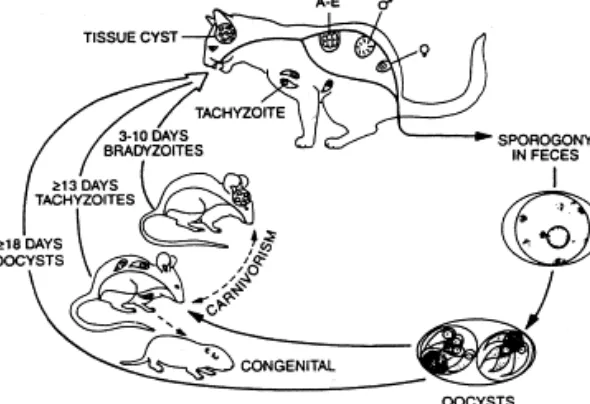
This parasite is famous for its complex life cycle. It moves between the environment, intermediate hosts, and cats. In cats, it produces oocysts that are excreted in the feces. These oocysts can contaminate soil, water, vegetables, cat litter, and outdoor spaces. After 1–5 days in the environment, oocysts become infectious.
In other animals and humans, Toxoplasma gondii usually forms tissue cysts, especially in muscle and nervous tissue. Many infections are mild, but they can be serious for pregnant people, unborn babies, newborns, and people with weakened immune systems.
Q: What is Toxoplasma gondii?
A: Toxoplasma gondii is a protozoan parasite that causes toxoplasmosis and infects many warm-blooded animals.
Q: Why are cats important in the Toxoplasma gondii life cycle?
A: Cats are the only hosts where the parasite completes sexual reproduction and releases oocysts.
Q: Can humans get Toxoplasma gondii from cats?
A: Yes, but usually through accidental contact with contaminated feces, soil, water, or litter—not by simply touching a healthy cat.
Quick Life Cycle Table
| Stage | Where It Happens | Main Form | Key Point |
| 1. Oocyst shedding | Cat intestine | Oocyst | Cats release oocysts in feces |
| 2. Environmental survival | Soil, water, litter | Sporulated oocyst | Becomes infectious after 1–5 days |
| 3. Fast multiplication | Host body cells | Tachyzoite | Spreads quickly during early infection |
| 4. Tissue cyst stage | Muscle, brain, eyes | Bradyzoite | Long-lasting, slow-growing form |
Important Things That You Need To Know
The term Toxoplasma gondii is often used by people searching for Toxoplasma gondii, but scientifically, Toxoplasma gondii is the parasite, and toxoplasmosis is the disease it causes.
The phrase “Toxoplasmosis “usually appears because users combine the parasite name and disease name. The correct term is Toxoplasma gondii infection or toxoplasmosis caused by Toxoplasma gondii.
One of the most searched topics is Toxoplasma gondii in cats because cats are central to the parasite’s life cycle. Cats become infected mainly by eating infected rodents, birds, raw meat, or materials contaminated with oocysts.
Many people also ask how cats get Toxoplasma gondii. The simple answer is: cats usually get it by hunting infected prey or eating raw/undercooked meat that contains bradyzoite tissue cysts. They may also ingest infectious oocysts from contaminated soil, water, or surfaces.
The phrase “Toxoplasma gondii in cats” is important because infected cats may not always appear sick. Many cats shed oocysts for only a short time, typically 1–2 weeks, but during that period, they can release many oocysts into the environment.
The History Of Their Scientific Naming, Evolution, and Origin
Scientific Naming of Toxoplasma gondii
The name Toxoplasma gondii comes from its curved or bow-like shape. “Toxo” refers to arc or bow shape, while “plasma” refers to form. The species name gondii is linked to the rodent-like animal in which the parasite was first described.
Taxonomic Position
Toxoplasma gondii belongs to the group Apicomplexa, a large group of parasitic protozoa. This group includes other medically important parasites that invade host cells.
Evolutionary Origin
The parasite evolved as an intracellular organism, meaning it lives inside host cells. Its success stems from its ability to infect many warm-blooded animals, while reproducing sexually only in cats.
Why Cats Became Central
Felids became the definitive host because the parasite’s sexual reproduction is adapted to the cat intestine. This makes Toxoplasma gondii highly dependent on cat ecology, hunting behavior, and food chains.
Their Reproductive Process, Giving Birth, And Rising Their Children
A Parasite Does Not Give Birth Like Animals
Toxoplasma gondii does not give birth or raise offspring like mammals, birds, or insects. Instead, it reproduces by creating new parasite cells through asexual and sexual stages.
Sexual Reproduction in Cats
Inside the small intestine of cats, the parasite undergoes sexual reproduction. Male-like and female-like stages combine and produce oocysts. These oocysts are shed from the cat’s body in feces.
Asexual Reproduction in Intermediate Hosts
In humans, rodents, birds, livestock, and other warm-blooded animals, the parasite reproduces asexually. The fast-moving form, called a tachyzoite, multiplies inside body cells.
Formation of Long-Term Cysts
After the immune system responds, tachyzoites can transform into bradyzoites. These slow-growing forms remain inside tissue cysts, often in muscle, brain, or eye tissue.
No Parental Care
There is no parental care. The parasite survives through numbers, environmental resistance, and host-to-host transmission.
Stages of Toxoplasma gondii Life Cycle
1. Oocyst Stage
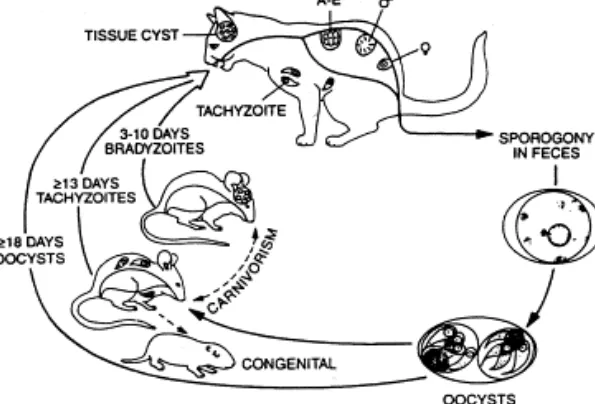
The life cycle begins when infected cats shed oocysts in feces. These oocysts are not always immediately infectious. In the environment, they need time to sporulate.
After about 1–5 days, they become infectious and may contaminate soil, water, vegetables, litter boxes, and outdoor surfaces.
2. Sporozoite Stage
Inside the mature oocyst are sporozoites. When a warm-blooded animal accidentally ingests infectious oocysts, sporozoites are released in the digestive system.
They invade host cells and begin the next phase of infection.
3. Tachyzoite Stage
The tachyzoite is the rapidly multiplying form. It spreads through the host body by invading cells and multiplying inside them.
This stage is important during early infection and can be dangerous if the host is pregnant or immunocompromised.
4. Bradyzoite Tissue Cyst Stage
As the immune system responds, tachyzoites become bradyzoites. These slow-growing forms hide inside tissue cysts.
Cats often become infected when they eat prey animals containing these tissue cysts. This connects hunting, food chains, and the parasite’s life cycle.
Their Main Diet, Food Sources, And Collection Process Explained
Toxoplasma gondii Does Not Eat Like Animals
Toxoplasma gondii does not have a normal diet like insects, mammals, or birds. It is an intracellular parasite, so it gets nutrients from inside host cells.
Nutrient Source
The parasite depends on host-cell materials for energy, growth, and reproduction. It invades cells and uses the host environment to multiply.
How It “Collects” Food
The parasite enters a host cell and forms a protective space around itself. From there, it absorbs nutrients and manipulates the host cell to support survival.
Food Chain Connection
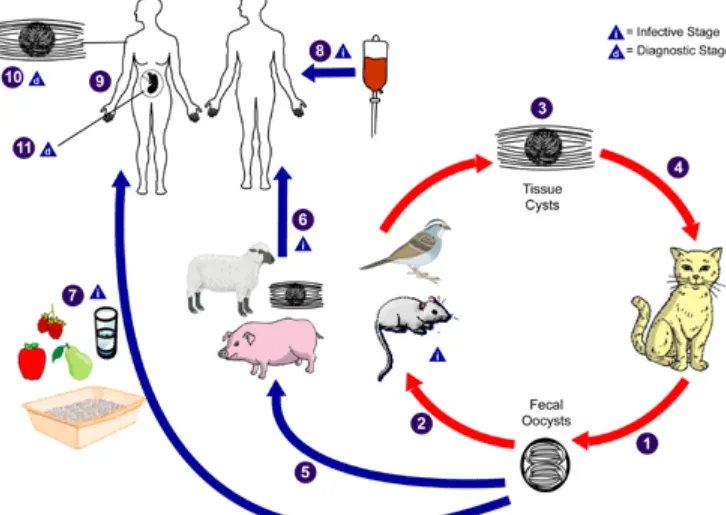
Although the parasite itself does not hunt, it spreads through food chains. Rodents, birds, pigs, sheep, goats, and other animals may carry tissue cysts.
Cats then become infected when they eat infected prey or raw meat. Humans may become infected through undercooked meat, contaminated soil, water, or unwashed produce.
How Long Does A Toxoplasma gondii Live
- Oocysts in the environment: Infectious oocysts can survive for long periods in suitable soil or moist conditions. This makes environmental contamination important.
- Oocyst shedding in cats: Cats usually shed oocysts for a short period, often around 1–2 weeks, but the number released can be very high.
- Tachyzoite stage: Tachyzoites are short-lived, rapidly growing forms. They multiply quickly during active infection but are controlled by the immune system in many hosts.
- Bradyzoite tissue cysts: Bradyzoites can survive for years, sometimes for the lifetime of the host, especially inside muscle and nervous tissue.
- Inside intermediate hosts: In animals and humans, the parasite may remain dormant in tissue cysts for a very long time.
- Inside cats: Cats can host both intestinal and tissue stages. The intestinal stage is key because it produces oocysts.
- In harsh conditions: Heat, drying, and proper cooking can destroy the parasite, but cool, moist environments help oocysts last longer.
- In meat: Tissue cysts may remain viable in raw or undercooked meat. Proper cooking greatly reduces infection risk.
Toxoplasma gondii Lifespan in the Wild vs. in Captivity
In the Wild
In the Wild, Toxoplasma gondii moves through predator-prey relationships. Rodents and birds ingest oocysts from contaminated soil or water. Cats then eat infected prey and continue the life cycle.
Wild environments may allow oocysts to spread widely through soil, rainwater, and animal movement.
In Captivity
In Captivity, such as indoor cats, farms, shelters, or laboratories, transmission depends on hygiene, diet, and exposure. Indoor cats fed cooked or commercial food are less likely to contract infections than outdoor hunting cats.
Key Difference
The parasite survives better when there is contact between cats, contaminated environments, and intermediate hosts. Captivity can reduce transmission when sanitation and food safety are strong.
Importance of Toxoplasma gondii in This Ecosystem
Part of Natural Food Webs
Toxoplasma gondii is part of predator-prey ecology. It moves between cats, rodents, birds, livestock, and other warm-blooded animals.
Indicator of Environmental Contamination
Its presence can show contamination of soil, water, or food sources by cat feces. This makes it important in public health and environmental monitoring.
Impact on Wildlife
The parasite can affect wildlife health, especially animals that are not well adapted to it. Some marine mammals can be exposed when oocysts wash from land into water systems.
Scientific Importance
Toxoplasma gondii is widely studied because it helps scientists understand parasite biology, host immunity, brain infection, pregnancy-related infection, and zoonotic disease transmission.
What To Do To Protect Them In Nature And Save The System For The Future
1. Control Environmental Contamination
- Keep litter boxes clean.
- Dispose of cat feces safely.
- Avoid flushing cat waste into waterways.
2. Support Responsible Cat Care
- Keep cats indoors when possible.
- Feed cats cooked or commercial food.
- Reduce the hunting of rodents and birds.
3. Improve Food Safety
- Cook meat properly.
- Wash vegetables and fruits.
- Avoid untreated water.
4. Protect Wildlife Habitats
- Reduce pollution that carries oocysts into rivers and coastal areas.
- Manage waste near farms and settlements.
5. Increase Public Awareness
- Teach safe litter handling.
- Educate pregnant people and immunocompromised people about prevention.
- Promote balanced information, not fear of cats.
Fun & Interesting Facts About Toxoplasma gondii
- Toxoplasma gondii can infect almost all warm-blooded animals.
- Cats are the only known hosts where the parasite completes sexual reproduction.
- The parasite has three major infectious forms: tachyzoites, bradyzoites, and sporozoites.
- Many infected cats do not show obvious signs.
- Humans usually do not get infected by petting cats.
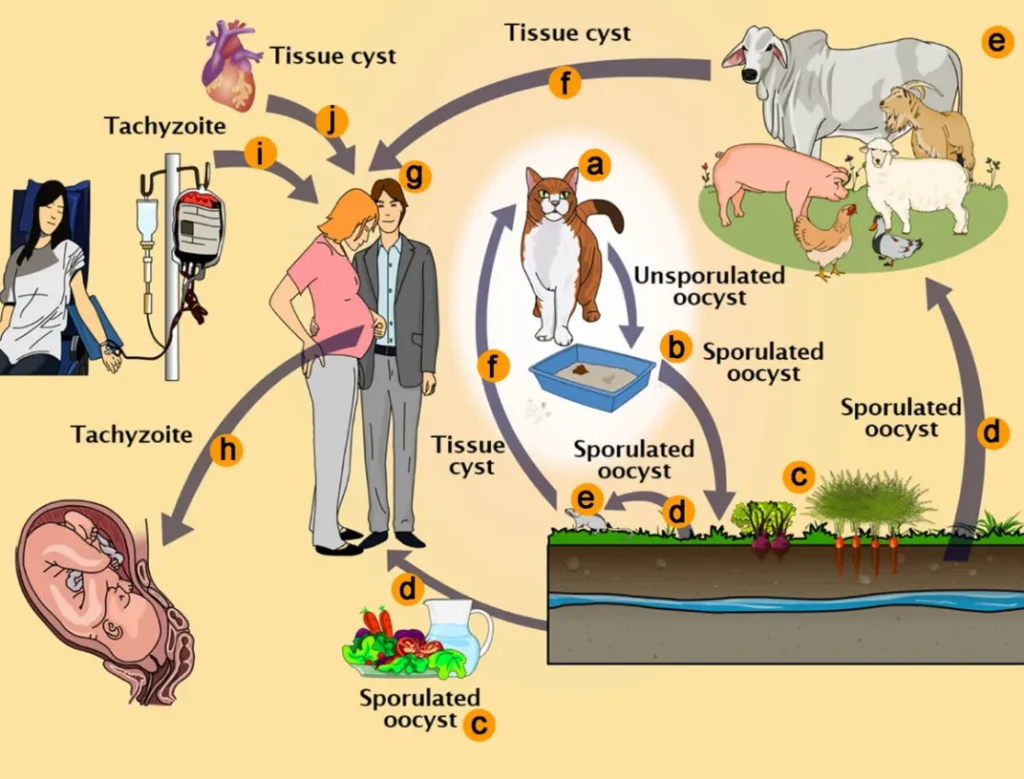
- Soil, water, raw meat, and unwashed produce are important routes of transmission.
- The parasite is one of the most studied protozoan parasites in the world.
- Its tissue cyst stage can remain hidden in the body for a very long time.
- Indoor cats that do not hunt and eat safe food have lower exposure risk.
- Toxoplasma gondii connects microbiology, veterinary science, public health, ecology, and food safety.
Frequently Asked Questions (FAQs)
Q: What is the life cycle of Toxoplasma gondii?
A: The life cycle includes oocysts shed by cats, infectious oocysts in the environment, tachyzoites multiplying in host cells, and bradyzoite tissue cysts in animals or humans.
Q: How do cats get Toxoplasma gondii?
A: Cats usually get infected by eating infected rodents, birds, raw meat, or contaminated material containing sporulated oocysts.
Q: Is Toxoplasma gondii dangerous for humans?
A: It can be mild in healthy people, but it may be serious during pregnancy or in people with weakened immune systems.
Q: Can indoor cats spread Toxoplasma gondii?
A: Indoor cats have a lower risk if they do not hunt and are fed safe food, but litter hygiene is still important.
Q: What is the most infectious stage of Toxoplasma gondii?
A: Infectious stages include sporozoites in sporulated oocysts, bradyzoites in tissue cysts, and tachyzoites during active infection.
Final Word
The life cycle of Toxoplasma gondii is among the most unique in parasite biology. It depends on cats for sexual reproduction, but it can survive in many warm-blooded animals through tissue cysts. Understanding this cycle helps explain why toxoplasmosis gondii in cats, food safety, soil hygiene, and responsible pet care are so important.
This parasite should not create fear of cats. Instead, it teaches the value of clean litter management, safe cooking, clean water, washed produce, and careful care for pregnant or immunocompromised people. With good hygiene and awareness, the risk of Toxoplasma gondii infection can be greatly reduced while keeping the natural balance between animals, humans, and the environment.
Also Read: life cycle of a great white shark
About the Author