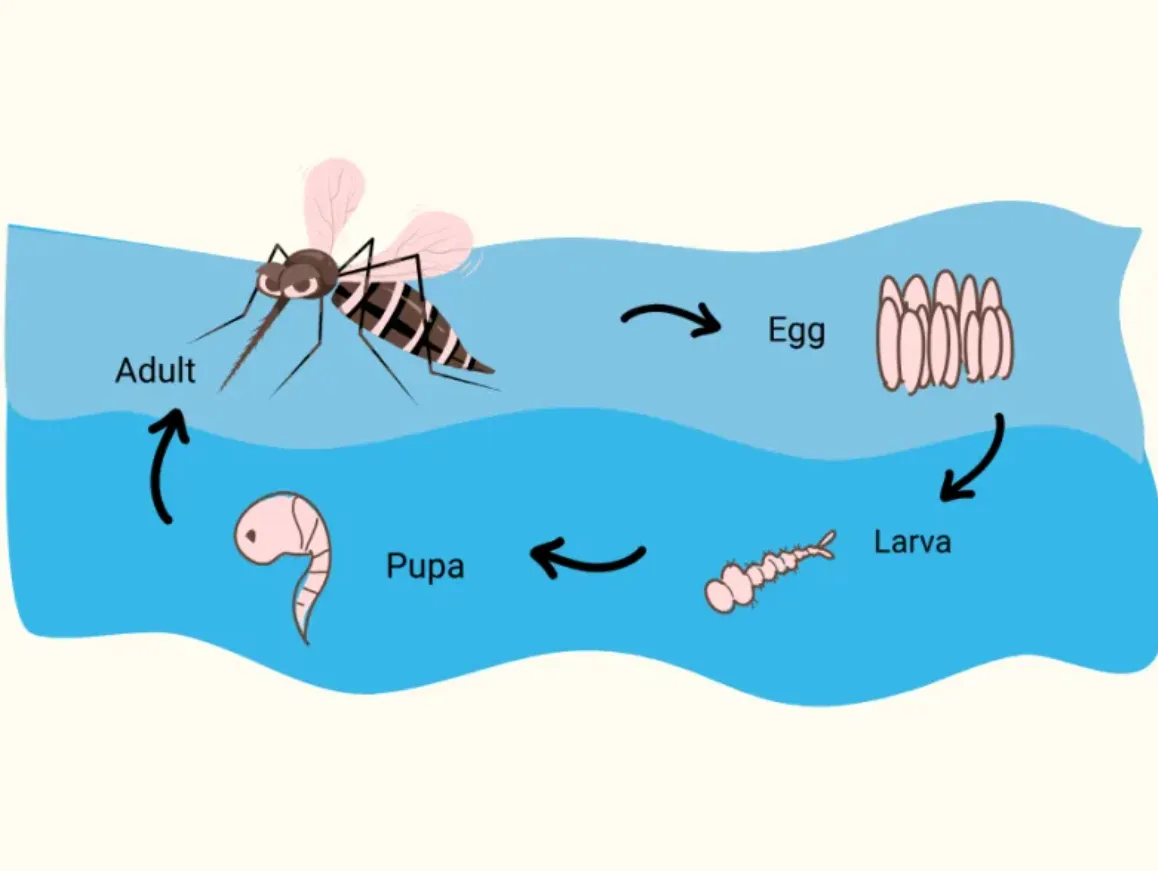
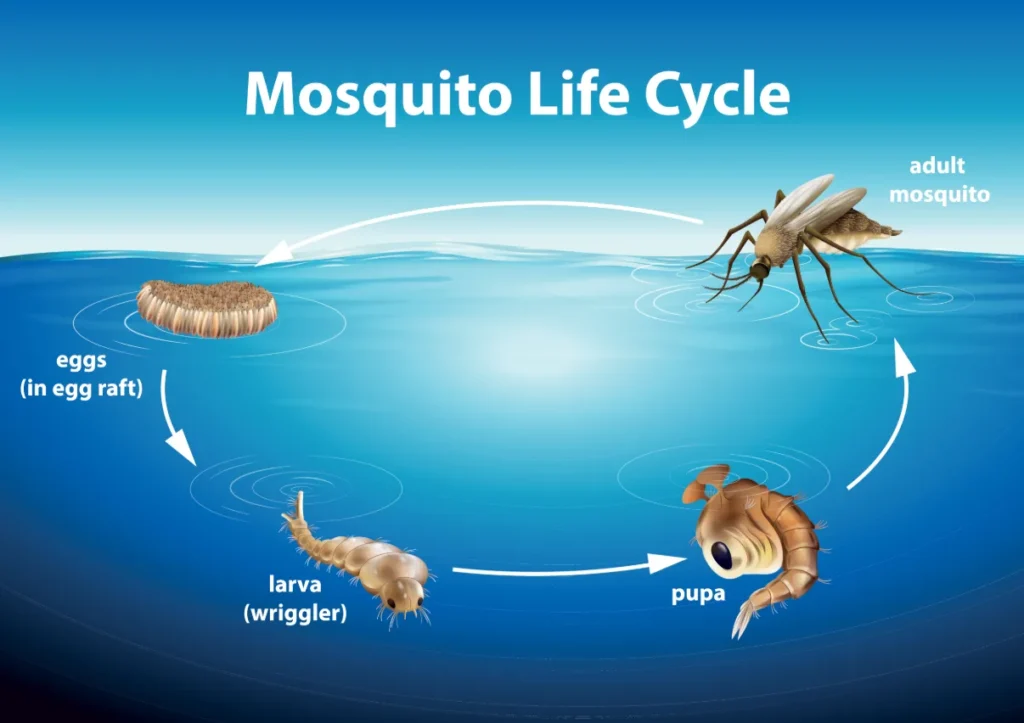
The life cycle of a mosquito is one of the most important topics in insect biology because it explains how a tiny flying insect develops from an egg into an adult mosquito capable of surviving in many environments. A mosquito passes through four main stages: egg, larva, pupa, and adult. Three of these stages are closely associated with water, which is why standing water is the main breeding ground for mosquitoes.
Mosquitoes are not just annoying insects. They are also medically important because some species can spread diseases such as malaria, dengue, Zika, chikungunya, and yellow fever. However, not every mosquito species spreads disease. Only certain species act as major disease vectors.
Understanding the life cycle of mosquitoes helps people control them more safely. Instead of only killing adult mosquitoes, effective mosquito management focuses on removing standing water, controlling mosquito larvae, and using safe prevention methods such as approved repellents or properly used larvicides.
Q1: What are the four stages in the life cycle of a mosquito?
A: The four stages are egg, larva, pupa, and adult.
Q2: Why do mosquitoes need water?
A: Mosquitoes need water because their eggs, larvae, and pupae develop in or near water.
Q3: Do all mosquitoes bite humans?
A: No. Only female mosquitoes bite, and they need blood mainly to produce eggs, while both males and females feed on plant sugars such as nectar.
Quick Life Cycle Table
| Life Cycle Stage | Where It Happens | Main Features | Why It Matters |
| Egg | On water, near water, or inside water-holding containers | Female mosquitoes lay eggs after mating and, in many species, after a blood meal | Removing standing water reduces egg-laying places |
| Larva | Water | Mosquito larvae feed, grow, and molt several times | This is one of the best stages for mosquito control |
| Pupa | Water | Pupae do not feed and prepare to become adults | Adult mosquitoes emerge from this stage |
| Adult | Air, vegetation, homes, and outdoor areas | Adults mate, feed, and reproduce | Female adults may bite humans or animals and may spread disease |
Important Things That You Need To Know
When people search for the life cycle of mosquitoes, they often also search for related terms such as mosquito dunks, mosquito hawk, mosquito control near me, mosquito larvae, and mosquito repellent plants. These terms are closely connected with mosquito biology and control.
Mosquito larvae are the early aquatic stage of the mosquito life cycle. They live in water and are easier to control than flying adults. This is why removing stagnant water from buckets, tires, plant saucers, drains, and containers is one of the most effective mosquito-control steps.
Mosquito dunks usually contain Bacillus thuringiensis israelensis (Bti). This biological larvicide is commonly applied to standing water to kill developing mosquito larvae before they become adult mosquitoes.
The term mosquito hawk is confusing. Many people use it for crane flies, but crane flies are not mosquitoes and are not reliable mosquito predators. Dragonflies, however, can eat mosquitoes and are natural predators in some habitats.
Mosquito control near me is a common search when mosquito numbers become high. A good local mosquito-control service should use Integrated Mosquito Management, which includes surveillance, source reduction, larval control, adult control when necessary, public education, and evaluation.
Mosquito repellent plants such as citronella, lavender, basil, and lemongrass are popular, but simply planting them may not fully protect people from bites. Plant oils may have repellent properties, but proven mosquito repellents are more reliable for personal protection.
The History of Their Scientific Naming
The scientific study of mosquitoes is closely linked to taxonomy, the system used to name and classify living organisms. Mosquitoes belong to the family Culicidae, within the order Diptera, which includes true flies. The family Culicidae is named after the Latin word culex, meaning gnat or mosquito-like fly.
Key points about mosquito scientific naming:
- The common word mosquito comes from Spanish and Portuguese roots, meaning little fly.
- Mosquitoes are placed under the order Diptera, meaning they have one main pair of wings.
- The family Culicidae includes major mosquito groups such as Anopheles, Aedes, and Culex.
- In 1818, the German entomologist Johann Wilhelm Meigen helped develop mosquito classification by establishing important genera such as Anopheles and Aedes.
- Modern mosquito classification is still under study and in flux because scientists use both morphological and molecular evidence to understand relationships among species.
This naming history matters because different mosquito genera exhibit distinct behaviors. For example, Aedes mosquitoes often lay eggs in containers, while Anopheles mosquitoes lay eggs directly on water.
Their Evolution And Their Origin
The evolutionary origin of mosquitoes goes back millions of years. Modern mosquitoes belong to the family Culicidae, a group of small two-winged flies that have become highly adapted to aquatic development and specialized feeding. Fossil and molecular evidence show that mosquitoes are an ancient insect group.
A major fossil study reported the preservation of mosquitoes in Lower Cretaceous amber from Lebanon, dating the definitive occurrence of the mosquito family back to the early Cretaceous. Interestingly, the fossils were male mosquitoes with piercing mouthparts, suggesting that the early evolution of blood-feeding may have been more complex than previously believed.
Today, only female mosquitoes of modern species take blood meals, while males feed on nectar and other sugar sources. This difference shows that mosquito feeding behavior has changed over evolutionary time.
Mosquitoes likely became successful because their life cycle is flexible. Their larvae can develop in ponds, marshes, tree holes, containers, drains, rice fields, and other water-holding habitats. Some species are highly adapted to human environments, especially species that breed in artificial containers.
Their origin also connects with the spread of flowering plants and vertebrate animals. Adult mosquitoes use plant sugars for energy, while females of many species use blood protein for egg production. This combination of plant feeding, aquatic development, and reproductive flexibility helped mosquitoes survive across tropical, temperate, and even colder regions.
Their main food and its collection process
Mosquitoes’ main food depends on their sex and life stage. Adult mosquitoes are often misunderstood because many people think all mosquitoes live only on blood. In reality, both male and female mosquitoes use plant sugars such as nectar, plant sap, and other sweet liquids as their main energy source.
Important feeding points:
- Male mosquitoes do not bite humans or animals. They mainly collect nectar and other plant-based sugars.
- Female mosquitoes also feed on nectar, but many species need a blood meal to develop eggs.
- Blood is not the daily energy food of mosquitoes. It is mainly a protein source for egg production.
- Female mosquitoes locate hosts by detecting signals such as carbon dioxide, body heat, moisture, odor, movement, and visual cues.
- Mosquito larvae feed in water. They consume microorganisms, organic particles, algae, and other small particles found in aquatic habitats.
The food collection process begins differently at each stage. Larvae feed continuously in water to grow quickly. Pupae do not feed because this stage is mainly for transformation. Adults fly to plants for sugar meals, and females search for blood hosts when they need protein for eggs.
This feeding system connects mosquitoes to both water and land. Their larvae process organic matter in aquatic habitats, while adults may visit flowers and become minor pollinators for some plants.
Their life cycle and ability to survive in nature
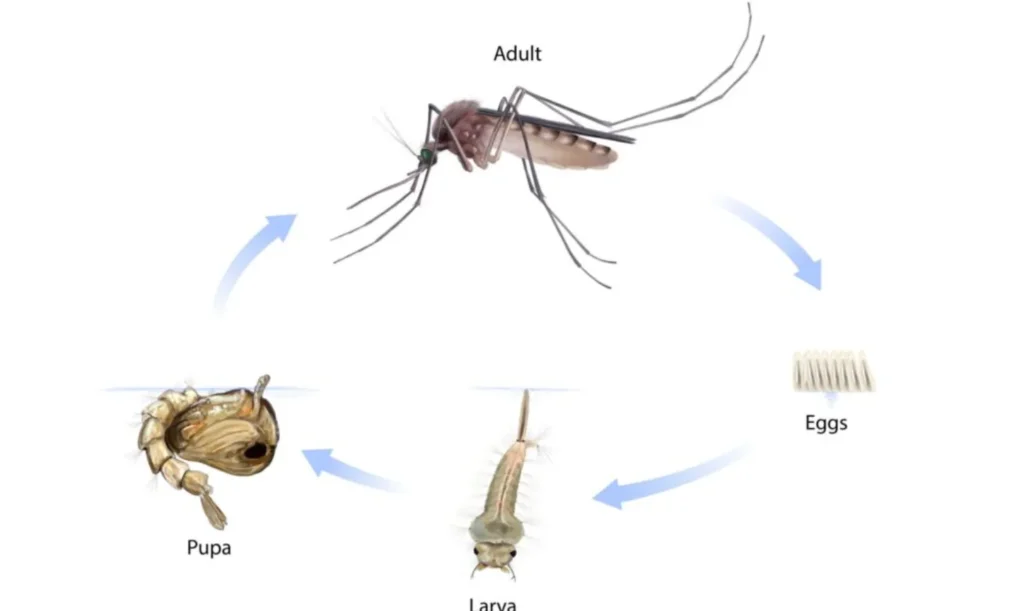
Egg Stage
The egg stage starts when a female mosquito lays eggs in or near water. Different mosquito groups choose different egg-laying places. Aedes mosquitoes often lay eggs on the inner walls of containers that can later fill with water, while Anopheles mosquitoes lay eggs directly on water.
This strategy helps mosquitoes survive dry periods. Some eggs can wait until water becomes available, allowing the life cycle to restart after rain.
Larval Stage
The larval stage is aquatic. Mosquito larvae hatch from eggs and live in water. They feed, grow, and molt several times before becoming pupae. Because larvae are concentrated in water, this is one of the most practical stages for control.
Pupal Stage
The pupal stage is also aquatic, but pupae do not feed. During this stage, the mosquito transforms into an adult. After development is complete, the adult mosquito emerges from the pupa and flies away.
Adult Stage
Adult mosquitoes survive by finding shelter, sugar sources, mates, and suitable breeding sites. Some mosquitoes bite during the day, while others are more active at night. Adult mosquitoes often live for 2 to 4 weeks, depending on temperature, humidity, species, and sex.
Their survival ability comes from fast reproduction, small body size, flexible breeding habitats, and strong host-finding skills.
Their Reproductive Process and raising their children
Mosquito reproduction is simple but highly effective. After emerging as adults, male and female mosquitoes mate. In many species, the female then searches for a blood meal to help her eggs mature.
Key reproductive steps:
- Mating: Adult mosquitoes usually mate soon after emergence.
- Blood meal: Female mosquitoes of many species bite humans, birds, mammals, or other animals to obtain protein for egg development.
- Egg development: After digesting the blood meal, the female develops eggs inside her body.
- Egg laying: The female lays eggs in suitable wet habitats, such as stagnant water, containers, ponds, ditches, marshes, or water-filled natural spaces.
- Repeating the cycle: After laying eggs, a female may seek another blood meal and produce another batch of eggs if she survives.
Mosquitoes do not raise their children like birds or mammals. There is no parental care after eggs are laid. Instead, their reproductive success depends on laying many eggs in places where larvae can survive.
This strategy is common among insects. Rather than protecting a small number of young, mosquitoes produce many offspring and rely on suitable environmental conditions. If water, warmth, food, and shelter are available, the new generation can complete the life cycle quickly.
The importance of them in this Ecosystem
Food Source for Other Animals
Mosquitoes are part of the food web. Fish, tadpoles, aquatic insects, and other small predators eat their larvae. Bats, birds, frogs, spiders, dragonflies, and other insects eat adult mosquitoes.
Role in Pollination
Many adult mosquitoes feed on nectar. While mosquitoes are not the most important pollinators for most crops, some species can help transfer pollen when visiting flowers. This means mosquitoes can play a small but real role in plant reproduction.
Role in Aquatic Nutrient Cycling
Mosquito larvae live in water and feed on microorganisms and organic matter. Through feeding and being eaten, they help move nutrients through aquatic ecosystems. Their bodies become food for larger organisms, linking tiny aquatic life with fish, amphibians, insects, and birds.
Public Health Importance
Mosquitoes are also important because some species transmit pathogens. This makes them one of the most studied insect groups in medical entomology. Understanding their life cycle helps reduce disease risk without destroying entire ecosystems.
A balanced view is important. Mosquitoes have ecological roles, but dangerous mosquito populations around homes and communities must be controlled through science-based methods.
What to do to protect them in nature and save the system for the future
Protecting nature does not mean encouraging mosquito breeding around homes. The goal should be to protect healthy ecosystems while controlling mosquito populations that create public health risks.
- Protect natural wetlands, ponds, and streams from pollution, as these habitats support many species, not just mosquitoes.
- Encourage natural predators such as dragonflies, fish, frogs, birds, and bats by maintaining balanced habitats.
- Avoid unnecessary broad-spectrum pesticide spraying, especially in areas where mosquito numbers do not pose a health risk.
- Use Integrated Mosquito Management instead of random chemical control. This includes surveillance, source reduction, larval control, adult control when necessary, and public education.
- Remove artificial standing water near homes, including buckets, tires, clogged gutters, plant saucers, and unused containers.
- Use Bti mosquito dunks only where water cannot be removed, and always follow the product label.
- Plant diverse native flowers to support pollinators, including insects that use nectar.
- Choose proven mosquito repellents for personal protection rather than relying solely on garden plants.
- Support local mosquito-control programs that use monitoring and evidence-based action rather than unnecessary spraying.
This approach protects biodiversity while reducing the risk of mosquito-borne disease.
Frequently Asked Questions (FAQs)
Q1: What is the life cycle of a mosquito?
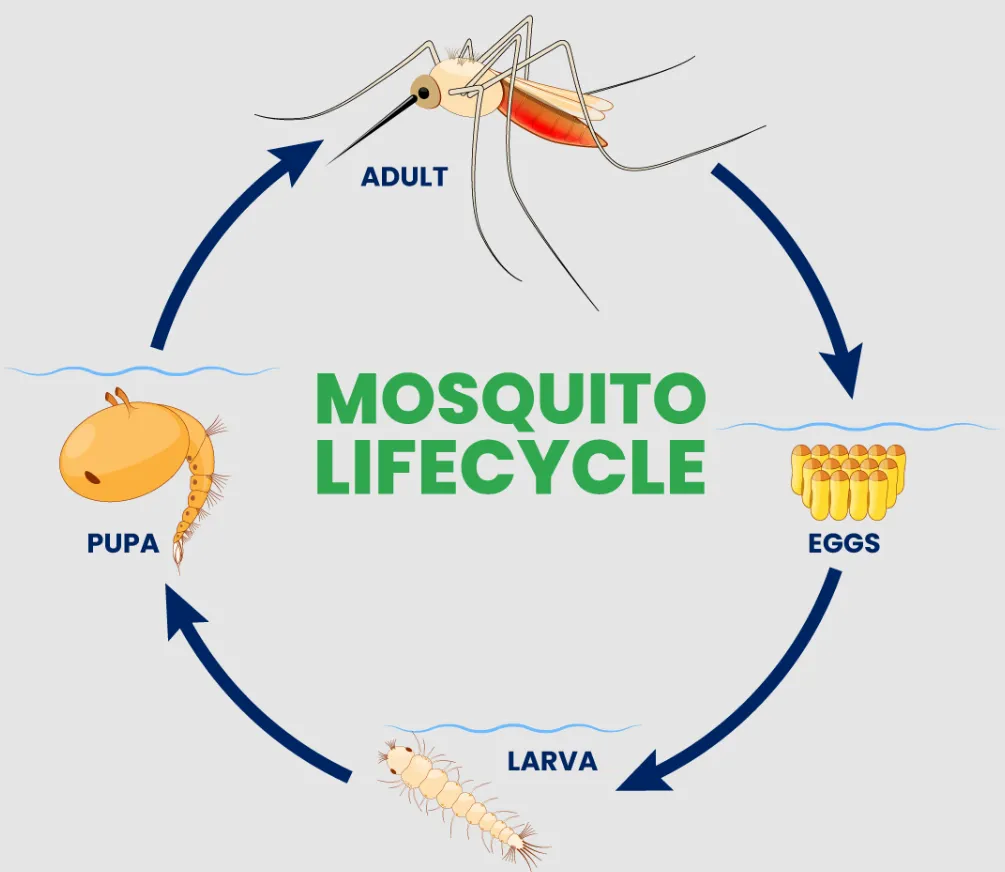
A: The life cycle of a mosquito has four stages: egg, larva, pupa, and adult. The larva and pupa stages occur in water.
Q2: How long does a mosquito take to become an adult?
A: The time depends on species, temperature, and environment. In warm conditions, some mosquitoes can complete development quickly, especially when standing water is available.
Q3: Where do mosquitoes lay eggs?
A: Mosquitoes lay eggs in or near water. Some lay eggs directly on water, while others lay eggs on container walls that later become wet.
Q4: What are mosquito larvae?
A: Mosquito larvae are the early aquatic stage of mosquitoes. They hatch from eggs, live in water, feed, grow, and later become pupae.
Q5: Do male mosquitoes bite?
A: No. Male mosquitoes do not bite. They feed mainly on nectar and other plant sugars. Only female mosquitoes bite, mainly to get protein for egg production.
Q6: Are mosquito dunks useful for mosquito control?
A: Yes. Mosquito dunks commonly use Bti, which targets mosquito larvae in standing water. They should always be used according to label instructions.
Q7: Do mosquito repellent plants really work?
A: Some plant oils can repel mosquitoes for a limited time, but simply planting mosquito repellent plants usually does not provide strong protection. Proven mosquito repellents are more reliable for preventing bites.
Q8: What should I look for when searching for mosquito control near me?
A: Look for services that use Integrated Mosquito Management, including inspection, standing-water removal, larval control, targeted adult control, and follow-up monitoring.
Conclusion
The mosquito’s life cycle is a powerful example of insect adaptation. From egg to larva, pupa, and adult, mosquitoes use water, warmth, plant sugars, and reproductive efficiency to survive in many environments. Their ability to breed in small amounts of standing water makes them difficult to control, but understanding their life cycle gives people a clear advantage.
Mosquitoes also have ecological value. They support food webs, facilitate nutrient movement in aquatic systems, and may help pollinate some plants. At the same time, some species create serious public health risks by spreading diseases.
The best approach is not careless destruction or careless protection. Instead, people should protect healthy ecosystems while reducing dangerous mosquito breeding near homes. Removing standing water, controlling mosquito larvae, using Bti mosquito dunks properly, and choosing proven repellents can help maintain both human safety and environmental balance.
Also Read: life cycle of horned tomato worm
About the Author