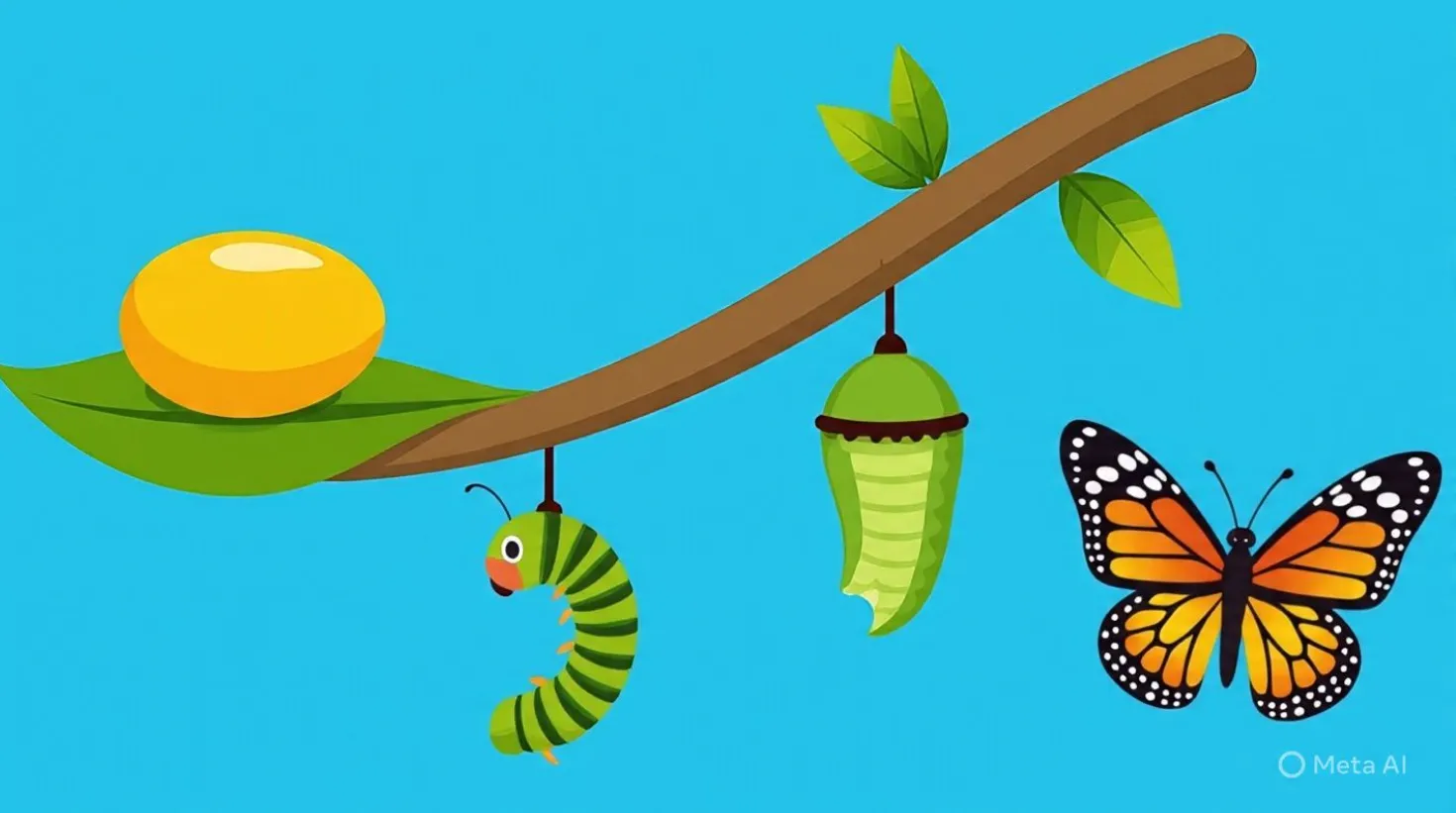
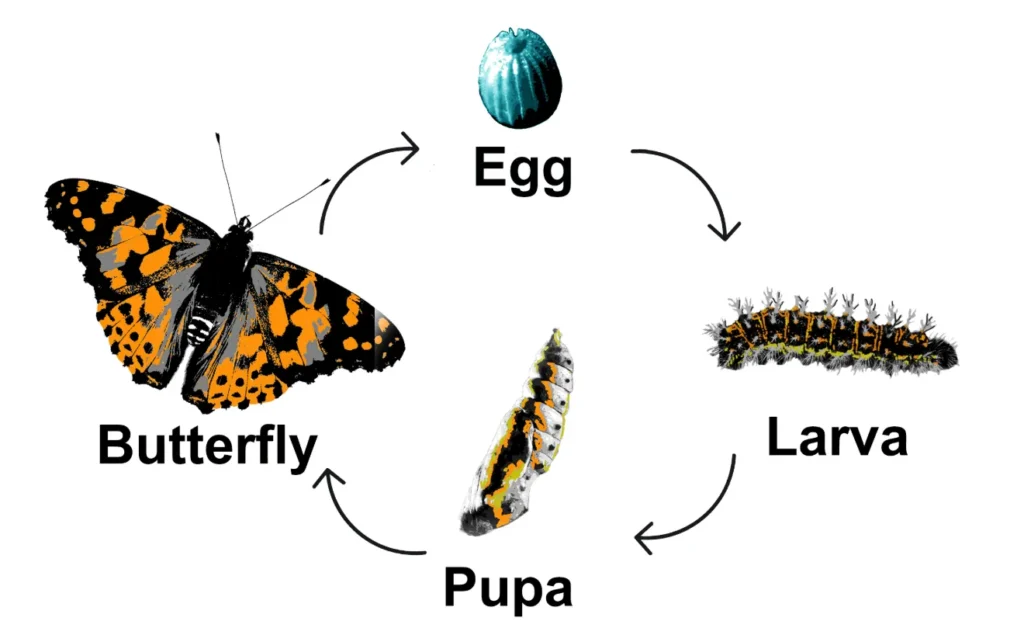
The butterfly’s life cycle is one of the most beautiful examples of complete transformation in nature. A butterfly does not begin life with wings. It starts as a tiny egg, becomes a hungry caterpillar, changes into a chrysalis, and finally emerges as an adult butterfly.
Butterflies belong to the insect order Lepidoptera, the same group that includes moths and skippers. They are known for their colorful, scale-covered wings and their long, coiled feeding tube called a proboscis. There are about 17,500 butterfly species worldwide, and they live in many habitats, including gardens, forests, grasslands, wetlands, farms, and mountain areas.
The life cycle is important because each stage has a different job. The egg protects the new life. The caterpillar eats and grows. The chrysalis is the transformation stage. The adult butterfly focuses on flying, feeding, mating, and laying eggs for the next generation.
Q: What are the four stages of the butterfly’s life cycle?
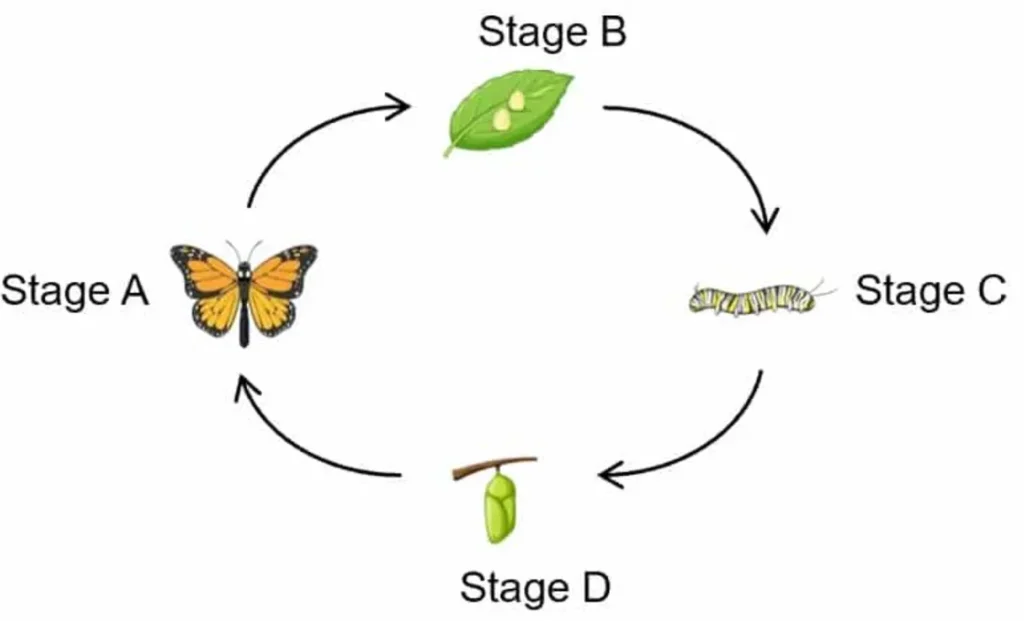
A: The four stages are egg, larva or caterpillar, pupa or chrysalis, and adult butterfly.
Q: How long does the butterfly’s life cycle take?
A: It depends on the species, weather, and food. Some butterflies complete the cycle in a few weeks, while others take months.
Q: What do butterflies eat?
A: Adult butterflies mostly drink flower nectar, but some also feed on tree sap, rotting fruit, minerals from mud, and other liquid nutrients.
Quick Life Cycle Table
| Stage | Simple Name | Main Activity | Common Time Range |
| 1 | Egg | Females lay eggs on host plants | A few days to weeks |
| 2 | Caterpillar | Eats leaves and grows fast | Around 2–5 weeks |
| 3 | Chrysalis | The body changes into a butterfly | Around 1–2 weeks or longer |
| 4 | Adult | Flies feed, mate, and lay eggs | Days, weeks, or months |
Important Things That You Need To Know
The butterfly’s life cycle is closely connected with plants, weather, predators, and habitat quality. Different types of butterflies need different host plants. For example, monarch butterflies need milkweed because their caterpillars feed only on milkweed plants. This is why planting the right host plants is more useful than planting only pretty flowers.
Many people ask, how long do butterflies live? The answer is not the same for every butterfly. Small species may live only a few days as adults. Many adult butterflies live for two to four weeks. Some overwintering species and migratory monarchs can live much longer.
People also ask, what do butterflies eat? Adults usually drink nectar, while caterpillars eat leaves of specific host plants. Some adults also visit mud, fruit, sap, dung, or damp soil to collect salts and minerals.
Another common question is, what do butterflies symbolize? In many cultures, butterflies symbolize change, hope, rebirth, and transformation, especially because they transform from caterpillars into winged adults.
The phrase “In the Time of the Butterflies” is also famous as the title of Julia Alvarez’s historical novel about the Mirabal sisters, known for their courage and resistance in the Dominican Republic.
The History of Their Scientific Naming, Evolution, and Origin
Scientific Naming
Butterflies are insects in the order Lepidoptera. The word Lepidoptera comes from Greek words meaning scale wing, because butterflies and moths have tiny scales on their wings and bodies. These scales help create their colors, patterns, and sometimes camouflage.
Classification
Most true butterflies are grouped under the superfamily Papilionoidea. They are different from many moths because butterflies usually have club-shaped antennae, bright daytime activity, and wings that often rest upright.
Evolution And Origin
Butterflies evolved from moth-like ancestors. Fossil and molecular evidence show that butterfly history goes back millions of years. The oldest known butterfly fossils are from around the Paleocene period, about 55–56 million years ago, while molecular evidence suggests their deeper origin may be older.
Connection With Flowering Plants
Butterflies became successful partly because flowering plants spread widely. Adult butterflies feed from flowers, while caterpillars depend on host plants. This plant-insect relationship shaped their evolution.
Their Reproductive Process, Giving Birth, And Rising Their Children
Mating Process
Butterflies reproduce through mating between a male and a female. Males often search for females by sight, scent, flight pattern, and pheromones. In many species, courtship flights happen before mating.
After mating, the female stores sperm inside her body. The eggs are fertilized before she lays them. This process allows one female butterfly to lay many eggs during her adult life.
Egg-Laying, Not Live Birth
Butterflies do not give birth to live babies. They lay eggs, usually on or near the correct host plant. This is very important because the newly hatched caterpillar cannot travel far to find food. If the egg is laid on the wrong plant, the caterpillar may not survive.
Female monarch butterflies, for example, lay eggs on milkweed because monarch caterpillars depend on milkweed as their food plant. Female monarchs can detect plant chemicals and may use taste receptors on their feet when choosing host plants.
Raising Their Children
Butterflies do not raise their young like birds or mammals. The mother’s main care is choosing the right place to lay eggs. After that, the caterpillar survives by eating, hiding, molting, and avoiding predators.
This may sound simple, but it is a smart survival system. By laying many eggs, butterflies increase the chance that at least some young will survive.
Stages of the Butterfly’s Life Cycle
Stage 1: Egg
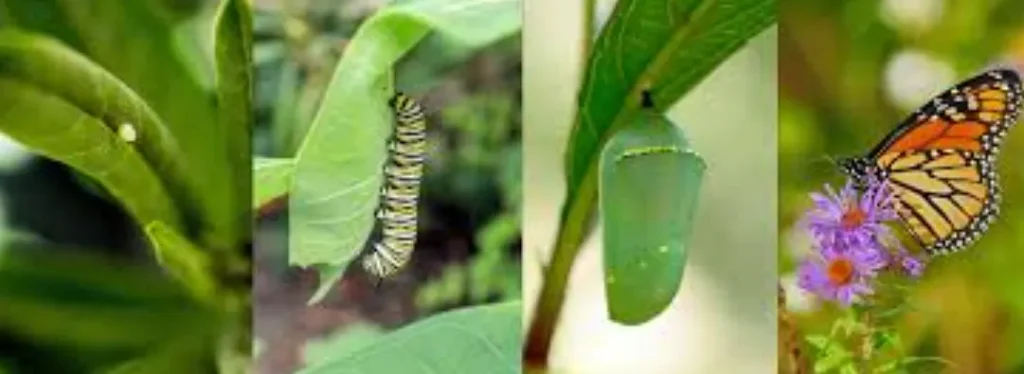
The first stage of the butterfly’s life cycle is the egg. A female butterfly lays eggs on leaves, stems, or other parts of the host plant. Eggs may be round, oval, ribbed, or tiny like dots, depending on the species.
Inside each egg, a young caterpillar begins to develop. When it is ready, it chews its way out. Many caterpillars eat their eggshell first because it gives them extra nutrients.
Stage 2: Caterpillar
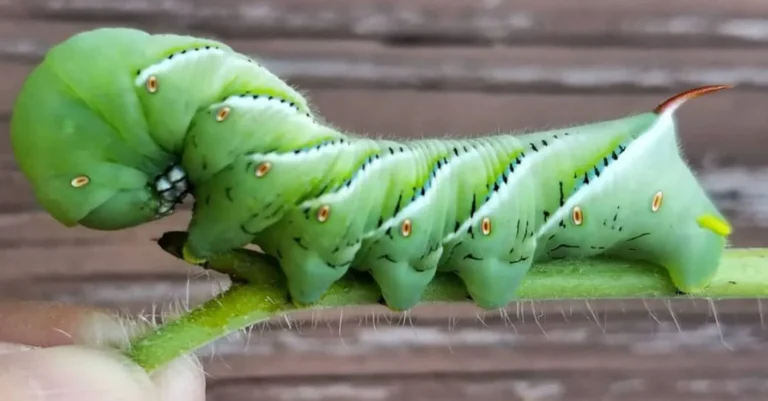
The second stage is the larva, commonly called a caterpillar. This is the main feeding and growing stage. Caterpillars eat leaves almost constantly because they need energy for the next stage.
As the caterpillar grows, its skin becomes too tight. It sheds this outer skin several times. Each growth period between molts is called an instar. Monarch caterpillars, for example, pass through five larval instars.
Stage 3: Chrysalis
The third stage is the pupa, commonly called a chrysalis. This is where the most dramatic change happens. From the outside, the chrysalis may look still, but inside, the caterpillar’s body is being rebuilt into an adult butterfly.
The American Museum of Natural History explains that deep transformation happens inside the chrysalis as the body reorganizes into a new form.
Stage 4: Adult Butterfly
The final stage is the adult butterfly. When it comes out of the chrysalis, its wings are soft and folded. It hangs upside down and pumps fluid into the wings until they expand.
After the wings dry and harden, the butterfly can fly. The adult stage focuses on feeding, finding a mate, and laying eggs to continue the cycle.
Their main diet, food sources, and collection process are explained
The diet of butterflies changes between the caterpillar stage and the adult stage. This is one reason the butterfly’s life cycle is so interesting.
Caterpillars mostly eat solid plant material. Most species need specific host plants. For example, monarch caterpillars eat milkweed, while swallowtail caterpillars may feed on parsley, dill, citrus, or related host plants, depending on the species.
Adult butterflies cannot chew leaves. They drink liquids using their proboscis, which works like a long, flexible straw. Their main food is flower nectar, which provides sugar for energy.
Adult butterflies may also collect nutrients from:
- Flower nectar for energy
- Tree sap for sugars and minerals
- Rotting fruit for liquid nutrients
- Wet mud for salts and minerals
- Animal dung or decaying matter for extra minerals in some species
This mud-feeding behavior is often called puddling. It is common in many male butterflies because minerals such as sodium can support reproduction.
Butterflies find food using color, smell, and taste. Many flowers attract them with bright colors and nectar. When butterflies move from flower to flower, they may also carry pollen, helping some plants reproduce.
How Long Does A Butterfly Live
The lifespan of a butterfly depends on species, climate, season, predators, and life stage. There is no single answer for all butterflies.
- Egg stage: Many butterfly eggs hatch within a few days to a couple of weeks. Warm weather often speeds up development, while cold weather slows it down.
- Caterpillar stage: This stage typically lasts 2–5 weeks, but timing varies by species and temperature. Caterpillars grow quickly because they must store enough energy for metamorphosis.
- Chrysalis stage: Many butterflies stay in the chrysalis for about 1–2 weeks. However, some species remain in the pupal stage much longer, especially if they pause development during cold or dry seasons.
- Adult stage: Many adult butterflies live only one to four weeks. Their main job is to feed, mate, and reproduce. Smaller species may live only a few days as adults.
- Longer-lived species: Some butterflies live longer by overwintering as adults. These butterflies may survive for several months when conditions are suitable.
- Monarch butterflies: Most breeding monarch adults live only a few weeks, but the migratory generation can live much longer. The USDA notes that some migratory monarchs can live up to 9 months, allowing them to travel long distances and overwinter.
- Wild risks: In nature, many butterflies die early due to birds, spiders, wasps, parasites, storms, drought, pesticides, and a lack of food plants.
- Captivity risks: In captivity, butterflies may be protected from predators, but they still need correct temperature, space, humidity, nectar, and host plants. Poor care can shorten their lives.
So, a simple answer is: many butterflies live a few weeks as adults, but their full life cycle may last weeks to months, and some special species or generations live much longer.
Butterflies Life Cycle Lifespan in the Wild vs. in Captivity
Lifespan in the Wild
In the wild, butterflies live naturally but face many dangers. Ants or tiny predators may eat eggs. Birds, wasps, spiders, disease, or bad weather may attack caterpillars. Chrysalises may be damaged by parasites or environmental stress.
Adult butterflies also face wind, rain, cold, predators, habitat loss, and limited nectar. Because of these threats, many wild butterflies do not live as long as their biological potential.
Lifespan in Captivity
In captivity, butterflies may avoid some predators and weather risks. Butterfly houses can provide flowers, fruit, warmth, and humidity. This may help some adults live longer than they would in harsh outdoor conditions.
However, captivity does not always mean a longer life. If the space is too small, the temperature is wrong, or the food is poor, butterflies may become weak.
Main Difference
The wild gives butterflies natural freedom and breeding conditions. Captivity gives protection but needs careful management. For conservation, the best option is usually to protect natural habitats rather than rely solely on butterfly cages.
Importance of the Butterfly Life Cycle in this Ecosystem
Pollination Support
Butterflies help pollinate some flowering plants when they move from flower to flower. They may not carry as much pollen as bees, but they can travel longer distances and support plant diversity.
Food Chain Role
Butterflies are food for many animals. Birds, spiders, reptiles, frogs, ants, wasps, and other insects eat eggs, caterpillars, chrysalises, and adults. This makes them an important part of the food web.
Plant Population Balance
Caterpillars eat leaves, which may sound harmful, but it is part of the natural balance. Healthy ecosystems can support both plants and caterpillars. This feeding relationship also supports predators that depend on caterpillars.
Environmental Indicators
Butterflies are sensitive to habitat loss, pesticides, temperature changes, and plant availability. When butterfly populations decline, it can show that the local environment is under stress.
Biodiversity Value
Different types of butterflies depend on different plants and habitats. Protecting them means protecting flowers, grasses, forests, wetlands, and many other small organisms that share the same ecosystem.
What to do to protect them in nature and save the system for the future
Plant Native Host Plants
- Grow native plants that caterpillars can eat.
- For monarch butterflies, plant native milkweed where it is suitable.
- Add different host plants for different butterfly species.
Grow Nectar Flowers
- Plant flowers that bloom in different seasons.
- Choose pesticide-free flowers.
- Use local plants because native butterflies often recognize them better.
Avoid Harmful Pesticides
- Reduce the use of chemical insecticides in gardens, farms, and parks.
- Even small pesticide exposure can harm eggs, caterpillars, and adults.
- Use natural pest control whenever possible.
Protect Natural Habitats
- Save grasslands, forests, wetlands, and wildflower areas.
- Do not remove every “wild” plant, because many caterpillars need them.
- Leave some leaf litter and safe corners for insects.
Support Butterfly-Friendly Communities
- Create butterfly gardens in schools, homes, and public spaces.
- Teach people why the butterfly’s life cycle matters.
- Report local butterfly sightings to citizen science projects when possible.
Fun & Interesting Facts About Butterflies’ Life Cycle
- Butterflies taste with their feet, which helps females choose the right plant for laying eggs.
- The caterpillar stage is mostly about eating and growing, not flying or mating.
- A butterfly’s wings are covered with tiny scales, which create colors and patterns.
- The chrysalis is not a sleeping stage. Big body changes happen inside it.
- Some butterflies can migrate long distances. Monarch butterflies are famous for their long migration.
- Many butterflies drink from mud to collect minerals. This is called puddling.
- Butterflies cannot chew food as adults. They drink liquid food with their proboscis.
- Some butterflies use camouflage. Their wings may look like leaves, bark, or eyespots.
- Caterpillars shed their skin several times because their bodies grow faster than their outer covering.
- Butterflies symbolize hope, change, and transformation in many cultures.
Frequently Asked Questions (FAQs)
Q: What is the butterfly’s life cycle?
A: The butterfly’s life cycle is the complete development process from egg to caterpillar, then chrysalis, and finally adult butterfly.
Q: How many stages are in the butterfly’s life cycle?
A: There are four main stages: egg, larva, pupa, and adult. This is called complete metamorphosis.
Q: How long do butterflies live?
A: Many adult butterflies live for only a few weeks. Some species live longer, and migratory monarchs may live for several months.
Q: What do butterflies eat during their life cycle?
A: Caterpillars eat leaves from host plants. Adult butterflies mostly drink nectar, but some also feed on sap, fruit juice, mud minerals, or other liquid nutrients.
Q: Why are monarch butterflies special?
A: Monarch butterflies are special because their caterpillars depend on milkweed, and some monarch generations migrate thousands of miles and live much longer than normal breeding generations.
Conclusion
The butterfly’s life cycle is more than a simple natural process. It is a powerful story of growth, survival, and transformation. From a tiny egg to a leaf-eating caterpillar, then to a quiet chrysalis, and finally to a flying adult butterfly, every stage has a clear purpose.
Butterflies support ecosystems through pollination, food chains, and plant relationships. They also help people understand the state of the natural world. When butterflies disappear, it often means plants, soil, water, and habitats are also under pressure.
To protect butterflies, we must protect their full life cycle. That means planting host plants, growing nectar flowers, avoiding harmful pesticides, and saving natural habitats. If we care for butterflies today, we also protect the wider system that supports birds, plants, insects, and future generations.
Also Read: blowfly life cycle
About the Author