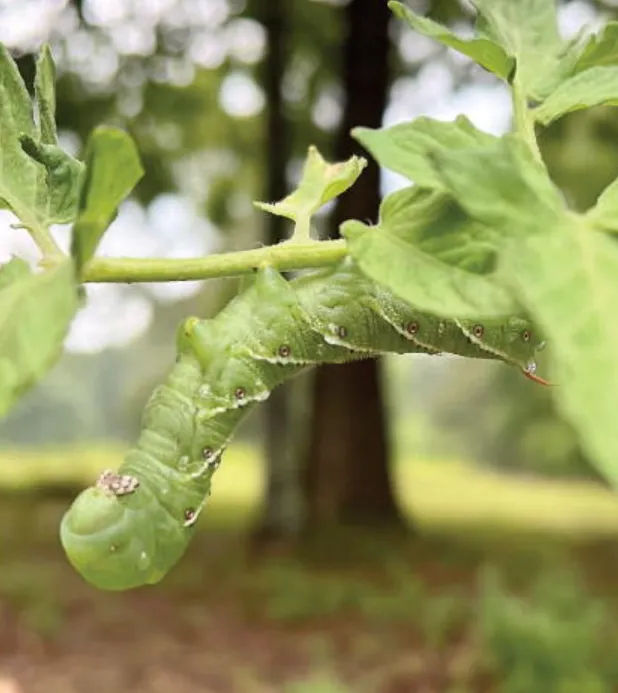
The life cycle of the tomato hornworm is one of the most interesting insect transformations found in vegetable gardens. The creature that many gardeners notice as a large green worm on tomato plants is actually the larval stage of the five-spotted hawkmoth, scientifically known as Manduca quinquemaculata. Although it is often called a “worm,” it is not a true worm. It is a caterpillar that later becomes a strong-flying night moth.
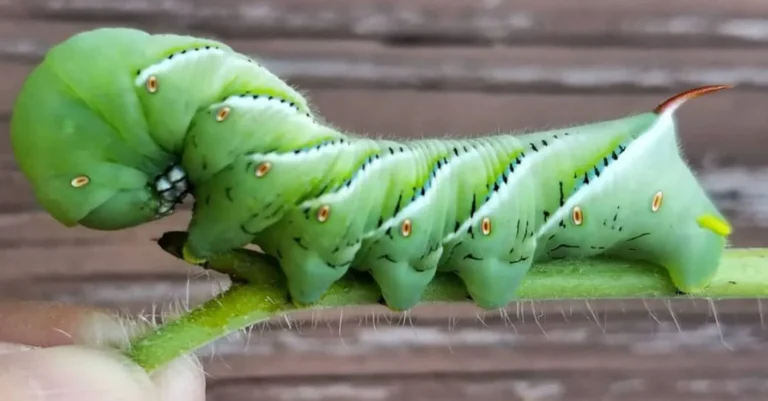
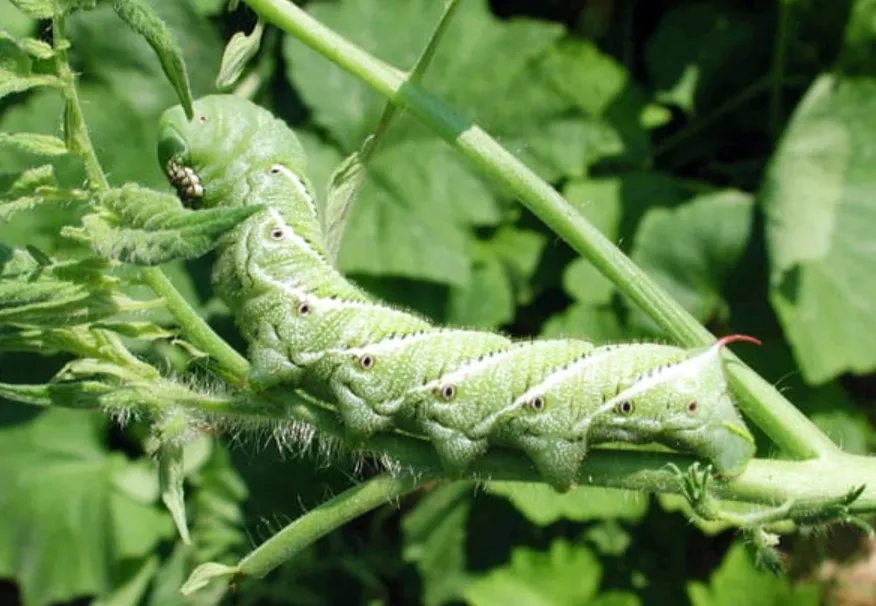
The tomato hornworm is famous for its green body, white V-shaped markings, and dark, horn-like tail. It feeds mainly on tomato plants but can also attack potato, eggplant, pepper, tobacco, and related nightshade plants. Because it blends with leaves, gardeners often notice the damage before they see the caterpillar. Missing leaves, chewed stems, green fruit scars, and dark droppings are common signs.
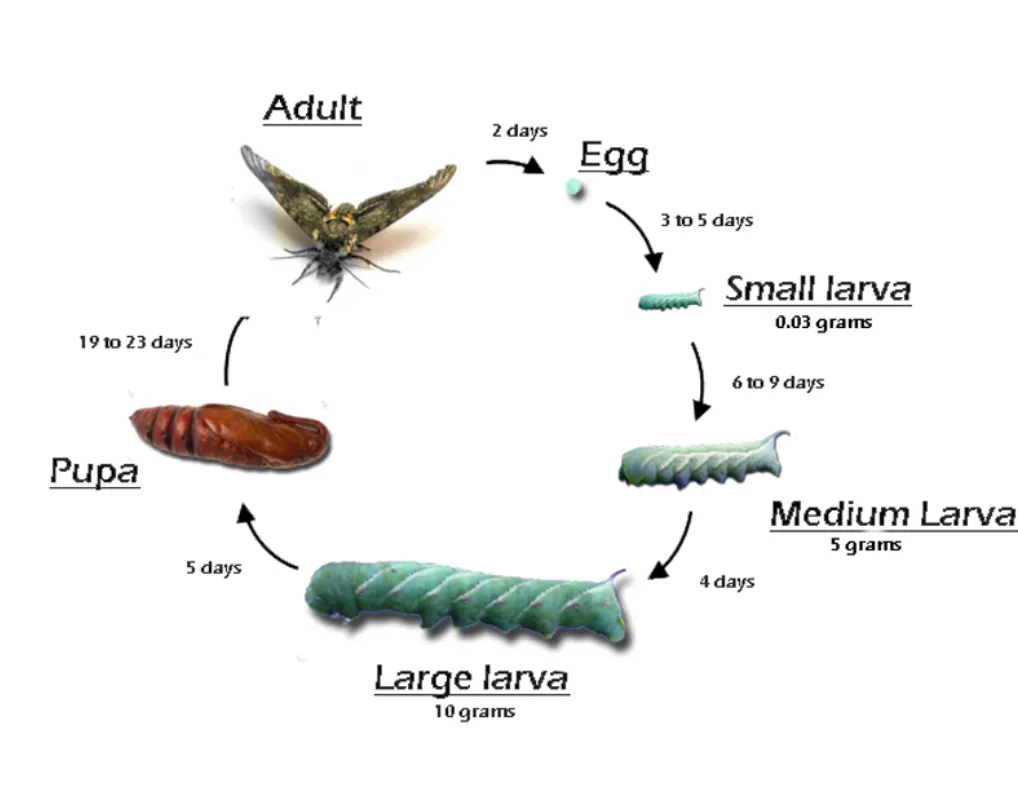
Understanding the tomato hornworm life cycle helps gardeners control plant damage naturally while also respecting its role in nature as part of the food web and pollination system.
Q: What does a tomato hornworm turn into?
A: A tomato hornworm turns into the five-spotted hawkmoth, a large moth also called a sphinx or hummingbird moth.
Q: How long does the tomato hornworm’s life cycle take?
A: The caterpillar stage usually lasts about three to four weeks before it drops into the soil and pupates. In warm seasons, more than one generation can occur.
Q: Are tomato hornworms harmful to tomato plants?
A: Yes, the larval stage can quickly remove tomato leaves and may also feed on green fruit, especially when the caterpillar becomes large.
Quick Life Cycle Table
| Stage | What Happens | Key Identification | Main Activity | Garden Impact |
| Egg | A female moth lays single eggs on host plant leaves | Small, smooth, pale green to yellow-green eggs | Development begins on tomato or other nightshade leaves | Usually hard to notice |
| Young Larva | Tiny caterpillar hatches and starts feeding | Small green body with a tiny horn | Eats leaf tissue near the egg site | Minor early chewing |
| Growing Larva | A caterpillar passes through several growth stages | Green body, white V-shaped marks, dark horn | Feeds heavily on foliage | Visible leaf loss begins |
| Mature Larva | Large caterpillar reaches full size | Thick green body, strong camouflage, visible droppings | Eats many leaves and may scar fruit | Highest plant damage |
| Pupa | Caterpillar drops to the soil and transforms underground | Reddish-brown pupa with a curved mouthpart case | Metamorphosis into an adult moth | Hidden below the soil |
| Adult Moth | Five-spotted hawkmoth emerges | Large gray-brown moth with five yellow-orange side spots | Mates, feeds on nectar, lays eggs | Pollination role and the new generation |
The History of Their Scientific Naming
The scientific name of the tomato hornworm is Manduca quinquemaculata. The species belongs to the family Sphingidae, a group known as sphinx moths, hawkmoths, or hummingbird moths. Taxonomic records classify it under Animalia, Arthropoda, Insecta, Lepidoptera, Sphingidae, and Manduca.
Important naming points:
- The word Manduca is connected with chewing or eating, which fits the heavy-feeding larval stage.
- The species name quinquemaculata means “five-spotted,” matching the adult moth’s five pairs of yellow-orange markings along the abdomen.
- The adult form is commonly called the five-spotted hawkmoth.
- The caterpillar form is commonly called the tomato hornworm.
- It is often confused with the tobacco hornworm, Manduca sexta, because both feed on plants in the nightshade family and look similar.
This naming history is important because the same insect has different common names depending on its life stage.
Their Evolution And Their Origin
The tomato hornworm belongs to the order Lepidoptera, which includes moths and butterflies. Its family, Sphingidae, is known for strong flight, long mouthparts, and close relationships with flowering plants. Adult sphinx moths often hover near flowers like hummingbirds while drinking nectar with a long proboscis.
The species Manduca quinquemaculata is native to North America and is widely associated with plants in the Solanaceae family. This plant family includes tomato, tobacco, eggplant, pepper, potato, nightshade, jimsonweed, and horsenettle. The insect’s evolution is closely tied to these host plants because the female moth lays eggs on leaves where the young caterpillars can immediately begin feeding.
The green body of the caterpillar is a strong survival adaptation. It blends with tomato leaves, allowing the larva to hide from birds, wasps, and other predators. Its horn-like tail may also help confuse predators, although it is not dangerous to humans.
Another evolutionary strength is complete metamorphosis. The insect develops through egg, larva, pupa, and adult stages. Each stage has a different job. The larva focuses on eating and growing. The pupa transforms underground. The adult moth flies, mates, feeds on nectar, and starts the next generation.
This division of life stages helps the tomato hornworm moth survive in changing garden and natural environments.
Important Things That You Need To Know
Many people search for tomato hornworm, tomato hornworm moth, tomato hornworm life cycle, tomato hornworm eggs, and tomato hornworm damage because this insect is both a garden pest and a natural pollinator. The most important point is that the “worm” stage and the moth stage are the same animal at different times.
The tomato hornworm moth is not a butterfly. It is a moth called the five-spotted hawkmoth. Some people search for “tomato hornworm butterfly,” but scientifically, that phrase is incorrect. The adult has a heavy body, narrow wings, and usually flies near dusk or at night.
The tomato hornworm eggs are small and usually found singly on leaf surfaces. After hatching, the caterpillar feeds on leaves and grows quickly. Large larvae can be difficult to see because their green bodies blend into the plant. Gardeners often find tomato hornworm poop, called frass, before finding the caterpillar itself. This frass may appear as dark green or black pellets on leaves or in the soil beneath damaged areas.
The most serious tomato hornworm damage occurs during the later larval stages. A large caterpillar can remove several leaves, expose fruit to sunscald, and chew green tomatoes. However, adult moths also support ecosystems by visiting flowers and pollinating.
So, the goal is not always destruction. In home gardens, balanced management is better: protect tomato plants, remove damaging larvae, and preserve beneficial insects.
Their main food and its collection process
The main food of the tomato hornworm is leaf tissue from plants in the nightshade family. The caterpillar stage is the only stage that damages tomato plants. The adult moth does not chew leaves; it drinks nectar from flowers.
Main food sources:
- Tomato leaves are the preferred garden food and are often where damage is first noticed.
- Tomato stems and tender shoots may be stripped when larvae become large.
- Green tomato fruit may be chewed if leaf supply becomes limited or larvae are heavy feeders.
- Potatoes, eggplants, peppers, and tobacco can also serve as host crops.
- Nightshade weeds, jimsonweed, and horsenettle may support the insect outside cultivated gardens.
Food collection process:
- The female moth first selects a suitable host plant and lays eggs on the leaves.
- When the egg hatches, the young larva begins feeding near the hatching site.
- As it grows, it eats more leaf tissue and may move across the same plant.
- The caterpillar usually feeds quietly and blends with the foliage.
- Feeding may be more noticeable in the morning or evening because hornworms avoid strong sunlight.
- The mature larva eats the most and causes the greatest plant loss.
This food collection process is simple but powerful. The caterpillar does not store food like ants or bees. Instead, it converts fresh leaf tissue into body mass very quickly before entering the pupal stage.
Their life cycle and ability to survive in nature
Egg Stage
The tomato hornworm life cycle begins when the adult female moth lays smooth, pale green eggs on tomato or other host leaves. Eggs are usually placed singly, often on the upper or lower leaf surface.
This gives the young caterpillar immediate access to food after hatching.
Larval Stage
The larva is the familiar green tomato hornworm. It passes through several growth stages called instars. During this time, it feeds heavily and grows fast.
The body is green with white V-shaped side marks and a dark horn at the rear. This camouflage helps it survive among tomato leaves.
Pupal Stage
When fully grown, the caterpillar drops from the plant and burrows into the soil. There, it forms a reddish-brown pupa and begins metamorphosis underground.
This soil stage protects it from the weather and many predators.
Adult Moth Stage
The adult emerges as the five-spotted hawkmoth. It flies strongly, feeds on nectar, mates, and lays eggs. In some regions, a second generation can occur in the same growing season.
Its survival depends on camouflage, fast growth, underground pupation, and suitable host plants.
Their Reproductive Process and raising their children
The tomato hornworm does not raise its young the way birds or mammals do. Instead, the female moth supports the next generation by choosing the right host plant for egg laying. This is a common reproductive strategy among moths.
Key reproductive points:
- The adult tomato hornworm moth emerges from the soil after completing the pupal stage.
- Male and female moths mate after emergence.
- The female searches for suitable host plants, especially tomato and other nightshade plants.
- Eggs are laid singly on leaf surfaces, giving each young larva access to food.
- A female moth may lay many eggs during her adult life, depending on conditions and survival.
- The parent moth does not guard the eggs after laying them.
- Once the egg hatches, the larva feeds independently.
- The caterpillar grows through several instars before dropping into the soil to pupate.
This reproductive process is efficient because the young caterpillar does not need parental care. Its food is already present on the host plant. The female’s most important “parenting” action is selecting the correct plant.
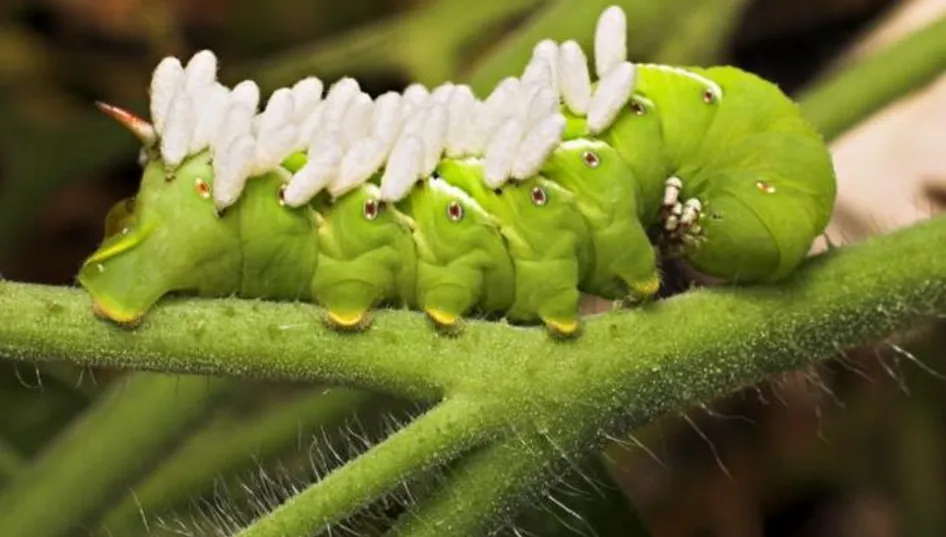
Natural enemies also affect reproduction. Lady beetles, lacewings, paper wasps, and parasitic wasps can reduce egg and larval survival. Braconid wasps are especially important because they develop inside hornworm caterpillars and later form white cocoons on the outside of the body. Gardeners are often advised to leave parasitized hornworms in place so beneficial wasps can continue their life cycle.
The importance of them in this Ecosystem
Food Web Support
The tomato hornworm is an important food source for birds, predatory insects, wasps, and other small animals. Although gardeners often see it only as a pest, it helps move energy from plants into the wider food web.
Beneficial insects may eat young larvae and eggs. Birds or parasitic wasps may attack larger caterpillars.
Pollination Role
The adult five-spotted hawkmoth feeds on flower nectar. Like other sphinx moths, it can visit flowers around dusk and at night. This makes it part of the pollination system, especially for night-blooming or strongly scented flowers.
This means the insect has two different ecological identities. The larva is a leaf-feeding herbivore, while the adult can support flowering plants.
Natural Balance
Hornworms also help maintain natural predator populations. When hornworms are present, beneficial insects such as braconid wasps and paper wasps have prey available.
In a balanced garden, not every hornworm needs to be destroyed. Heavy infestations should be controlled, but a few individuals can support biodiversity.
Soil Connection
The pupal stage takes place underground. This connects the insect’s life cycle to soil health, seasonal change, and garden cleanup practices.
Healthy soil systems are not empty spaces. They contain insects, pupae, microbes, roots, and organic matter that all interact.
What to do to protect them in nature and save the system for the future
The goal is to protect the ecosystem while preventing severe damage from tomato hornworms. A balanced approach works better than unnecessary chemical use.
- Check tomato plants at least twice a week during the growing season, especially in summer.
- Look for missing leaves, chewed stems, green fruit scars, and dark tomato hornworm poop or frass.
- Handpick large caterpillars from tomato plants when plant damage becomes serious.
- Move a few hornworms to a sacrificial tomato plant if you want to protect pollinators while saving your main crop.
- Do not kill hornworms covered with white rice-like cocoons. These are usually parasitic wasp cocoons, and the wasps help control future hornworms.
- Grow a diverse garden with flowers that support adult moths, bees, and beneficial insects.
- Remove nightshade weeds near vegetable beds if hornworm pressure is high.
- Rotate crops whenever possible to reduce pest buildup in the same area.
- Till or disturb the soil after harvest only when hornworm populations are severe, because pupae may overwinter underground.
- Use Bacillus thuringiensis (Bt) only on young caterpillars when needed, and always follow label directions.
- Avoid broad-spectrum pesticides because they can kill beneficial insects that naturally control hornworms.
- Teach children and new gardeners that the adult is a moth, not a butterfly, and that every stage of its life has a purpose in nature.
Frequently Asked Questions (FAQs)
Q: What is the life cycle of the tomato hornworm?
A: The life cycle of the tomato hornworm includes egg, larva, pupa, and adult moth. The egg hatches into a green caterpillar, which feeds on tomato leaves, then drops into the soil to pupate. Finally, it emerges as the five-spotted hawkmoth.
Q: What does a tomato hornworm moth look like?
A: The tomato hornworm moth is a large gray-brown moth with narrow wings and yellow-orange spots along the sides of its abdomen. It is also called a sphinx moth, hawkmoth, or hummingbird moth.
Q: Is the tomato hornworm butterfly a correct name?
A: No. “Tomato hornworm butterfly” is a common search phrase, but it is not scientifically correct. The adult stage is a moth, not a butterfly.
Q: Where are tomato hornworm eggs found?
A: Tomato hornworm eggs are usually found singly on the upper or lower surfaces of leaves. They are small, smooth, and pale green to yellow-green in colour.
Q: What does tomato hornworm damage look like?
A: Tomato hornworm damage includes missing leaves, stripped stems, chewed green tomatoes, and visible droppings. Large larvae can quickly remove many leaves.
Q: What is tomato hornworm poop called?
A: Tomato hornworm poop is called frass. It often appears as dark green or black pellets on leaves, stems, or the ground below the feeding area.
Q: Should I kill tomato hornworms?
A: If they are heavily damaging your tomato plants, handpicking is a practical control method. However, if a hornworm has white wasp cocoons on its body, leave it in the garden so beneficial wasps can emerge.
Q: Are tomato hornworms dangerous to humans?
A: No. Tomato hornworms are not dangerous to humans. The horn at the rear is not a stinger. They may look alarming, but they do not bite or sting people.
Conclusion
The life cycle of the tomato hornworm shows how one insect can be both a garden pest and an important part of nature. As a caterpillar, it can damage tomato plants by eating leaves, stems, and sometimes green fruit. As an adult, the five-spotted hawkmoth becomes a nectar-feeding moth that supports pollination and biodiversity.
For gardeners, the best solution is balance. Regular plant inspections, handpicking, weed control, and protection of beneficial insects can reduce tomato hornworm damage without harming the wider ecosystem. Understanding tomato hornworm eggs, frass, feeding habits, pupation, and moth development makes management easier and more natural.
Instead of seeing this insect only as a problem, it is better to understand its complete role. The tomato hornworm life cycle reminds us that every stage of life serves a function in the garden, the soil, and the ecosystem.
Also Read: life cycle of malarial parasite plasmodium
About the Author