The life cycle of Toxoplasma gondii is one of the most important topics in parasitology because it connects animals, humans, soil, food, and the natural environment. The correct scientific name of the parasite is Toxoplasma gondii, and the disease it causes is toxoplasmosis. Many people search for “Toxoplasma gondii,” but the organism is scientifically called Toxoplasma gondii.
This parasite can infect many warm-blooded animals, including humans, cats, birds, rodents, sheep, goats, pigs, and wild mammals. However, cats are the most important host in the complete life cycle because the sexual reproductive stage occurs only inside cats and other members of the cat family.
The parasite survives in different forms, mainly oocysts, tachyzoites, and bradyzoites. These stages help it spread, multiply, and remain hidden inside host tissues for a long time.
Q: What is Toxoplasma gondii?
A: Toxoplasma gondii is a microscopic single-celled parasite that causes the disease known as toxoplasmosis.
Q: How do cats get Toxoplasma gondii?
A: Cats usually become infected by eating infected rodents, birds, or raw meat that contains tissue cysts.
Q: What are common Toxoplasma gondii symptoms?
A: Many infected humans and cats show no symptoms, but possible signs include fever, weakness, swollen lymph nodes, appetite loss, eye inflammation, and neurological problems in severe cases.
Quick Life Cycle Table
| Stage | Where It Happens | What Happens | Why It Matters |
| Oocyst stage | Cat intestine and environment | Cats shed oocysts in faeces. These oocysts later become infective in the environment. | This stage helps the parasite spread through soil, water, plants, and litter. |
| Sporozoite stage | Inside mature oocysts | Infective oocysts contain sporozoites that enter a new host after ingestion. | This allows infection of birds, rodents, livestock, humans, and cats. |
| Tachyzoite stage | Host body tissues | Fast-growing forms multiply quickly and spread through the body. | This stage is linked with active infection and disease symptoms. |
| Bradyzoite stage | Muscle and nervous tissue | Slow-growing forms stay inside tissue cysts. | This allows long-term survival inside intermediate hosts. |
| Sexual reproduction stage | Cat intestine | The parasite produces new oocysts inside cats. | This makes cats essential to the complete life cycle. |
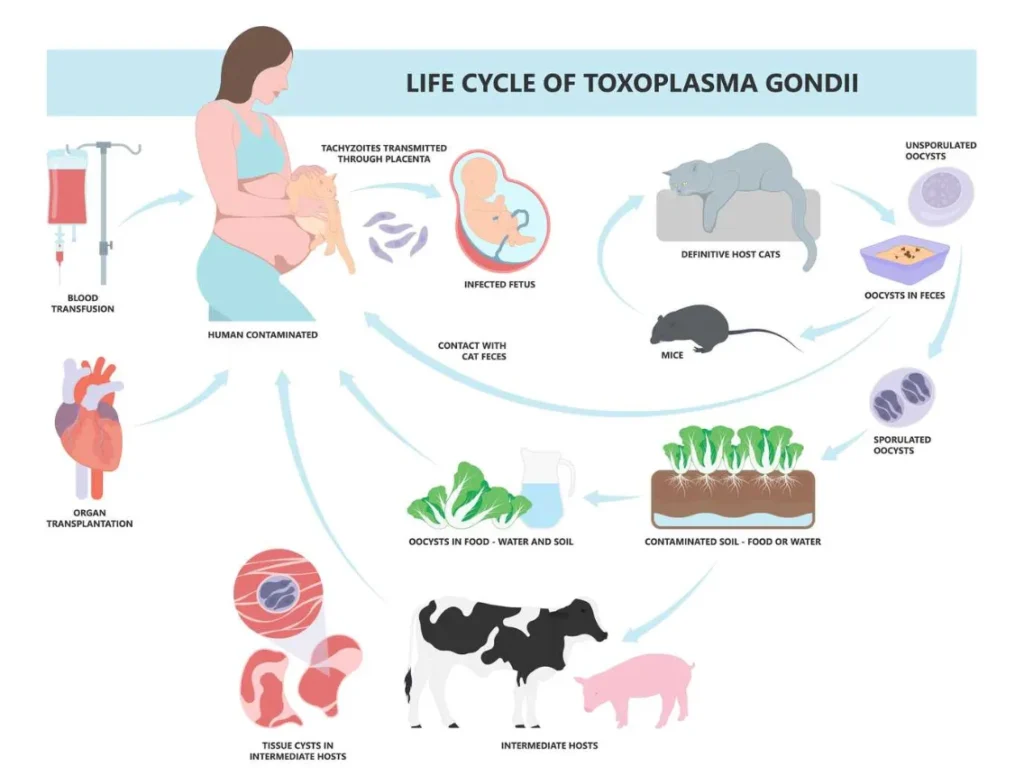
The History of Their Scientific Naming
The scientific name Toxoplasma gondii has an interesting history. The name describes both the shape of the parasite and the animal in which it was first identified.
- The word Toxoplasma comes from Greek roots. Toxon means “arc” or “bow,” and plasma means “form.” This refers to the parasite’s curved, crescent-like shape.
- The species name gondii was derived from the rodent Ctenodactylus gundi, where the parasite was first discovered.
- At first, scientists believed the parasite was connected to only a limited number of animals. Later, research showed that it could infect many warm-blooded animals worldwide.
- The disease caused by this parasite is called toxoplasmosis. This is why people often search for ‘Toxoplasma gondii’, even though the correct name is ‘Toxoplasma gondii‘.
- Today, it is classified as an apicomplexan protozoan parasite, meaning it belongs to a group of intracellular parasites that live and multiply within host cells.
This naming history is important because it helps readers understand the difference between the parasite and the disease.
Their Evolution And Their Origin
The evolution of Toxoplasma gondii is closely connected with host-parasite relationships. It belongs to the group Apicomplexa, which includes several parasites that survive by entering and living inside host cells. This intracellular lifestyle gives the parasite protection and helps it multiply efficiently.
Over time, Toxoplasma gondii developed a complex life cycle involving both definitive hosts and intermediate hosts. Cats are the definitive hosts because the sexual stage of the parasite happens only inside the intestines of cats and other felids. Other animals, such as birds, rodents, livestock, and humans, act as intermediate hosts.
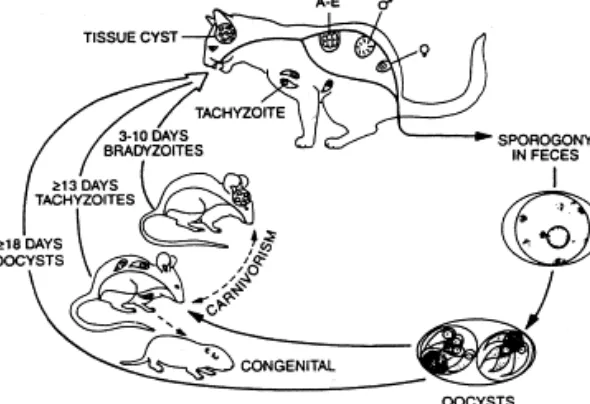
This life cycle is successful because it follows natural food chains. For example, a rodent may swallow infective oocysts from contaminated soil. The parasite then forms tissue cysts inside the rodent. When a cat eats that infected rodent, the parasite returns to the cat’s intestine and completes its sexual reproductive stage.
This predator-prey connection explains why Toxoplasma gondii in cats is such an important topic. Cats are not just accidental hosts; they are the key animals that allow the parasite to complete its full life cycle.
The origin of Toxoplasma gondii can therefore be understood as a result of long-term adaptation, environmental survival, and interaction between predators and prey. Its ability to infect many hosts has helped it become one of the most widespread parasites in the world.
Their main food and its collection process
Toxoplasma gondii does not eat or collect food like animals do. It is not an insect, bird, mammal, or worm. It is a microscopic parasite that survives inside host cells and uses nutrients from the host’s body.
- Inside host cells
Toxoplasma gondii enters host cells and creates a protective space around itself. This space helps the parasite survive while it uses nutrients from the host cell.
- Using host nutrients
The parasite depends on host-derived nutrients such as amino acids, lipids, and other cellular materials. It does not hunt, chew, digest, or gather food from the natural world.
- Fast multiplication stage
During the tachyzoite stage, the parasite multiplies quickly. This stage needs more energy because the parasite spreads rapidly through the body tissues.
- Long-term survival stage
During the bradyzoite stage, the parasite grows slowly inside tissue cysts. This stage is designed for survival rather than rapid expansion.
- Environmental stage
The oocyst stage does not actively feed in soil, water, or litter. It remains in the environment until swallowed by a suitable host.
- Movement through food chains
The parasite spreads through food chains. A rodent may become infected from contaminated soil, and a cat may become infected by eating that rodent.
So, the “food collection process” of Toxoplasma gondii is actually a host-dependent nutrient absorption process.
Important Things That You Need To Know
Many readers search for “Toxoplasma gondii,” but the correct scientific name is Toxoplasma gondii. The disease is called toxoplasmosis, and the parasite is called Toxoplasma gondii. This difference is important for students, pet owners, farmers, health workers, and researchers.
One of the most important LSI topics is Toxoplasma gondii in cats. Cats are central to the parasite’s life cycle because they are the only hosts where sexual reproduction occurs. However, this does not mean every cat is dangerous. Many infected cats show no symptoms, and they usually shed oocysts for a limited period after infection.
Another important topic is the symptoms of Toxoplasma gondii. In healthy people, infection may cause no symptoms or mild flu-like illness. However, in pregnant women, unborn babies, people with weak immune systems, and people with eye infections, toxoplasmosis can become serious.
People also ask, how do cats get Toxoplasma gondii? Cats usually become infected by eating infected rodents, birds, or raw meat containing tissue cysts. They may also swallow infective oocysts from contaminated soil or litter.
The topic of Toxoplasmosis gondii in cats is also important because infected cats may appear healthy. When symptoms occur, they may include fever, loss of appetite, tiredness, breathing problems, eye inflammation, jaundice, or neurological signs.
Understanding these facts helps people reduce risk without creating unnecessary fear of cats.
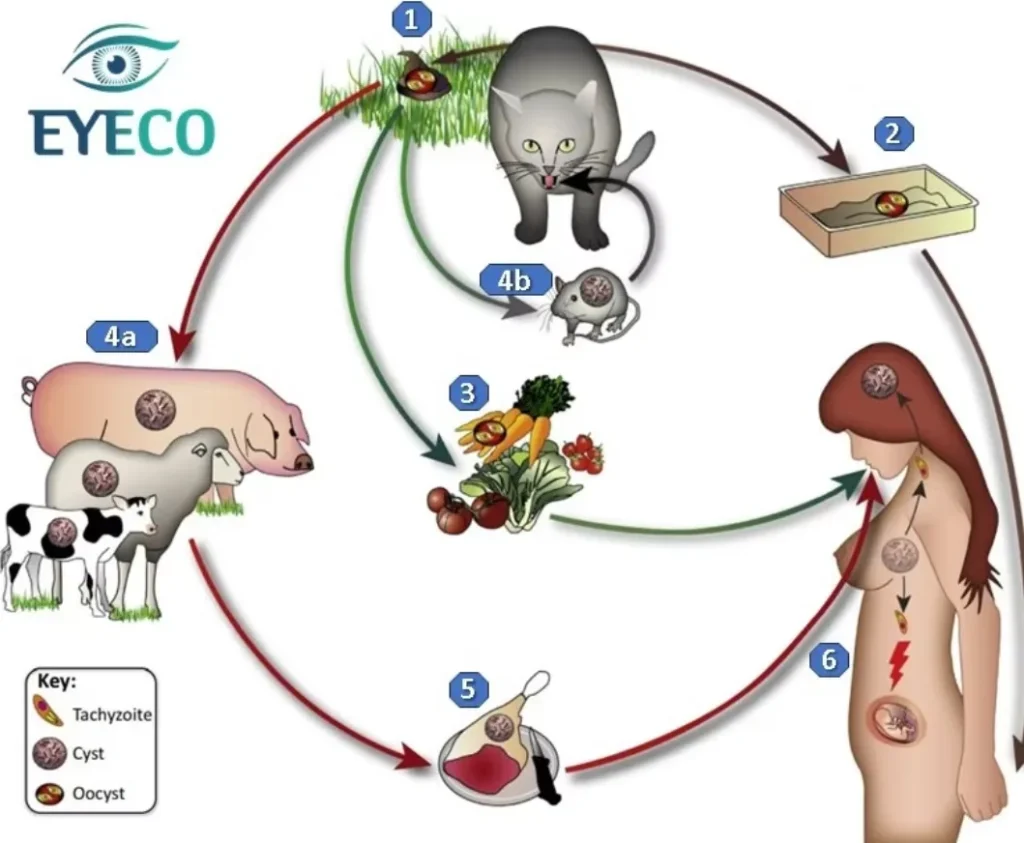
Their life cycle and ability to survive in nature
Stage 1: Cats release oocysts
The life cycle begins when an infected cat sheds oocysts in its faeces. These oocysts are not always immediately infective. They usually need time in the environment to mature and become capable of causing infection.
Stage 2: The environment becomes contaminated
After oocysts mature, they can contaminate soil, water, plants, litter boxes, gardens, farms, and outdoor surfaces. Their strong outer wall helps them survive in the environment.
Stage 3: Intermediate hosts become infected
Birds, rodents, livestock, and humans may swallow infective oocysts through contaminated food, water, soil, or hands. After entering the body, the parasite undergoes a change into tachyzoites.
Stage 4: Tachyzoites multiply quickly
Tachyzoites are the fast-growing stage of Toxoplasma gondii. They spread through the body and infect different tissues. This stage is often linked with active infection.
Stage 5: Tissue cysts form
Some tachyzoites change into bradyzoites. These slow-growing forms remain inside tissue cysts, especially in muscles, the brain, and nervous tissue.
Stage 6: Cats continue the cycle
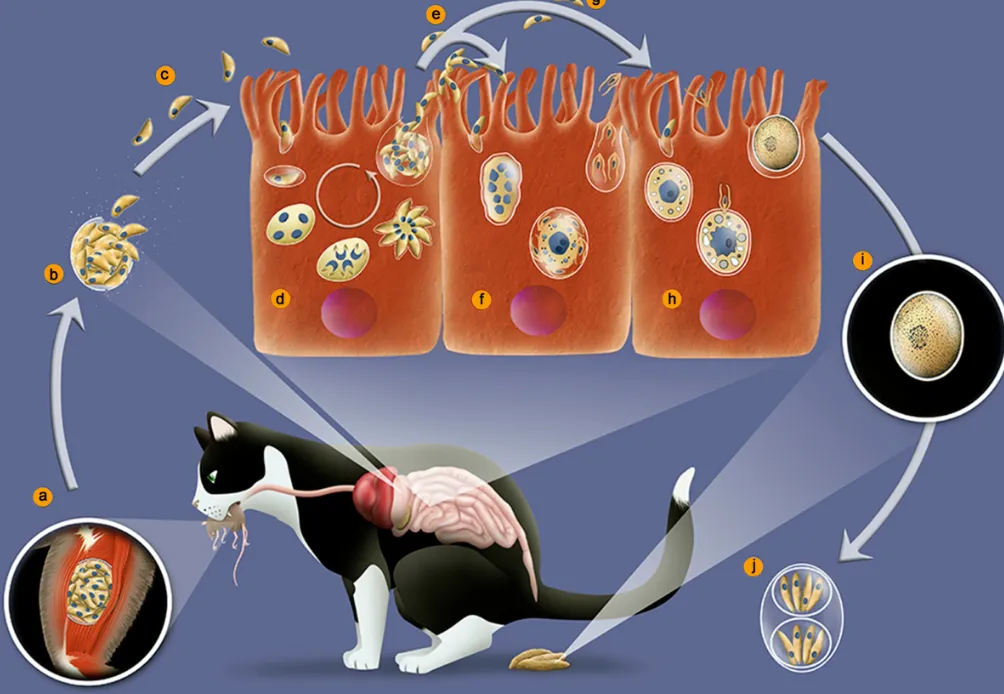
When a cat eats an infected bird, rodent, or raw meat containing tissue cysts, the parasite reaches the cat’s intestine. There, it completes sexual reproduction and produces new oocysts.
This life cycle shows how Toxoplasma gondii survives by moving between cats, prey animals, the environment, and other hosts.
Their Reproductive Process and raising their children
Toxoplasma gondii does not raise children like animals. It has no parents, babies, nests, family groups, or nurturing behaviour. Instead, it reproduces through biological stages that give rise to new parasite forms.
- Asexual reproduction in many hosts
In humans, birds, rodents, livestock, and cats, the parasite can multiply asexually. The fast-growing tachyzoites divide inside host cells and spread through the body.
- Tissue cyst formation
Some tachyzoites become bradyzoites. These bradyzoites remain inside tissue cysts and can survive for long periods.
- Sexual reproduction in cats
The sexual stage occurs only inside cats and other felids. In the cat intestine, the parasite produces reproductive forms that fuse to form oocysts.
- Oocyst production
New oocysts leave the cat’s body through faeces. These oocysts are not babies in the animal sense. They are resistant reproductive forms.
- No parental care
After oocysts are released, the parasite does not protect or care for them. Their survival depends on environmental resistance and reaching a new host.
- Mass production strategy
Instead of caring for offspring, Toxoplasma gondii produces many oocysts. This increases the chance that some will survive and continue the cycle.
So, this parasite does not raise children. It survives through reproduction, environmental resistance, and host-to-host transmission.
The importance of them in this Ecosystem
Part of predator-prey ecology
Toxoplasma gondii is connected with natural predator-prey relationships. It moves between prey animals and cats. Rodents, birds, and small mammals can carry tissue cysts, while cats complete the reproductive cycle.
Indicator of environmental contamination
The presence of Toxoplasma gondii oocysts may indicate contamination from cat faeces in soil, water, farms, gardens, and food-related environments. This makes the parasite important in environmental health studies.
Influence on wildlife health
The parasite can infect wildlife, including birds and mammals. In some species, infection may affect survival, behaviour, movement, or health condition. This is why wildlife monitoring is important in areas with large populations of large cats.
Connection with human health
Toxoplasma gondii is a zoonotic parasite, meaning it can infect both animals and humans. Most healthy people may not become seriously ill, but infection can be dangerous for unborn babies and people with weak immune systems.
Value in scientific research
Scientists study Toxoplasma gondii to understand intracellular infection, immune response, chronic disease, parasite evolution, and host-parasite interaction.
Its importance in the Ecosystem is not because it is simply helpful. It is important because it connects food chains, animal health, public health, and environmental hygiene.
What to do to protect them in nature and save the system for the future
Because Toxoplasma gondii is a disease-causing parasite, the goal is not to protect or increase the parasite in nature. The real goal is to protect humans, cats, livestock, wildlife, and the environment by controlling unsafe transmission.
- Keep pet cats indoors when possible to reduce the hunting of infected rodents and birds.
- Avoid feeding cats raw or undercooked meat.
- Clean litter boxes regularly and safely.
- Pregnant women and immunocompromised people should avoid handling cat litter when possible.
- Wash your hands after gardening, cleaning litter, touching soil, or handling raw meat.
- Wash fruits and vegetables properly before eating.
- Cook meat thoroughly before consumption.
- Cover children’s sandboxes to prevent contamination by cat faeces.
- Control rodents around homes, farms, and food storage areas.
- Support responsible cat ownership to reduce unmanaged feral cat populations.
- Maintain clean animal housing and safe farm management practices.
- Keep food and water sources protected from contamination.
- Take sick cats to a veterinarian if they show fever, appetite loss, breathing problems, eye inflammation, or neurological signs.
- Protect wildlife by reducing domestic cats’ unnecessary outdoor hunting.
This approach helps save the natural system by reducing disease risk while supporting animal welfare and environmental health.
Frequently Asked Questions (FAQs)
Q: What is the correct name, Toxoplasmosis gondii or Toxoplasma gondii?
A: The correct parasite name is Toxoplasma gondii. Toxoplasmosis is the disease caused by this parasite. Many people use the phrase “Toxoplasma gondii,” but it is not the official scientific name.
Q: What are the main stages in the life cycle of Toxoplasmosis gondii?
A: The main stages are oocysts, sporozoites, tachyzoites, and bradyzoites. These stages help the parasite spread, multiply, and survive inside hosts and the environment.
Q: Why are cats important in this life cycle?
A: Cats are important because they are the definitive hosts. The sexual reproductive stage of Toxoplasma gondii occurs only inside cats and other felids.
Q: How do cats get Toxoplasma gondii?
A: Cats usually get infected by eating infected birds, rodents, or raw meat containing tissue cysts. They may also swallow infective oocysts from contaminated soil, litter, or water.
Q: What are common Toxoplasma gondii symptoms in cats?
A: Many cats show no symptoms. When symptoms appear, they may include fever, tiredness, loss of appetite, breathing difficulty, eye inflammation, jaundice, or neurological problems.
Q: Can humans get infected from cats?
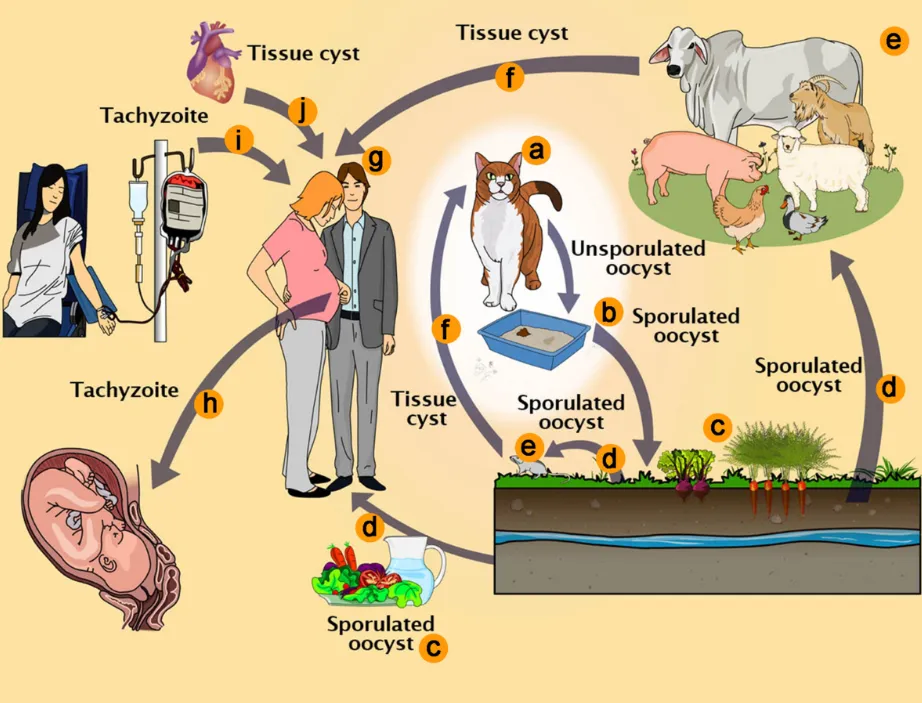
A: Humans can become infected through contaminated soil, food, water, litter, or undercooked meat. Direct contact with a healthy cat is not usually the main source of infection.
Q: Is Toxoplasma gondii dangerous for everyone?
A: Not always. Many healthy people have no symptoms or only mild illness. However, it can be serious for pregnant women, unborn babies, people with weakened immune systems, and people with eye disease.
Q: How can Toxoplasma gondii infection be prevented?
A: Prevention includes cooking meat properly, washing vegetables, washing hands after soil contact, keeping cats away from raw meat, cleaning litter safely, and practising good hygiene.
Conclusion
The life cycle of Toxoplasma gondii is a complex and fascinating biological process. The correct scientific name is Toxoplasma gondii, and the disease it causes is called toxoplasmosis. This parasite survives through several stages, including oocysts, tachyzoites, and bradyzoites.
Cats are central to the complete life cycle because sexual reproduction occurs only inside them. Other animals and humans can become intermediate hosts when they swallow infective oocysts or eat undercooked meat containing tissue cysts.
Understanding Toxoplasma gondii symptoms, transmission routes, and the role of cats helps reduce fear and improve prevention. The parasite does not eat, hunt, or raise children like animals. Instead, it survives through host cells, tissue cysts, environmental resistance, and reproduction.
Good hygiene, safe food handling, responsible cat care, and environmental awareness are the best ways to protect humans, animals, and ecosystems from unnecessary infection.
Also Read: life cycle of malaria disease
About the Author