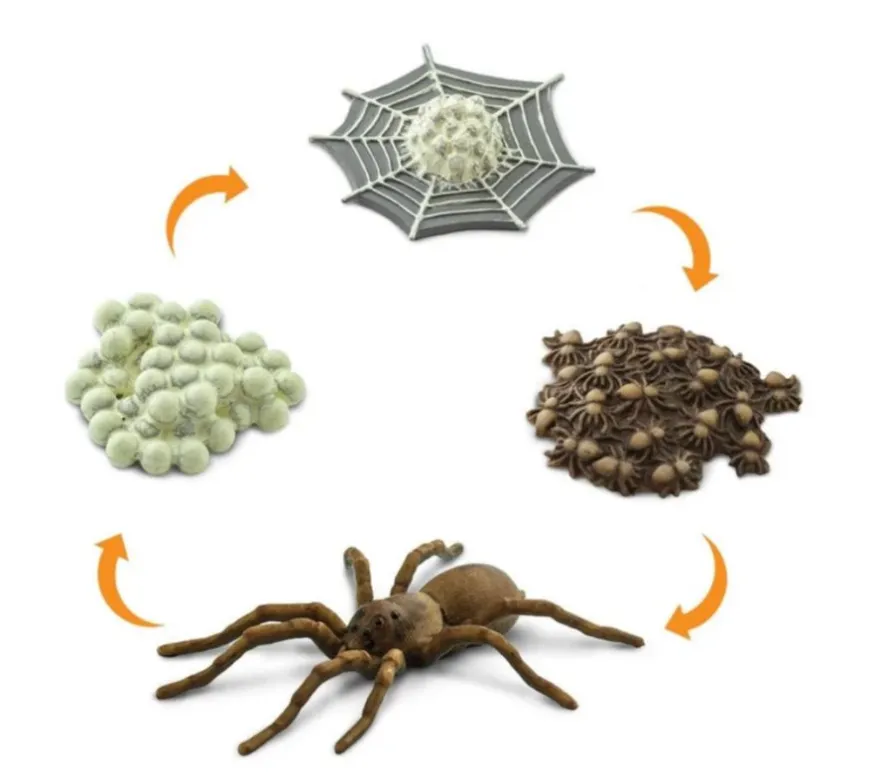
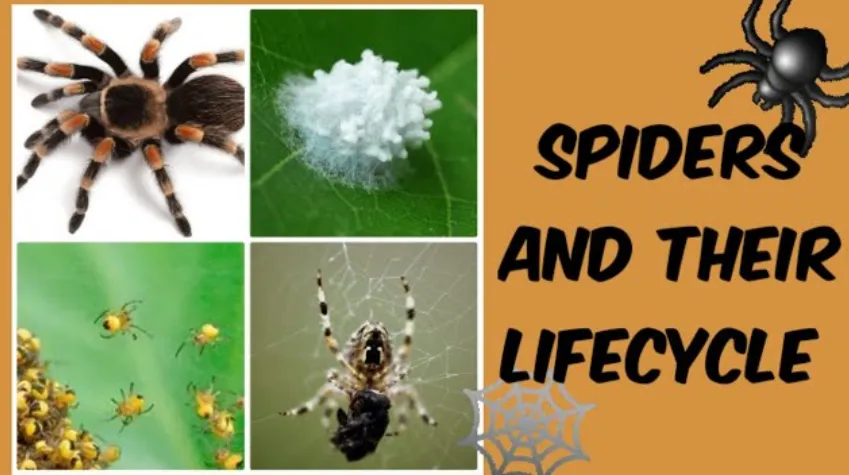
The spider lifecycle is one of the most interesting natural processes in the animal world. A spider does not grow like a butterfly, beetle, or mosquito. It does not pass through a larva or pupa stage. Instead, its life begins as an egg, continues as a spiderling, and later develops into an adult spider.
Spiders belong to the class Arachnida and the order Araneae. This means they are not insects. A spider has eight legs, two main body parts, no wings, no antennae, and special silk-producing organs called spinnerets. These features make spiders different from insects and help them survive in many environments.
The spider lifecycle is important because spiders play a major role in nature. They control insect populations, reduce pests, support food chains, and help maintain ecological balance. Most spiders are harmless to humans and prefer to stay hidden. Even a black spider is not always dangerous, although some species should be treated with caution.
Q: What are the main stages of the spider lifecycle?
A: The main stages are egg, spiderling, and adult spider.
Q: Is a spider an insect?
A: No. A spider is an arachnid, not an insect.
Q: Why is the spider lifecycle important?
A: It helps us understand spider growth, reproduction, survival, and their value in the Ecosystem.
Quick Life Cycle Table
| Life Cycle Stage | What Happens | Key Features | Survival Challenge |
| Egg | A female spider lays eggs inside a silk sac | Protected by silk | Weather, predators, parasites |
| Egg Sac | Eggs develop safely inside the sac | May contain a few to hundreds of eggs | Dryness, damage, and predators |
| Spiderling | Young spiders hatch and emerge | Looks like a tiny adult spider | Finding food and avoiding danger |
| Juvenile Spider | Spider grows through molting | Sheds old exoskeleton | Injury during molting |
| Adult Spider | A fully developed spider can reproduce | Hunts, mates, and produces offspring | Predators, habitat loss, food shortage |
The spider lifecycle is a form of simple development. Spiderlings already look like small adult spiders, but they are not fully mature. They must molt several times before they become adults.
The History of Their Scientific Naming
The scientific study of spiders is called arachnology. Spiders are classified in the order Araneae, which is derived from the Latin and Greek words for ‘spider’. This scientific name helps researchers identify and organise spider species worldwide.
Spiders belong to the larger group called Arachnida. This group also includes scorpions, ticks, mites, and harvestmen. Scientists separated arachnids from insects because they have different body structures.
Important scientific classification:
- Kingdom: Animalia
- Phylum: Arthropoda
- Class: Arachnida
- Order: Araneae
- Common Name: Spider
The word spider is commonly used in daily language, but the scientific name Araneae is used in research. Scientific naming is important because common names can vary from place to place. A single spider may have different local names, but its scientific name remains the same.
This naming system also helps scientists study the spider lifecycle, compare different spider families, and understand how species are related to each other.
Their Evolution And Their Origin
Spiders have a very ancient origin. They evolved from early arachnid ancestors that adapted to life on land. These ancestors developed strong outer bodies, jointed legs, and special feeding structures that helped them survive outside water.
One of the most important evolutionary developments in spiders was the evolution of silk production. Silk gave spiders a major survival advantage. They could use silk to protect eggs, build webs, create shelters, move safely, and catch prey.
The early evolution of spiders was closely connected with the rise of insects. As insects became more common, spiders developed many hunting methods. Some spiders became web builders, while others became active hunters. This diversity allowed spiders to live in forests, grasslands, deserts, wetlands, caves, gardens, farms, and homes.
The spider lifecycle also helped spiders survive for millions of years. Egg sacs protected the next generation. Spiderlings spread into new places. Adult spiders reproduce and continue the cycle.
Today, spiders are found almost everywhere in the world except Antarctica. Their ability to adapt is one reason they are so successful. Some species live under leaves, some live in burrows, some build webs in corners, and some hunt openly on the ground.
Spiders are small, but their evolutionary success is enormous. Their body design, hunting ability, venom, silk, and lifecycle all work together to make them one of nature’s most effective predators.
Their main food and its collection process
Most spiders are predators. Their main food includes insects and other small arthropods. A spider may eat flies, mosquitoes, moths, beetles, ants, grasshoppers, aphids, small larvae, and other tiny animals.
Spiders do not all hunt in the same way. Their food collection process depends on their species, body structure, web type, and habitat.
- Web-building spiders use silk webs to trap flying or crawling insects.
- Jumping spiders use excellent eyesight to stalk prey and jump quickly.
- Wolf spiders hunt on the ground rather than using webs to catch prey.
- Trapdoor spiders hide in burrows and ambush prey that comes nearby.
- Crab spiders wait on flowers and attack insects that visit for nectar.
- Funnel-web spiders build funnel-shaped webs and wait inside for prey movement.
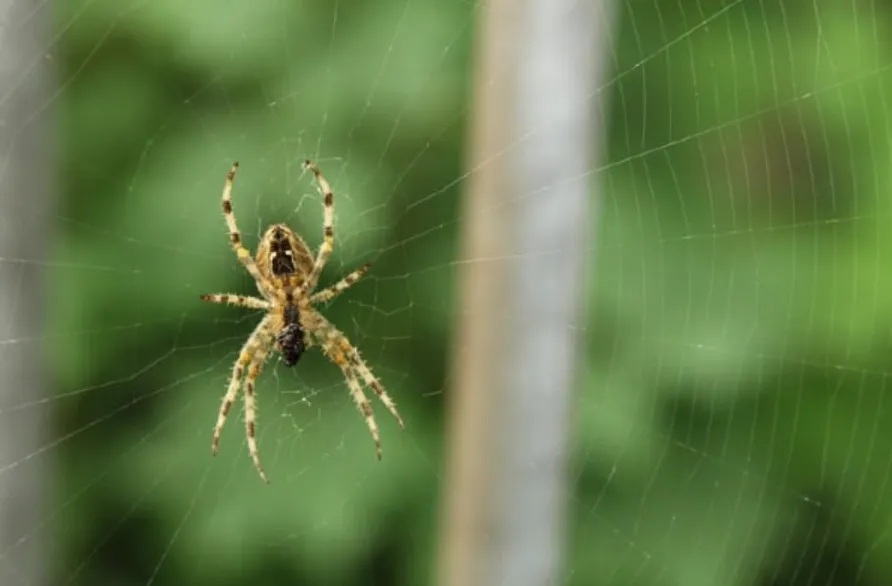
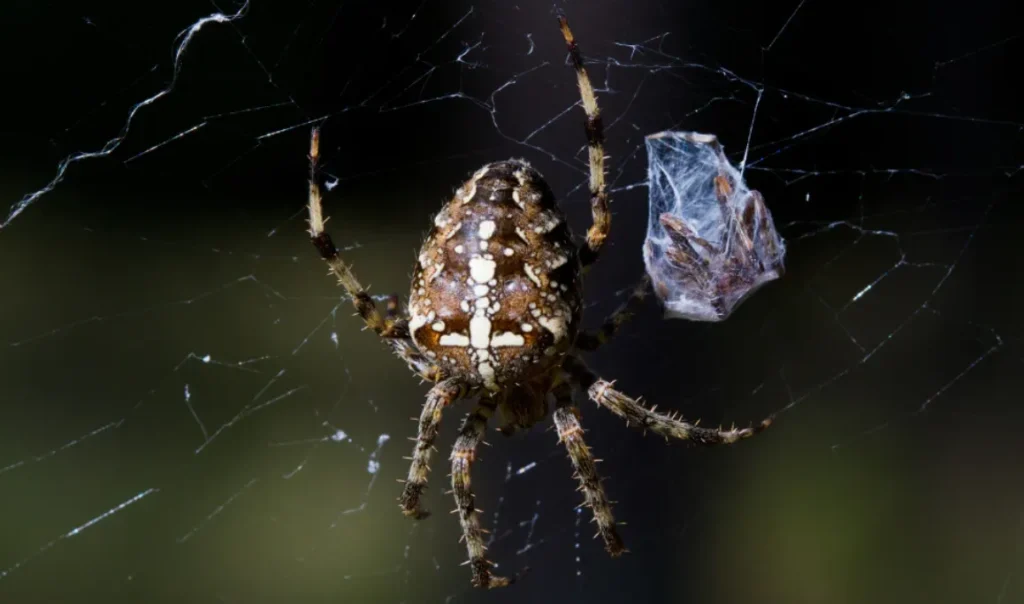
- Orb-weaver spiders build round sticky webs to catch flying insects.
After catching prey, the spider usually injects venom through its fangs. The venom helps stop the prey from escaping. Then the spider releases digestive fluid that breaks down the prey’s body. Spiders cannot chew solid food like humans. They suck liquid nutrients from the prey.
Food is very important in the spider lifecycle. A well-fed female spider can produce stronger egg sacs. Spiderlings also need small prey after they leave the egg sac. If food is limited, growth becomes slower, and survival becomes harder.
Important Things That You Need To Know
The spider lifecycle is often misunderstood because many people think spiders are insects. However, a spider is an arachnid. It has eight legs, while insects have six. Spiders also have two main body sections, while insects usually have three.
Another important point is that not every black spider is dangerous. People often search for ‘black spider’ or ‘black spiders’ because they feel afraid when they see a dark-coloured spider. But many black spiders are harmless and avoid humans. Only a few species, such as some widow spiders, can be medically important.
Spiders are also famous for their silk. Silk is not only used for webs. A spider may use silk for egg sacs, safety lines, shelters, mating signals, and movement. Some young spiderlings use silk to travel through the air in a process called ballooning.
Spiders are also natural pest controllers. They eat many insects that may damage plants, spread disease, or become household pests. In gardens and farms, spiders help reduce pest pressure naturally.
Important LSI keywords used in this article include spider, black spider, black spideer, spider lifecycle, and adult spider.
A spider should not be killed immediately without identification. Most spiders are useful, shy, and important for the natural system. Learning about them helps reduce fear and encourages respect for biodiversity.
Their life cycle and ability to survive in nature
Egg Stage
The spider lifecycle begins when a female spider lays eggs. These eggs are usually placed inside a silk-made egg sac. The sac protects the eggs from drying, predators, and environmental stress.
Depending on the species, one egg sac may contain only a few eggs or hundreds. Some female spiders produce one egg sac, while others produce several during their lifetime.
Spiderling Stage
After development inside the egg sac, young spiders hatch. These young spiders are called spiderlings. They often remain in the sac for a short time before emerging.
Spiderlings look like tiny adult spiders. However, they are weak, small, and not ready to reproduce. This stage is dangerous because they can be eaten by predators or starve to death.
Juvenile Stage
As spiderlings grow, they enter the juvenile stage. During this period, they molt several times. Molting means shedding the old outer body covering so the spider can grow larger.
Molting is risky because the spider’s new body covering is soft for a short time. During this period, the spider can be easily injured or attacked.
Adult Stage
When the spider becomes mature, it enters the adult stage. Adult spiders can hunt, reproduce, build stronger webs, and continue the next generation.
Adult survival depends on food, shelter, temperature, moisture, and predator avoidance. Some spiders live only one season, while larger species may live for many years.
Their Reproductive Process and raising their children
Spider reproduction is a detailed and sometimes risky process. Male spiders usually become mature and then search for females. Since spiders are predators, males must approach carefully to avoid being attacked.
Before mating, male spiders often use signals. These signals may include web vibration, leg tapping, movement patterns, or courtship dances. These behaviours help the female recognise the male as a mate rather than prey.
Important reproductive points:
- The male spider produces sperm and stores it in special structures called pedipalps.
- During mating, the male transfers sperm to the female using these pedipalps.
- The female stores the sperm and later uses it to fertilise her eggs.
- After fertilisation, the female produces eggs.
- The eggs are placed inside a silk egg sac.
- Some females guard the egg sac until the spiderlings hatch.
- Some species carry the egg sac attached to the body.
- Wolf spider mothers carry spiderlings on their backs for a short time.
- Many spider species provide no care after placing the egg sac safely.
Spiders do not raise their young like birds or mammals. However, some species show basic parental care. They may protect eggs, guard spiderlings, or carry them during the early stage.
The reproductive process is essential to the spider’s lifecycle. Without successful mating and egg protection, the next generation cannot survive.
The importance of them in this Ecosystem
Natural Pest Control
Spiders are important natural pest controllers. They eat insects that may damage crops, gardens, trees, and stored food. By reducing insect populations, spiders help maintain balance without the need for excessive chemical use.
In farms and gardens, spiders can naturally reduce pest populations. This makes them valuable for sustainable agriculture and healthy plant growth.
Food Chain Support
A spider is both a predator and prey. It eats insects, but birds, frogs, lizards, wasps, and small mammals also eat it.
This makes spiders an important part of the food chain. If spider numbers fall too low, insect populations may rise, and animals that eat spiders may lose a food source.
Biodiversity Balance
Spiders help maintain biodiversity. Different spider species live in different habitats. Some live in soil, some in trees, some in grass, and some near water.
Their presence shows that an ecosystem has active predator-prey relationships. A healthy spider population often means the environment has enough insects, shelter, and natural structure.
Plant Protection
By eating plant-damaging insects, spiders indirectly protect plants. Healthy plants support pollinators, birds, soil organisms, and other wildlife.
This means the spider lifecycle is connected with the larger cycle of nature. Spiders may be small, but their ecological value is very large.
What to do to protect them in nature and save the system for the future
Protecting spiders means protecting the natural balance of the environment. Spiders need safe spaces, food, shelter, and reduced chemical disturbance.
- Avoid unnecessary pesticide use in gardens, farms, and lawns.
- Keep natural plants, shrubs, leaf litter, and grass edges.
- Do not destroy every spider web unless it is causing a real problem.
- Learn to identify harmful and harmless spider species.
- Move harmless indoor spiders outside instead of killing them.
- Protect forests, wetlands, grasslands, and native vegetation.
- Avoid clearing natural habitats during breeding seasons.
- Reduce outdoor light pollution, as it affects insect and spider hunting.
- Support organic and biodiversity-friendly gardening.
- Keep outdoor spaces clean but not completely lifeless.
- Teach children that most spiders are useful and not dangerous.
- Use window screens and sealed gaps to prevent indoor spider problems.
- Avoid unnecessary fear of every black spider.
- Support natural pest control rather than relying solely on chemicals.
- Respect the role of the spider lifecycle in ecosystem health.
Spiders have survived for millions of years, but habitat loss, pesticide use, and human fear can harm their populations. Protecting spiders helps protect the entire natural system.
Frequently Asked Questions (FAQs)
Q: What is the spider lifecycle?
A: The spider lifecycle is the complete growth process of a spider from egg to spiderling and then to adult spider.
Q: How many stages are in the spider lifecycle?
A: The main stages are egg, spiderling, and adult spider. Some people also include the juvenile stage because spiders molt several times before maturity.
Q: Do spiders have a larva stage?
A: No. Spiders do not have a larva or pupa stage. Young spiders hatch as spiderlings that look like tiny adults.
Q: How long does a spider live?
A: It depends on the species. Some small spiders live for a few months or one year, while larger species may live for several years.
Q: What do baby spiders eat?
A: Baby spiders, or spiderlings, usually eat tiny insects and small arthropods. Some may survive for a short time after hatching using stored energy.
Q: Are black spiders dangerous?
A: Not all black spider species are dangerous. Many are harmless. However, some species, such as widow spiders, should be treated carefully.
Q: Why do spiders molt?
A: Spiders molt because their hard outer body covering does not grow with them. They shed it to become larger.
Q: Why are spiders important in nature?
A: Spiders control insect populations, support food chains, protect plants, and help maintain ecological balance.
Conclusion
The spider lifecycle is a simple yet powerful process that begins with eggs, continues through spiderlings, and culminates in adult spiders. Each stage has an important purpose. Eggs protect the next generation, spiderlings spread into new habitats, and adult spiders reproduce to continue the cycle.
A spider may look small, but its role in nature is very important. Spiders reduce insects, support food chains, protect plants, and help keep ecosystems balanced. Even a black spider should not always be feared because many dark-coloured spiders are harmless and beneficial.
By understanding the spider lifecycle, people can replace fear with knowledge. Spiders are not only web makers; they are natural pest controllers and silent protectors of the Ecosystem. Protecting them means protecting biodiversity, agriculture, gardens, and the future balance of nature.
Also Read: life cycle of an angiosperm plant
About the Author