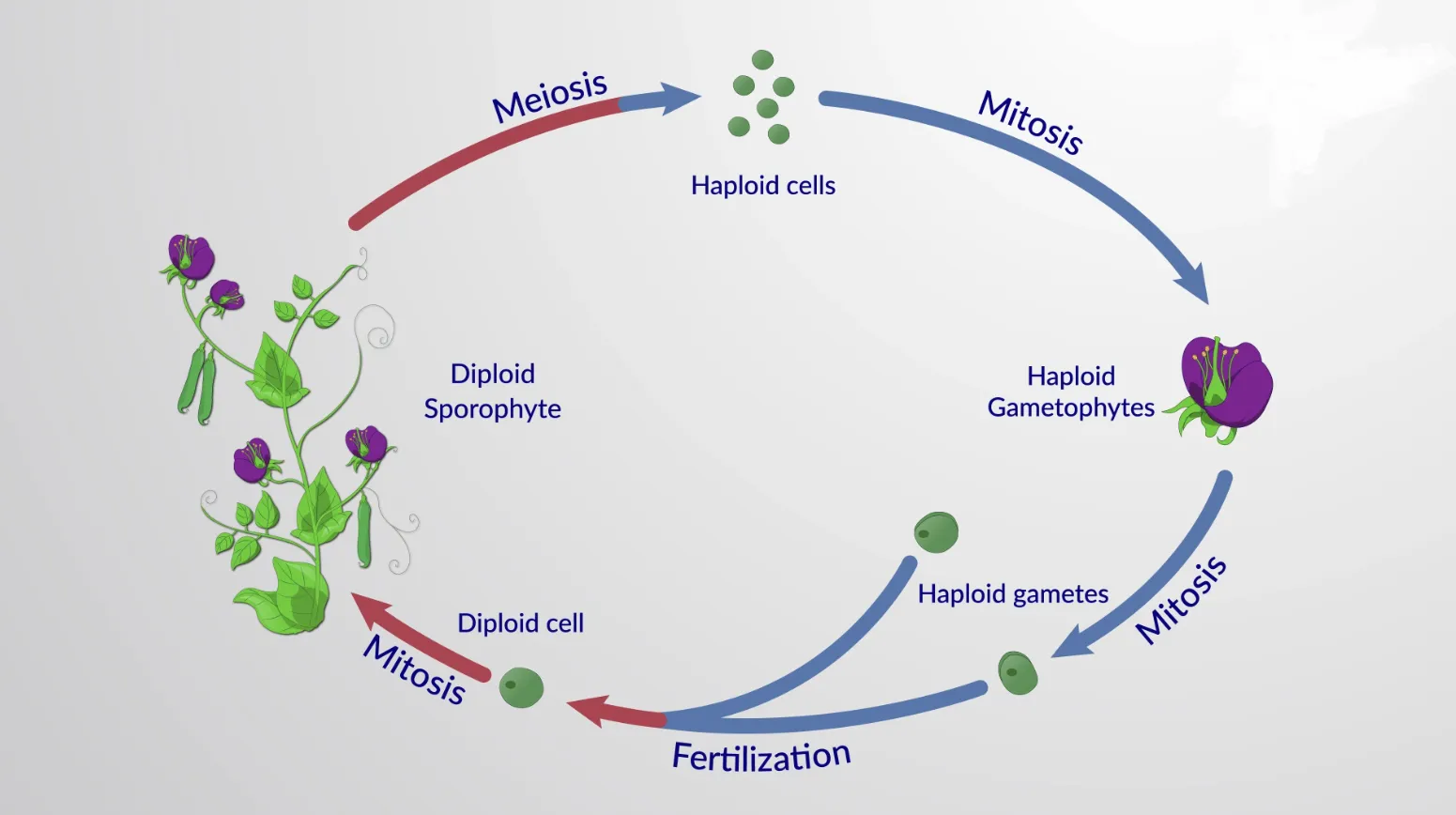
The angiosperm life cycle is the complete process through which flowering plants grow, reproduce, and continue their species from one generation to the next. Angiosperms are the most familiar plants on Earth. They include grasses, rice, wheat, mango trees, roses, lilies, orchids, sunflowers, and most crop plants people depend on every day. In fact, flowering plants are the largest and most diverse group of land plants, which is why understanding their life cycle is so important in biology, ecology, and agriculture.
In simple words, the life cycle of an angiosperm starts with a seed. That seed germinates, grows into a seedling, and then develops into a mature plant. The mature plant produces flowers, and inside those flowers, the reproductive process begins. After pollination and fertilization, seeds form again, often inside fruits, and the cycle repeats.
Angiosperms are highly successful in nature because they have flowers for efficient reproduction and fruits for seed protection and dispersal. These two features helped them spread across forests, wetlands, grasslands, farms, and even cities. Their life cycle is one of the main reasons they dominate most land ecosystems today.
Quick Answer 1: What is an angiosperm?
An angiosperm is a flowering plant whose seeds develop inside an ovary that usually becomes a fruit.
Quick Answer 2: What is special about the angiosperm life cycle?
Its most distinctive feature is double fertilization, in which one sperm forms the embryo and the other forms endosperm, the seed’s food supply.
Quick Answer 3: Why are angiosperms important?
They produce most of the world’s food plants, support pollinators, and form the base of many ecosystems.
Quick Life Cycle Table
| Stage | What Happens | Why It Matters |
| Seed | A dormant seed contains an embryo and a food reserve | Helps the young plant survive before growth begins |
| Germination | The seed absorbs water and starts growing | Marks the beginning of a new plant |
| Seedling Stage | Roots, stems, and leaves begin to form | Builds the plant body for future survival |
| Mature Plant | The plant becomes fully developed | Allows flowering and reproduction |
| Flowering | Reproductive organs form inside flowers | Makes pollination possible |
| Pollination | Pollen reaches the stigma | Transfers male reproductive cells |
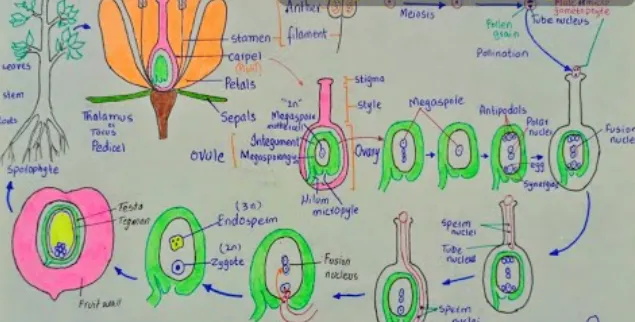
| Fertilization | Double fertilization occurs | Produces embryo and endosperm |
| Fruit and Seed Formation | Ovules become seeds, and the ovary becomes the fruit | Protects and spreads the next generation |
Important Things That You Need To Know
To understand the angiosperm life cycle, you also need to understand several important related ideas. First, the angiosperm definition is simple: an angiosperm is a flowering plant whose seeds are enclosed inside an ovary. This is the key feature that separates angiosperms from other seed plants.
When many people ask, what is an angiosperm, they usually want easy examples. Common angiosperm examples include rice, wheat, mango, apple, sunflower, rose, grasses, orchids, beans, and lilies. These examples show how angiosperms are found in both natural ecosystems and human agriculture.
Another major concept is angiosperm vs gymnosperm. Angiosperms produce flowers and fruits, while gymnosperms usually produce cones and naked seeds. This means angiosperm seeds are protected within a fruit, whereas gymnosperm seeds are exposed. Because of this protection and their advanced reproductive system, angiosperms often have greater reproductive success in many environments.
The phrase gymnosperm vs angiosperm is also widely searched by students. The easiest way to remember it is this: gymnosperms have naked seeds, but angiosperms have enclosed seeds. Gymnosperms include pine, fir, and spruce, while angiosperms include nearly all flowering trees, crops, and garden plants.
Finally, remember that angiosperm examples are not limited to colorful flowers. Even grasses, cereals, vegetables, fruit trees, and many aquatic plants are angiosperms. This is why angiosperms are central to ecosystems, farming, biodiversity, and human life.
The History Of Their Scientific Naming
The scientific naming of angiosperms has a long and fascinating history. The name itself reflects one of the most important features of these plants: their enclosed seeds.
- The word angiosperm comes from Greek roots. “Angio” means container or vessel, and “sperm” means seed. Together, the word refers to plants with seeds enclosed in a protective structure.
- Early botanists used the term to describe plants whose seeds were hidden rather than exposed.
- Over time, scientists studied plant reproductive structures more carefully and began to separate flowering plants from cone-bearing plants.
- This distinction eventually led to the clear classification of angiosperms and gymnosperms as two major groups of seed plants.
- As botanical science advanced, classification systems became more detailed, focusing not only on visible plant features but also on evolutionary relationships.
- Today, angiosperms are classified in modern phylogenetic systems that group plants based on shared ancestry and genetic evidence.
So, the scientific name of angiosperms is not just a label. It reflects one of the most important biological traits in plant evolution: seeds enclosed within a protective reproductive structure. This naming history also shows how plant science has evolved from simple observation to a highly advanced field grounded in evolution, morphology, and genetics.
Their Evolution And Their Origin
The origin of angiosperms is one of the most important topics in plant evolution. Flowering plants did not appear overnight. They evolved gradually over a very long period and eventually became the dominant plants in most land environments.
Scientists believe that angiosperms rose to prominence during the age of dinosaurs, especially in the Cretaceous period. Their appearance changed terrestrial ecosystems in major ways. Before angiosperms became widespread, many landscapes were dominated by other plant groups such as ferns, cycads, and gymnosperms. But flowering plants brought a new level of reproductive efficiency and ecological adaptability.
One major reason for their success was the flower itself. Flowers improved pollination by attracting insects, birds, and other animals. This made reproduction more targeted and often more effective than simple wind-based systems alone. Another major advantage was the fruit, which protected seeds and helped spread them over long distances through animals, wind, and water.
Angiosperms also developed efficient vascular systems that allowed them to move water and nutrients effectively through roots, stems, and leaves. This helped them grow quickly, adapt to different climates, and compete successfully with older plant groups. Over time, they spread into forests, wetlands, grasslands, deserts, and mountains.
Their evolution also created strong ecological partnerships. Pollinators benefited from nectar and pollen, while flowering plants benefited from more reliable reproduction. This co-evolution helped both plants and animals diversify.
Today, angiosperms dominate most land ecosystems. Their origin was not just the beginning of a new plant group. It was a turning point in the history of life on Earth, shaping food webs, habitats, biodiversity, and the future of terrestrial ecosystems.
Their Main Food and Its Collection Process
Plants do not eat food like animals do, so when we talk about the “main food” of angiosperms, we are really referring to the food they produce themselves. Their main food is sugar, especially glucose, produced by photosynthesis.
Photosynthesis occurs mainly in leaves. Green pigments such as chlorophyll absorb sunlight, and the plant combines this light energy with carbon dioxide from the air and water from the soil. As a result, the plant produces sugars that fuel growth, flowering, fruiting, and seed development.
Here is how angiosperms collect the materials needed for food production:
- Sunlight collection: Leaves capture sunlight through chlorophyll, which powers photosynthesis.
- Water absorption: Roots absorb water from the soil and send it upward through xylem tissues.
- Mineral uptake: Roots also absorb essential minerals such as nitrogen, potassium, and phosphorus.
- Carbon dioxide intake: Tiny pores called stomata in the leaves allow carbon dioxide to enter from the atmosphere.
- Sugar production: Inside leaf cells, the plant converts water and carbon dioxide into glucose using sunlight.
- Food transport: The sugar is then transported through the phloem to stems, roots, flowers, fruits, and seeds.
- Storage: Some food is used immediately, while some is stored in seeds, fruits, roots, or stems for later use.
This process is the foundation of the angiosperm life cycle. Without photosynthesis, seeds could not form, flowers could not develop, and seedlings could not survive. The plant’s ability to efficiently collect sunlight, water, air, and minerals is one of the biggest reasons angiosperms are so successful in nature.
Their Life Cycle and Ability to Survive in Nature
Seed Dormancy and Germination
The angiosperm life cycle usually begins with a seed. Inside the seed is a young embryo and a food reserve. Many seeds remain dormant for some time until the environment becomes favorable. This dormancy helps the plant avoid harsh conditions such as cold, drought, or lack of light.
When conditions improve, the seed absorbs water and begins germination. The embryo becomes active, and the first root usually emerges. This root anchors the plant and starts absorbing water and nutrients.
Seedling Development
After germination, the seedling grows. During this stage, roots become stronger, the stem rises upward, and leaves begin to unfold. The seedling is still very delicate, so this is one of the most dangerous stages in its life cycle.
To survive, the young plant must quickly begin photosynthesis, compete for sunlight, and avoid damage from drought, insects, disease, or grazing animals.
Growth into a Mature Plant
As the seedling grows, it becomes a mature sporophyte plant. This is the dominant stage in the angiosperm life cycle. At this point, the plant develops a full root system, a stem structure, and many leaves. Once mature enough, it begins producing flowers.
Flowering and Reproduction
Flowers contain the reproductive organs of the plant. This is where the male and female parts interact through pollination and fertilization. Once this process is complete, seeds begin to form.
Survival in Nature
Angiosperms survive so successfully in nature because their life cycles are highly adaptable. Seeds can stay dormant until conditions are right. Flowers attract pollinators. Fruits protect developing seeds. Seed dispersal spreads offspring into new environments. Together, these strategies allow angiosperms to survive in forests, farms, wetlands, grasslands, and even disturbed human landscapes.
Their Reproductive Process and Raising Their Children
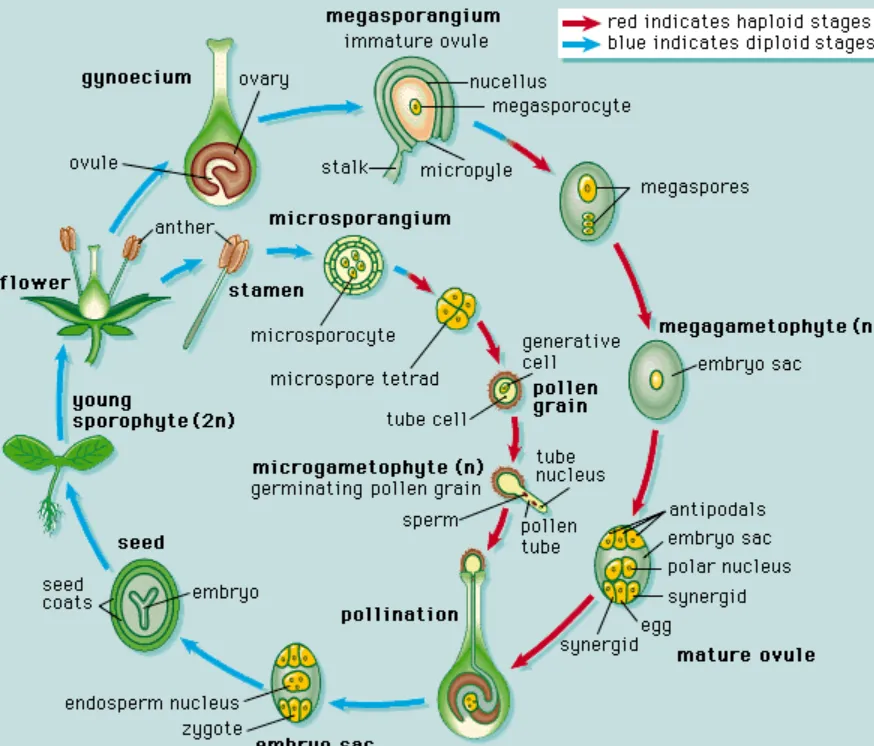
The reproductive process of angiosperms is among the most advanced in the plant kingdom. It begins with the flower, which contains both male and female reproductive structures.
The male part is the stamen, which produces pollen. The female part is the carpel or pistil, which includes the stigma, style, and ovary. Reproduction begins when pollen lands on the stigma. This process is called pollination.
Pollination may happen through:
- Wind
- Water
- Insects
- Birds
- Bats
- Other animals
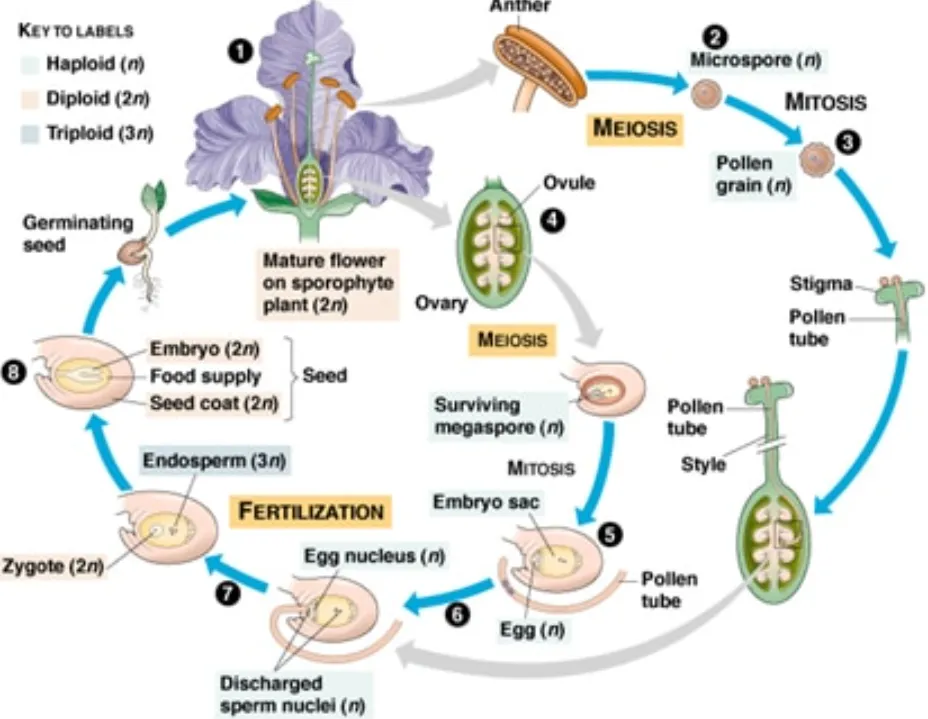
Once pollen reaches the stigma, it forms a pollen tube that grows down toward the ovule. Inside the ovule, the sperm cells are delivered for fertilization.
The most special part of the angiosperm reproductive system is double fertilization:
- One sperm joins with the egg and forms the embryo.
- The other sperm joins with other nuclei to form endosperm, which provides food for the embryo.
If we compare this to “raising their children,” angiosperms do three important things:
- They protect the embryo inside the seed.
- They provide food through endosperm or stored tissue.
- They help with dispersal by forming fruits that move seeds to new places.
Some fruits attract animals, which eat them and later release the seeds elsewhere. The wind carries some fruits. Others float in water. In this way, flowering plants invest in the survival of the next generation.
So while plants do not raise children in the animal sense, they do support their offspring through protection, nourishment, and transport. This makes the angiosperm reproductive process highly efficient, and it is one of the main reasons flowering plants dominate the natural world.
Importance of Them in This Ecosystem
They Form the Foundation of Food Webs
Angiosperms are primary producers, which means they convert sunlight into usable energy. Herbivores feed on their leaves, fruits, nectar, seeds, and stems. Carnivores then depend on those herbivores. In this way, flowering plants form the base of many terrestrial food webs.
They Support Pollinators and Biodiversity
Flowering plants are closely linked to bees, butterflies, moths, birds, bats, and other pollinators. Their flowers provide nectar and pollen, while pollinators help plants reproduce. This partnership increases biodiversity and strengthens ecosystems.
They Build Habitats
Angiosperms create the physical structure of many habitats. Forest trees provide canopy shelter. Grasses build grasslands. Wetland flowering plants create breeding grounds for birds, fish, and insects. Without angiosperms, many species would lose their homes.
They Improve Soil and Water Systems
Roots help prevent soil erosion, improve soil structure, and support water absorption. Leaf litter and decaying flowers add organic matter to the soil. These processes improve fertility and help maintain healthy ecosystems.
They Support Human Life
Most of the world’s crops are angiosperms. They provide food, medicine, timber, fiber, oil, spices, beauty, and oxygen. Human society depends heavily on flowering plants for daily survival and economic activity.
Because of all these roles, angiosperms are not just beautiful plants. They are essential to ecosystem balance, biodiversity, climate stability, agriculture, and the overall health of life on Earth.
What to Do to Protect Them in Nature and Save the System for the Future
- Protect natural habitats, including forests, wetlands, grasslands, and riverbanks.
- Reduce unnecessary pesticide and chemical use that harms pollinators and soil health.
- Plant native flowering species in gardens, parks, and community spaces.
- Prevent deforestation and uncontrolled land destruction.
- Support seed banks and botanical conservation programs.
- Encourage sustainable agriculture that protects biodiversity.
- Maintain pollinator-friendly environments with year-round blooming flowers.
- Control invasive species that crowd out native angiosperms.
- Promote awareness about the importance of flowering plants in schools and communities.
- Take climate action, because changing weather patterns affect flowering, pollination, and seed survival.
Protecting angiosperms means protecting food systems, biodiversity, pollinators, and future ecological stability. Since flowering plants support so much life, every step toward conservation matters.
Frequently Asked Questions (FAQs)
1. What is an angiosperm?
An angiosperm is a flowering plant whose seeds are enclosed inside an ovary, which often develops into a fruit.
2. What is the angiosperm life cycle?
It is the process in which a flowering plant grows from seed to mature plant, produces flowers, forms seeds through fertilization, and begins the cycle again.
3. What makes angiosperms different from gymnosperms?
Angiosperms have flowers and enclosed seeds, while gymnosperms usually have cones and exposed seeds.
4. What is double fertilization in angiosperms?
Double fertilization is when one sperm forms the embryo and another forms endosperm, which nourishes the embryo.
5. What are common angiosperm examples?
Examples include rice, wheat, mango, sunflower, rose, orchid, bean plants, and grasses.
6. Why are angiosperms important to ecosystems?
They support food webs, provide habitats, help pollinators, improve soil health, and produce oxygen.
7. How do angiosperms make their food?
They make food through photosynthesis using sunlight, water, and carbon dioxide.
8. Why should we protect angiosperms?
They are essential for biodiversity, agriculture, climate balance, and ecosystem stability.
Conclusion
The angiosperm life cycle is among the most successful life cycles in nature. It begins with a seed, continues through germination and growth, reaches maturity in the flowering plant, and then returns to seed production through pollination and fertilization. This cycle is efficient, highly adaptable, and perfectly designed for survival in changing environments.
What makes angiosperms truly remarkable is how many advantages they combine into a single system. They produce flowers to improve pollination, develop fruits to protect seeds, create food through photosynthesis, and support the next generation through embryo nourishment and seed dispersal. These features helped them become the dominant plant group in most land ecosystems.
Angiosperms are also deeply connected to life on Earth. They support pollinators, provide food, shape habitats, protect soil, and sustain biodiversity. Understanding their life cycle is not only useful for students and researchers but also for anyone who wants to understand how nature works. In the end, protecting angiosperms means protecting the future of ecosystems, food security, and life itself.
Also Read About: varied carpet beetle life cycle
About the Author