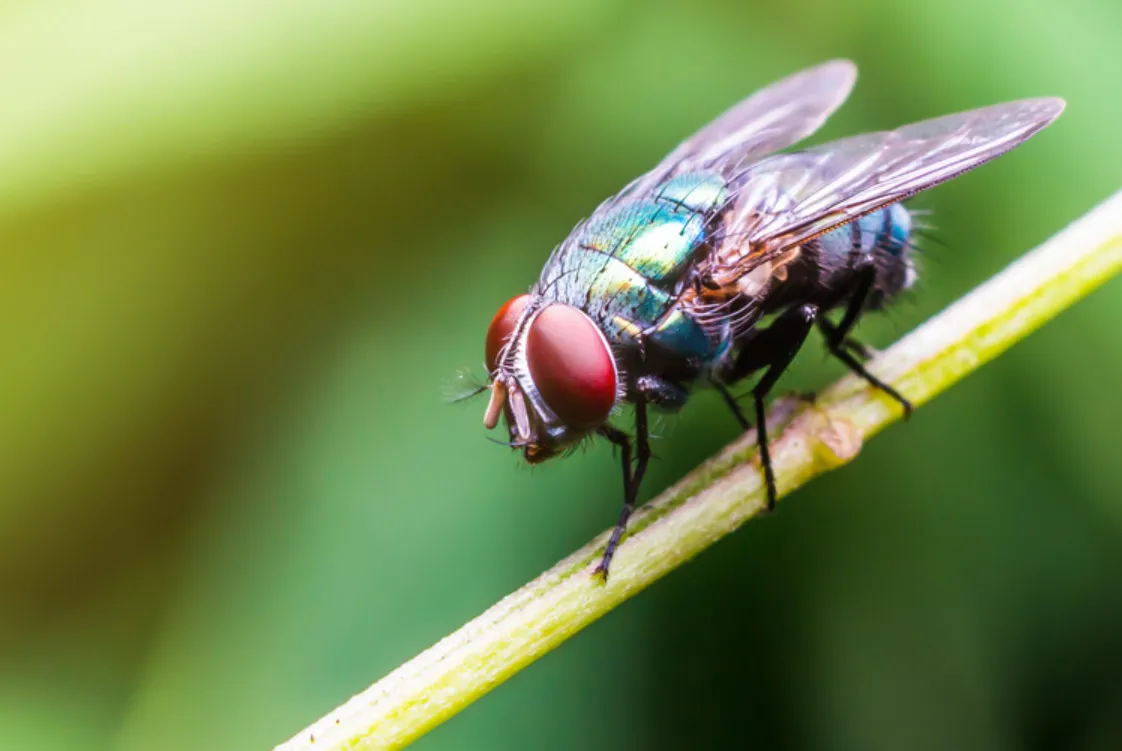
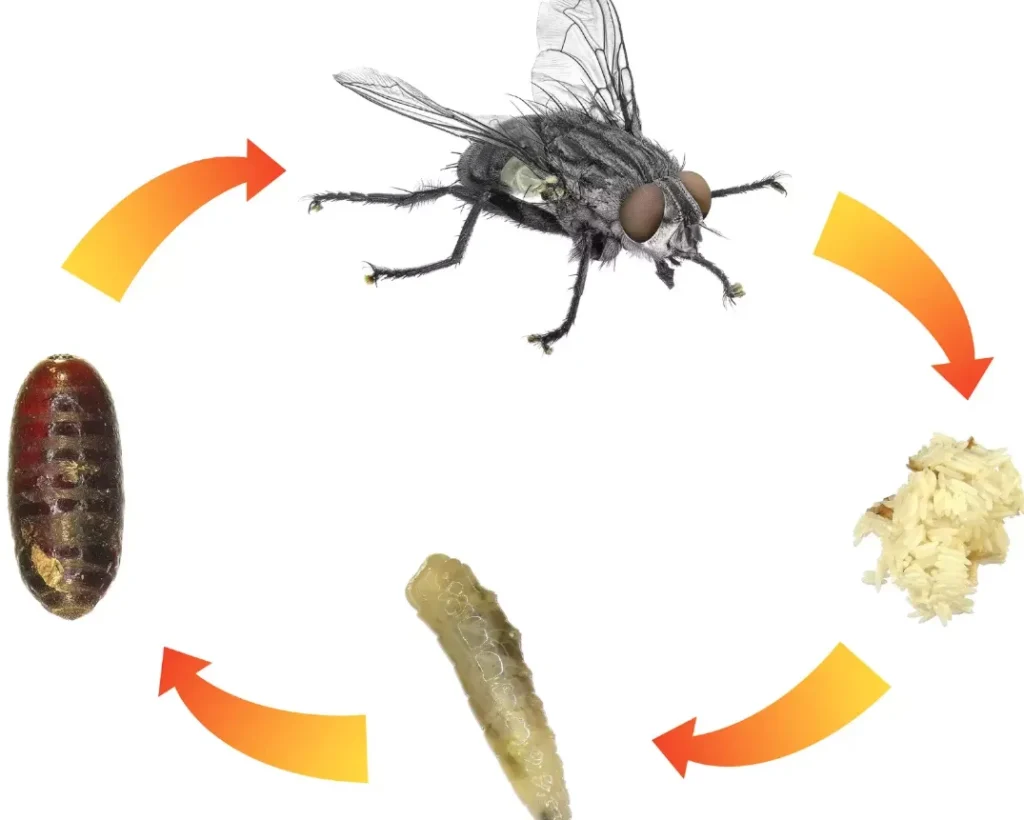
When people search for the life cycle of a fly, they usually want a simple answer: how a fly is born, how fast it grows, and why it seems to appear everywhere so quickly. In everyday use, “a fly” often refers to the housefly (Musca domestica), so this article uses the housefly as the main example while also explaining how true flies fit into the larger insect order Diptera. True flies are one of the largest insect groups on Earth, with more than 160,000 described species, and all of them pass through four major life stages: egg, larva, pupa, and adult.
A fly’s life is short, but it is highly efficient. Under warm and favorable conditions, a housefly can go from egg to adult in as little as 7 days. A female can lay more than 100 eggs at a time and between about 600 and 1,000 eggs over her life, which is why fly numbers can rise so fast around food waste, manure, and other moist organic material.
Quick Answer 1: What are the 4 stages in the life cycle of a fly?
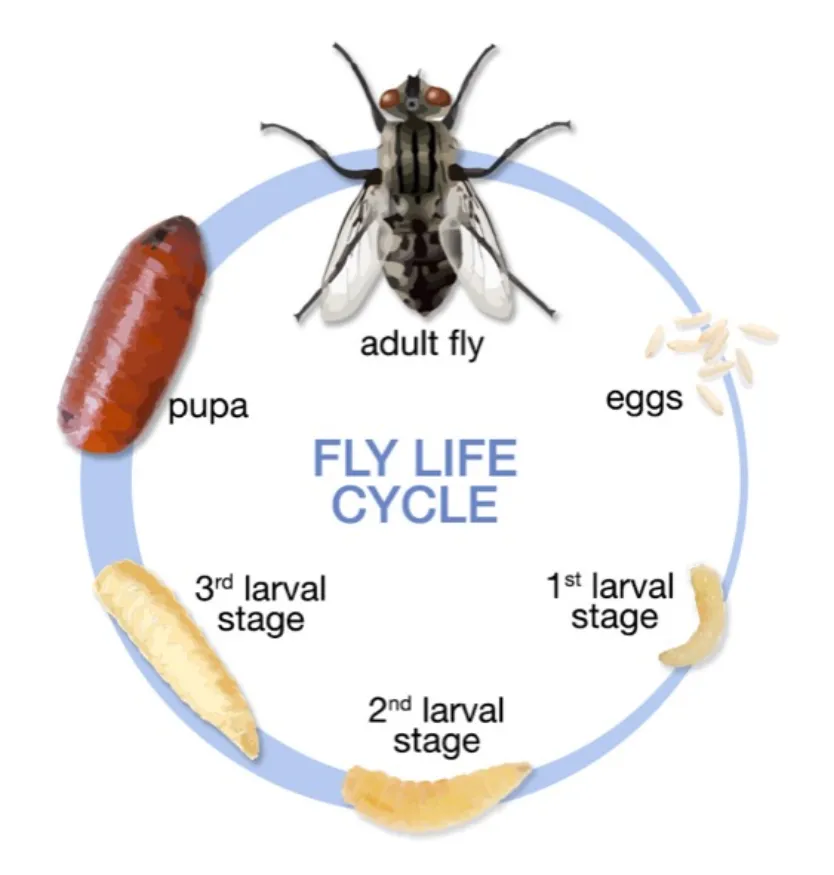
A fly develops through egg, larva (maggot), pupa, and adult. This is called complete metamorphosis.
Quick Answer 2: How long does the life cycle of a fly take?
For a housefly, the full cycle can take as little as 7 days in ideal warm conditions, though it may take longer in cooler or poorer environments.
Quick Answer 3: Why do flies multiply so fast?
They reproduce quickly because females lay many eggs, larvae grow in food-rich decaying material, and development speeds up in warm, moist environments.
Important Things That You Need To Know
Before going deeper, it helps to understand the related search terms people often see around this topic. Some are truly connected to fly biology, while others are only loosely related. Knowing the difference improves both search intent and understanding.
The fruit fly trap is directly relevant. Fruit flies, especially spotted-wing drosophila and similar small vinegar-loving flies, are commonly monitored or managed with traps. Extension guidance recommends simple cup-style traps baited with apple cider vinegar and a drop of dish soap, showing how closely trapping is tied to fly life cycles, breeding, and pest management.
A horse fly is also a true fly, but it is very different from a housefly. Horse flies belong to the family Tabanidae in the order Diptera. Unlike houseflies, many female horse flies bite and feed on blood, while males usually feed on nectar, sap, or honeydew.
Dragonfly is a common search term, but the standard spelling is dragonfly. A dragonfly is not a true fly. Dragonflies belong to the order Odonata, not Diptera, so their life cycle is different from that of houseflies and fruit flies.
Rear delt fly sounds related because of the word “fly,” but it is not an insect topic at all. It refers to a shoulder exercise, often called a reverse fly, that targets the rear deltoid muscles. That means it is an unrelated keyword from the fitness world, not entomology.
So, if your goal is to understand the life cycle of a fly, the most useful connected insect terms are fruit fly trap, horse fly, and dragonfly/dragonfly as a comparison point. The term rear delt fly belongs in workout content, not insect science.
Quick Life Cycle Table
Typical timing varies by temperature, moisture, and food supply. Still, authoritative references consistently describe the same four-stage pattern for true flies and show that houseflies can complete development very quickly in warm conditions.
| Stage | What happens | Typical timing for houseflies | Why this stage matters |
| Egg | Females lay eggs on moist organic matter such as manure, garbage, or decaying food | 12–24 hours to hatch | Fast hatching reduces exposure to drying and predators |
| Larva (maggot) | Legless larvae feed heavily and molt several times | Usually, a few days; rapid in warm conditions | Main growth stage: converts waste into body mass |
| Pupa | Larva moves to a drier place and transforms into a puparium | Often several days | Protective transformation stage |
| Adult | Winged fly emerges, mates, feeds, and lays eggs | Often around 2–4 weeks, depending on conditions | Dispersal and reproduction stage |
The key takeaway is simple: the fly’s life cycle is short, flexible, and highly adapted to temporary food sources. That combination is the secret behind its survival success.
The History of Their Scientific Naming
The scientific naming of the common housefly is one of the clearest examples of classical insect taxonomy becoming stable and widely accepted over time. The currently accepted name is Musca domestica Linnaeus, 1758, and that authority line tells an important story in just a few words.
- Musca domestica was formally described by Carl Linnaeus in 1758, the landmark year associated with the 10th edition of Systema Naturae, which shaped modern zoological naming.
- The species belongs to the order Diptera, the group known as the true flies.
- It belongs to the family Muscidae, a major family that includes the housefly and its close relatives.
- The species name has remained remarkably stable, underscoring how recognizable and globally important this insect has been to science, medicine, and daily life.
- In practical terms, the name can be read as the familiar “domestic” or household fly, which fits its long association with human homes, farms, and settlements. This is a straightforward inference from its established taxonomy and ecology.
Scientific naming matters because it gives researchers, health workers, and farmers one exact label for the same insect worldwide. Without that shared name, research on disease transmission, insecticides, development, and ecology would be much harder to compare.
Their Evolution And Their Origin
To understand the life cycle of a fly, it helps to look at the much older history of the fly group. True flies belong to the order Diptera, and the fossil record suggests that dipterans appeared in the Triassic, roughly 240 million years ago. Later in the Mesozoic, fly fossils became increasingly abundant, especially in the Jurassic and Early Cretaceous, showing that flies diversified early and successfully occupied many ecological roles.
One reason flies evolved so successfully is their complete metamorphosis. A larva and an adult do not live the same kind of life. The larva often lives deep inside food, soil, water, dung, rotting plants, or carrion, while the adult becomes a mobile flying stage focused on dispersal, feeding, and reproduction. Britannica notes that flies effectively live “two distinct lives,” which helps them adapt to changing environments.
Over evolutionary time, flies developed traits that made them exceptionally versatile. They have one functional pair of wings and reduced hind wings called halteres that help with balance. Their mouthparts also diversified: some suck liquids, some sponge softened food, and others evolved piercing methods. This flexibility allowed different fly groups to become decomposers, pollinators, predators, parasites, blood-feeders, and disease vectors.
The housefly represents one branch of this long success story. It became especially effective because it adapted to living close to humans and domestic animals, where organic waste, manure, food scraps, and warm shelter create ideal breeding conditions. In that sense, the origin of the modern housefly lifestyle is tied not only to ancient evolution, but also to the rise of human settlements, agriculture, and animal keeping.
So, the fly’s origin is not just a fossil story. It is also a story of adaptation: from ancient Triassic ancestors to modern species that can exploit almost every habitat where moisture, organic matter, and warmth are available.
Their main food and its collection process
The main food of a housefly is not “solid food” in the way humans think of it. Houseflies are built to consume liquid or liquefied material, and that is why their feeding process is so distinctive. They are especially attracted to decaying organic matter, animal waste, body secretions, sugary liquids, and softened food residues.
- Houseflies have sponging or lapping mouthparts, so they do not bite.
- When they land on solid food, they often first release saliva to soften it.
- They may also regurgitate onto food to help liquefy it before sucking it up.
- Their food sources commonly include animal feces, body secretions, kitchen waste, carrion, sugary substances, and rotting fruits or vegetables.
- Because they feed in dirty places and then move to human food, they can mechanically spread microbes.
This food collection process explains both its ecological usefulness and its public health risks. On one hand, flies help break down waste and move nutrients through ecosystems. On the other hand, the same behavior allows them to carry microorganisms from manure or garbage onto food and surfaces used by humans and animals.
The larval stage feeds even more intensely than the adult stage. Maggots remain inside or close to the organic material where the eggs were laid, converting rich waste into insect biomass very quickly. That is why breeding sites with warmth, moisture, and rotting organic matter are so productive for fly development.
In short, flies eat what many other animals avoid. That feeding strategy is one of the main reasons they have survived so successfully worldwide.
Their life cycle and ability to survive in nature
A fly’s life cycle is short, but each stage is built for survival. What makes flies so resilient is that every stage solves a different ecological problem.
Egg stage
The female lays eggs in warm, moist organic material where newly hatched larvae will have immediate food. This is a survival shortcut: instead of searching for food after birth, the larvae hatch directly into it. Eggs can hatch in about 12 to 24 hours in favorable conditions.
Larval stage
The larva, or maggot, is the main feeding and growth stage. Young larvae burrow into the material and avoid light, which helps them stay moist and protected. As they mature, older larvae move toward drier and cooler areas to prepare for pupation.
Pupal stage
Inside the puparium, the insect is reorganized from a wormlike larva into a winged adult. This stage acts like a protective transformation chamber. The fly is inactive from the outside, but internally it is undergoing one of the most dramatic body changes in the insect world.
Adult stage
The adult emerges, expands its wings, feeds, disperses, mates, and starts the cycle again. Adults can exploit new food patches and breeding sites, which allows the species to spread quickly. Because larvae and adults use different spaces and resources, the species avoids depending on only one habitat type. That split lifestyle is a major survival advantage in nature.
Their Reproductive Process and raising their children
Flies reproduce with impressive efficiency. They do not raise offspring as birds or mammals do, but they still employ a highly effective reproductive strategy: they place the next generation exactly where it has the best chance of survival.
- Adult flies mate after emergence and maturity. The main biological goal of the adult stage is dispersal and reproduction.
- The female lays batches of more than 100 eggs on moist, decaying organic matter. Over her life, she may lay roughly 600 to 1,000 eggs.
- Egg-laying sites are carefully selected because larvae need warmth, moisture, and immediate food after hatching.
- The larvae hatch quickly and begin feeding right away, so the mother does not need to bring them food later.
- The females do not provide parental care after laying eggs. Their “raising” strategy is ecological rather than behavioral: they invest in high egg numbers and smart egg placement.
This strategy works because fly larvae are independent almost immediately. They do not need nests, feeding trips, or parental protection. Instead, survival depends on being born into the right microhabitat. If the egg is laid in rich organic material, the larva can feed, molt, grow, pupate, and later emerge as a mobile adult.
The importance of them in this Ecosystem
Flies are often dismissed as pests, but an ecological view is too narrow. As a group, true flies are deeply important to ecosystem stability and nutrient flow.
Decomposition and nutrient cycling
Many flies feed on dung, carrion, decaying plants, and other organic waste. Their larvae help break down those materials and return nutrients to soil and food webs. This makes flies part of the planet’s natural cleanup system.
Pollination
Although bees get most of the attention, flies are also important pollinators. Many flies visit flowers, and flies regularly pollinate some plants. In colder climates and certain habitats, flies can be especially valuable pollinators.
Food for other animals
Flies and their larvae are food for birds, amphibians, reptiles, spiders, fish, dragonflies, and many other insect-eating animals. That means they convert waste and nectar into biomass that supports larger parts of the Ecosystem.
Ecological diversity
Diptera is one of the largest insect orders, with over 160,000 described species. Across that diversity, flies act as scavengers, predators, parasites, pollinators, and even biological control agents. So even though some species are nuisances or disease vectors, the group as a whole is essential to ecosystem function.
What to do to protect them in nature and save the system for the future
Not every fly species needs the same kind of protection, and pest species near homes must still be managed hygienically. But if we want healthy ecosystems, we should protect fly diversity overall, especially beneficial pollinating and decomposing flies.
- Plant native flowering plants so adult flies and other pollinators have nectar and shelter across the season. Native plants are often the best long-term sources of food and habitat for local pollinators.
- Avoid spraying pesticides on blooming flowers. Extension advice warns against applying pesticides to flowers in bloom and recommends reducing exposure to pollinators by timing and targeted use.
- Use spot treatments instead of broad spraying when pest control is necessary. This protects beneficial insects while still allowing practical management of harmful species.
- Protect wetlands, stream edges, and damp natural habitats. Habitat loss in wetlands and along rivers is a known driver of decline in dragonflies and other insect communities, and freshwater habitats are also crucial for many fly species.
- Manage waste and compost responsibly. Good sanitation reduces the explosive growth of nuisance houseflies without attacking the broader fly diversity.
- Keep some wild habitat patches with leaf litter, native plants, and undisturbed corners, because insects need feeding, resting, and breeding spaces.
- Reduce unnecessary insecticide use and adopt integrated pest management. This helps control disease-risk flies near people while preserving beneficial pollinators and decomposers elsewhere.
- Support biodiversity education. The more people understand that not every fly is the same, the easier it becomes to protect useful species while controlling harmful ones intelligently.
Frequently Asked Questions (FAQs)
1) What is the life cycle of a fly in simple words?
A fly passes through four stages: egg, larva (maggot), pupa, and adult. The larva is commonly called a maggot, and the adult is the winged stage most people notice.
2) How long does it take for a fly to become an adult?
For a housefly, development can happen in as little as 7 days in warm, favorable conditions, though it may take longer in cooler or poorer environments.
3) How many eggs can one fly lay?
A female housefly can lay more than 100 eggs at a time and about 600 to 1,000 eggs in her lifetime. That high output is a major reason fly populations grow so quickly.
4) Where do flies lay their eggs?
Houseflies usually lay eggs in warm, moist, decaying organic material such as manure, garbage, rotting vegetables, fruit waste, or contaminated soil.
5) Do flies bite humans?
Most houseflies do not bite because they have sponging mouthparts. However, horse flies are different, and many female horse flies bite and feed on blood.
6) Are dragonflies the same as true flies?
No. A dragonfly belongs to the order Odonata, while true flies belong to Diptera. The names sound similar, but they are different insect groups.
7) Why are flies important if they are pests?
Some flies spread disease, but many others help with decomposition, pollination, and support of the food web. Ecologically, flies are far more important than their reputation suggests.
8) What is a fruit fly trap, and why is it useful?
A fruit fly trap is a monitoring or control tool, often baited with apple cider vinegar, used to detect and reduce populations of certain flies. It is especially useful for garden and fruit pests, such as spotted wing drosophila.
Conclusion
The life cycle of a fly is a powerful example of how small insects achieve big ecological success. From egg to larva, pupa, and adult, each stage has a specific purpose: fast hatching, intense feeding, protected transformation, and rapid reproduction. That design helps flies survive in changing environments and explains why they can multiply so quickly around warmth, moisture, and organic matter.
At the same time, flies are more than household nuisances. As a larger group, they are decomposers, pollinators, and food for many other animals. Understanding their life cycle helps us do two things at once: manage harmful species like houseflies more intelligently and appreciate the broader ecological value of fly diversity. In short, the fly’s short life is far from simple. It is one of nature’s most efficient systems for survival, recycling, and renewal.
Also Read: grasshopper life cycle
About the Author